

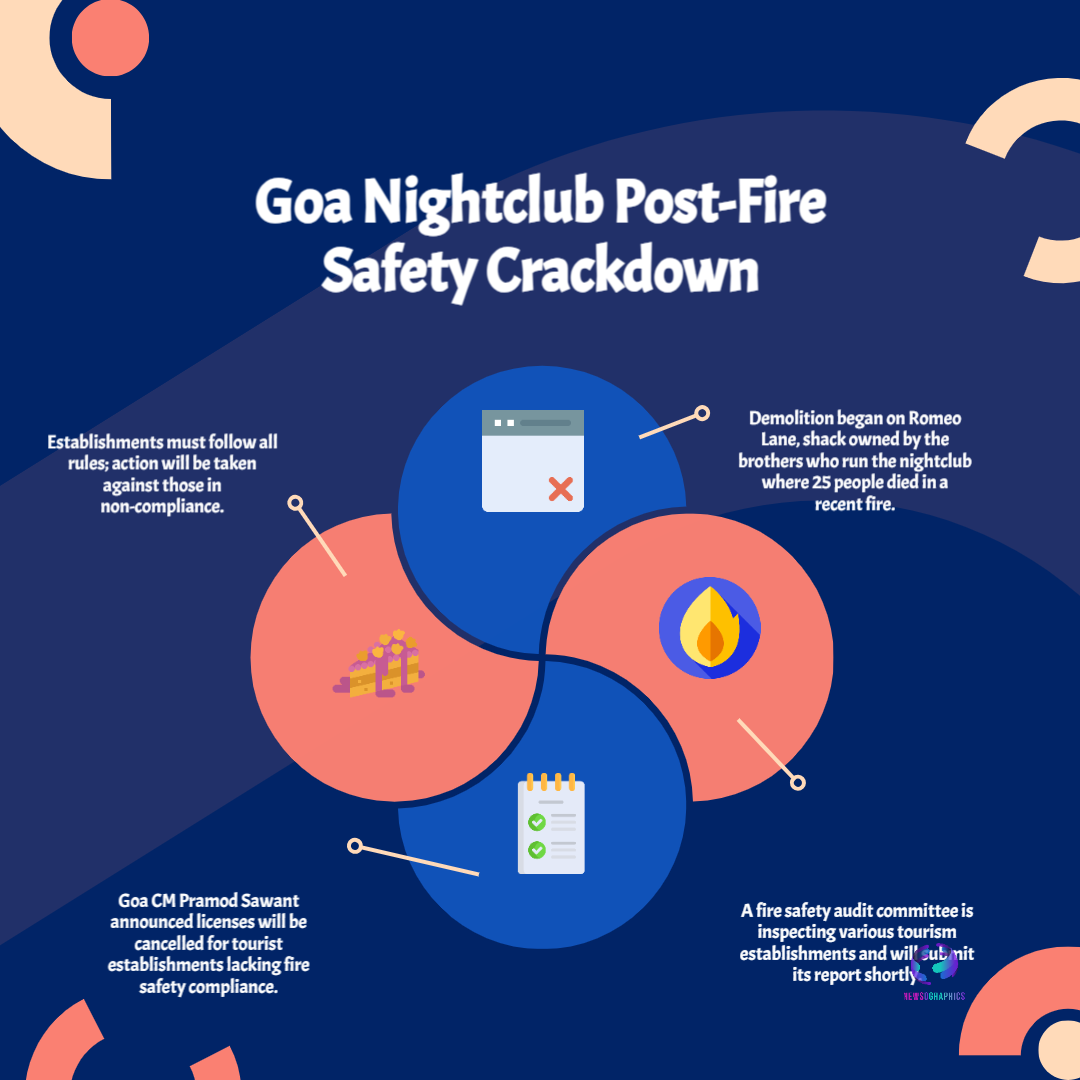
In the wake of the tragic 2025 nightclub fire in Arpora, Goa’s Chief Minister Pramod Sawant has ordered fire-safety audits of tourist venues and warned that licences of non-compliant establishments will be cancelled and sealed. What led to this decision — and what it means for Goa’s nightlife and tourism sector.
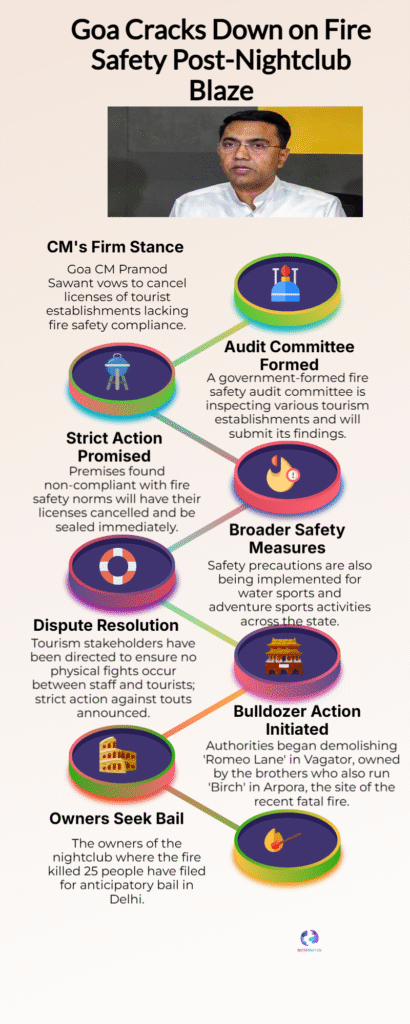
What happened: The Arpora nightclub fire and its aftermath
On December 6, 2025, a devastating fire broke out around midnight at Birch by Romeo Lane nightclub in Arpora, North Goa. The blaze killed 25 people — most of them staff, along with several tourists.
Investigations so far have revealed that the Nightclub allegedly lacked mandatory fire-safety clearances, including a valid fire-department NOC. The premises reportedly had structural and safety deficiencies: narrow access lanes that prevented fire engines from reaching the spot quickly, wooden or palm-leaf-based décor/materials that ignited rapidly, and poor emergency-exit planning.
Authorities arrested four members of the club’s management and filed FIRs against the owners and event organizers. Several government officials — including local panchayat, pollution control and regulatory authorities — have also been suspended pending inquiry.
The state government ordered a magisterial inquiry and offered ex-gratia compensation to victims’ families (₹5 lakh each) and for those injured (₹50,000 each).
The government crackdown: What CM Sawant has mandated
In response to the tragedy, Chief Minister Pramod Sawant convened a high-level meeting with district, police and tourism officials. He announced that a government-appointed fire-safety audit committee has begun inspecting tourist establishments statewide, including nightclubs, restaurants, adventure-sport and water-sport operators.
His warning was stark: any tourist establishment found lacking compliance with fire-safety norms will have its licence cancelled — and the premises sealed.
Beyond licensing — the government also asked stakeholders to ensure no illegal activity (including touting) and enforce safety protocols ahead of the peak holiday season, given Goa’s high tourist footfall expected for Christmas and New Year.
Why the crackdown — structural failures and systemic risks exposed
Safety-norm violations and regulatory lapses
The fire laid bare a pattern of flouting rules. The club reportedly operated without proper documentation: no pollution-control clearance, no valid fire licence, no structural safety compliance.
Moreover, the location — a salt pan / water-surrounded area with narrow lanes and a small bridge — made both evacuation and emergency-response extremely difficult. Fire trucks reportedly had to park nearly 400 metres away during the blaze.
Decorative materials — easily flammable — and absence of adequate exits and fire-safety equipment turned the venue into a death trap once the fire began.
Warning signal for tourism and nightlife economy
Goa depends heavily on tourism and nightlife. The incident underlines how safety violations in high-footfall venues can transform a vacation hotspot into a disaster zone — threatening lives and the state’s tourism credibility.
By ordering a blanket audit and linking licence renewals to compliance, the government is signaling a shift: safety norms must no longer be optional in nightlife-driven economies.
What this could mean — Implications for Goa’s nightlife & beyond
- Many nightclubs, beach shacks, restaurants and tourist-focused venues may now face strict enforcement of fire and safety clearances. Several establishments operating without proper documentation could be shut — especially if they are structurally non-compliant.
- Licensing authorities (local panchayats, pollution control boards, fire departments) will likely face increased scrutiny and accountability. Approvals and renewals may become more stringent and documentation-heavy.
- For patrons and tourists: increased safety checks may restore some confidence in nightlife venues. But in short-term, options may shrink as non-compliant venues get shut, and holiday-season nightlife could see disruption.
- More broadly, this could set a precedent for other states: building codes, fire safety audits, licensing and enforcement — especially in high-density entertainment hubs — may gain renewed attention nationwide.
The human cost — Why compliance must be non-negotiable
The Arpora tragedy serves as a grim reminder that lax regulations and unchecked commercial ambitions can cost lives. Twenty-five people — including workers from across India and tourists — lost their lives because basic safety norms were allegedly ignored.
While financial compensation and legal action are necessary, they cannot undo the loss. The swift—but retrospective—government action is a start. But the bigger challenge lies in ensuring structural safety becomes a permanent, enforceable priority — not just in Goa but across India’s tourism- and nightlife-driven regions.