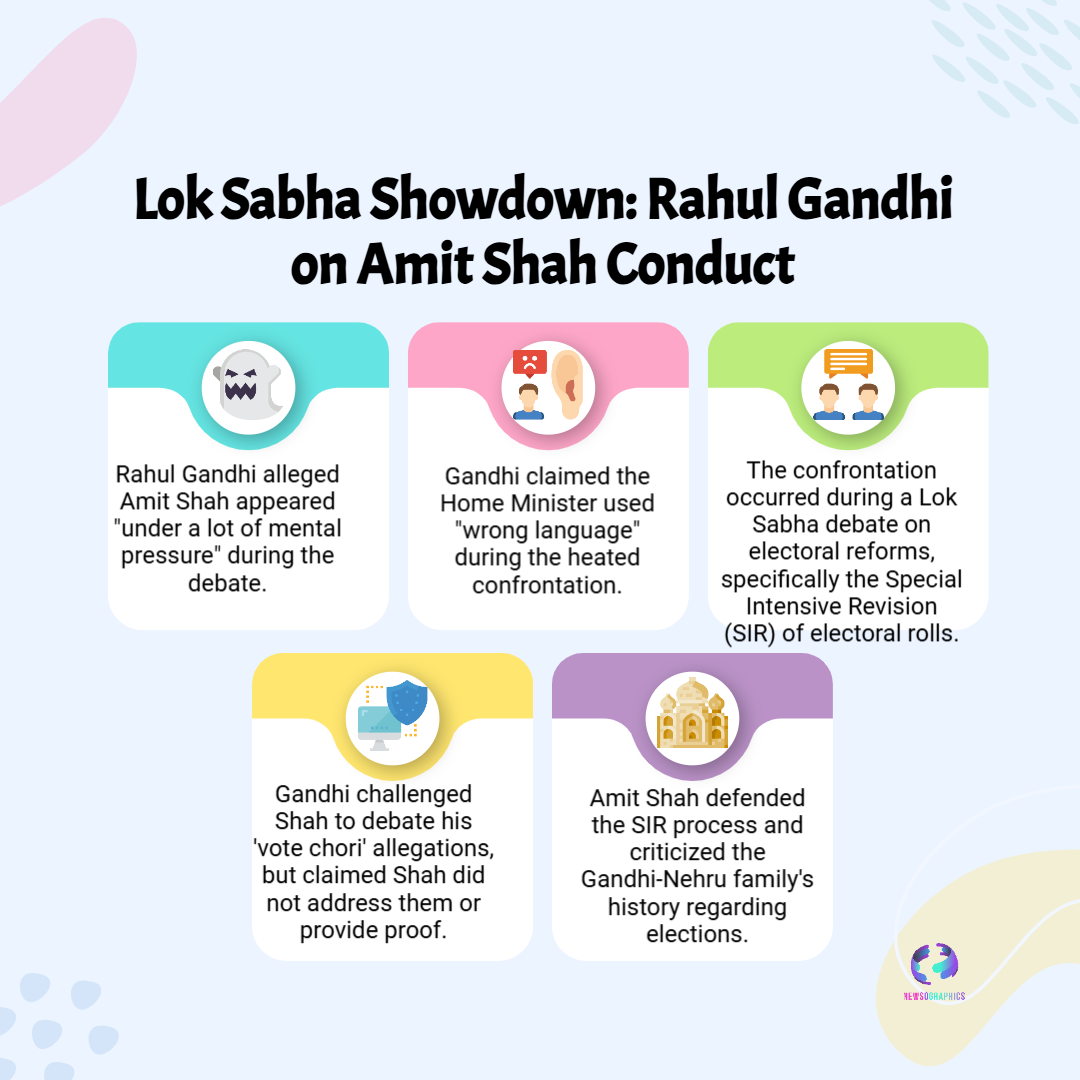
: Rahul Gandhi claim that Amit Shah appeared “nervous” and under “mental pressure” during a Lok Sabha debate has intensified political tensions. Explore the deeper implications for parliamentary discourse and India’s shifting political dynamics.
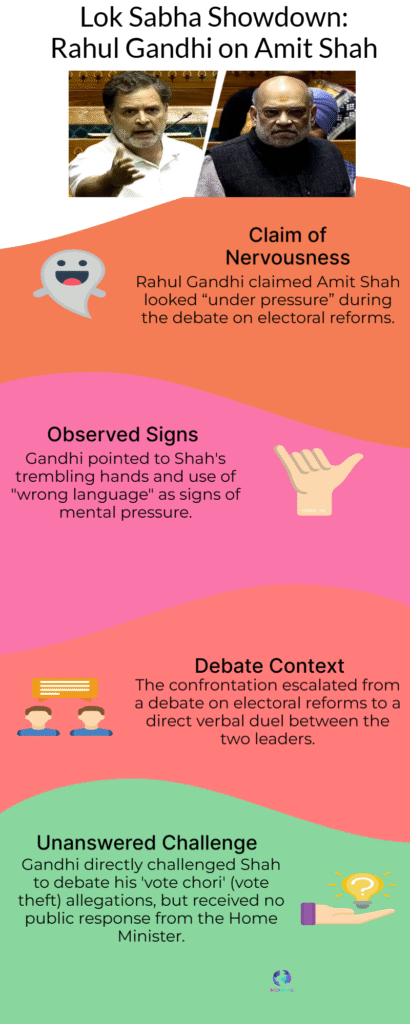
The Flashpoint: Rahul Gandhi’s Comment on Amit Shah
In a charged Lok Sabha session, Rahul Gandhi accused Union Home Minister Amit Shah of appearing “nervous” and under “mental pressure.” Such remarks—sharp, personal, and delivered within Parliament—rarely go unnoticed. They reflect not just disagreement on policy but a broader contest over perception, authority, and political momentum.
The exchange underscores how parliamentary debates increasingly serve dual purposes: legislative discourse and public political theatre. The tone, timing, and framing of Gandhi’s accusation indicate a deliberate attempt to challenge the ruling party’s confidence during a high-stakes discussion.
Why the Accusation Carries Political Weight
A Direct Challenge to a Key Power Centre
Amit Shah is widely regarded as one of the most influential political figures in the country. Publicly questioning his composure signals a strategic escalation from the Opposition, aiming to puncture the image of steadfast leadership projected by the ruling alliance.
A Shift Toward Personality-Driven Confrontation
Indian politics has long seen ideological battles, but recent years have brought an intensification of personality-focused rhetoric. Gandhi’s comments align with this shift, framing political disagreements through assessments of individual temperament and pressure handling.
Amplification Through Parliamentary Optics
Comments made inside Parliament hold greater symbolic power. They are seen as challenges issued at the heart of India’s democratic institution, increasing both their visibility and potential consequences.
What This Episode Reveals About Today’s Parliamentary Dynamics
More Confrontational, Less Deliberative Sessions
Lok Sabha debates have become arenas of rapid-fire exchanges, interruptions, pointed remarks, and competitive narrative-setting. Gandhi’s statement fits into a broader pattern where:
- The Opposition uses sharp critiques to capture public attention.
- The government counters by emphasizing stability, governance, and experience.
This creates a climate where personal remarks become tools in a larger political playbook.
The Rise of Rhetorical Signaling
Accusations of nervousness or pressure are not purely descriptive—they are rhetorical strategies designed to shift perceptions. Such language pushes audiences to interpret political strength or vulnerability through visible reactions rather than policy positions alone.
Reactions as Political Currency
The response from the Treasury benches, the Speaker’s intervention, and media amplification all contribute to how such statements shape public sentiment. In the current climate, even brief verbal exchanges become catalysts for full-scale political commentary.
Reading the Exchange Through a Strategic Lens
The Opposition’s Attempt to Regain Narrative Ground
Rahul Gandhi’s message appears aimed at positioning the Opposition as assertive and unafraid of confronting top government figures. It helps shift attention toward his leadership stance and reinforces his role as a principal challenger.
The Government’s Calculus
For Amit Shah and the ruling party, the challenge lies in responding without appearing ruffled—maintaining the very image of composure that Gandhi questioned. Their strategy typically involves shifting focus back to policy, governance issues, or opposition inconsistencies.
Building Emotional Frames Around Political Debates
Terms like “mental pressure” appeal to public perceptions of stress, responsibility, and leadership under fire. They invite voters to consider not just actions but emotional resilience—a theme increasingly used across global political contexts.
The Broader Implications for India’s Political Narrative
A Reflection of Deepening Polarization
Sharp exchanges are symptoms of wider partisan divides. Both sides enter debates with entrenched positions, leaving little room for consensus-driven dialogue. This environment encourages pointed personal remarks as tools of political differentiation.
The Evolving Role of Parliament in Public Opinion
Parliamentary debates are no longer confined to the House; they are replayed, dissected, and reframed across television, social media, and party communication channels. A comment made in seconds can define a news cycle.
The Humanization—and Weaponization—of Leadership Traits
Political communication increasingly relies on portraying leaders as strong, calm, decisive, or conversely, anxious or overwhelmed. Gandhi’s accusation taps into this trend, challenging the ruling party’s narrative of unwavering control.
What This Tells Us About the Road Ahead
As India moves through an era of heightened political contestation, such confrontations inside Parliament are likely to become more frequent and more intense. Rahul Gandhi’s accusation against Amit Shah is not an isolated remark but part of a larger pattern of rhetorical brinkmanship.
For the electorate, these moments raise important questions:
- Do such exchanges strengthen democratic debate?
- Or do they shift focus away from substantive policy discussions?
Whatever the answer, one fact remains clear: the battle for political perception now plays out as fiercely on the floor of Parliament as it does on the campaign trail.