
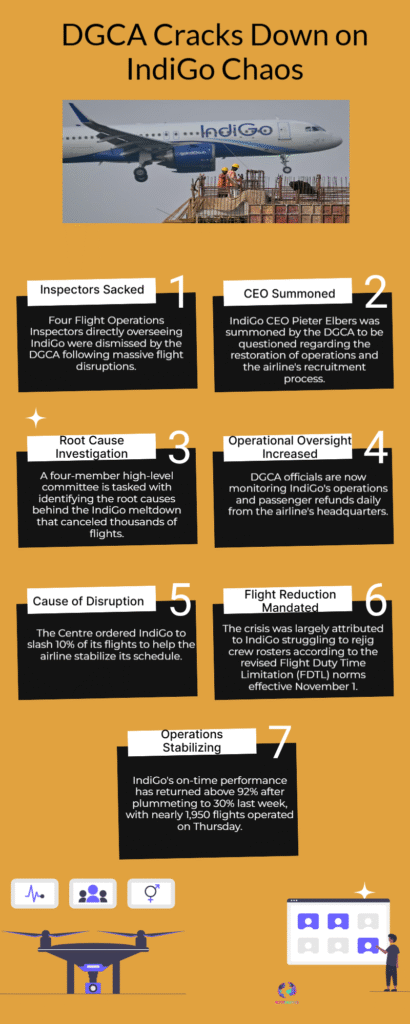
India’s aviation regulator has terminated four Flight Operations Inspectors after severe oversight failures linked to IndiGo’s nationwide cancellation chaos. Here’s what led to the unprecedented action.
Understanding the Crisis That Rocked Indian Aviation
The mass flight cancellations at IndiGo — India’s largest airline by market share — triggered one of the most disruptive operational breakdowns the country has witnessed in recent years. Thousands of passengers were stranded across airports as schedules collapsed under the weight of crew shortages, operational mismanagement, and strained pilot availability.
The chaos soon prompted questions not only about IndiGo’s internal planning but also the regulatory oversight mechanisms intended to keep such failures in check.
Regulator Steps In: Why Four DGCA Inspectors Were Fired
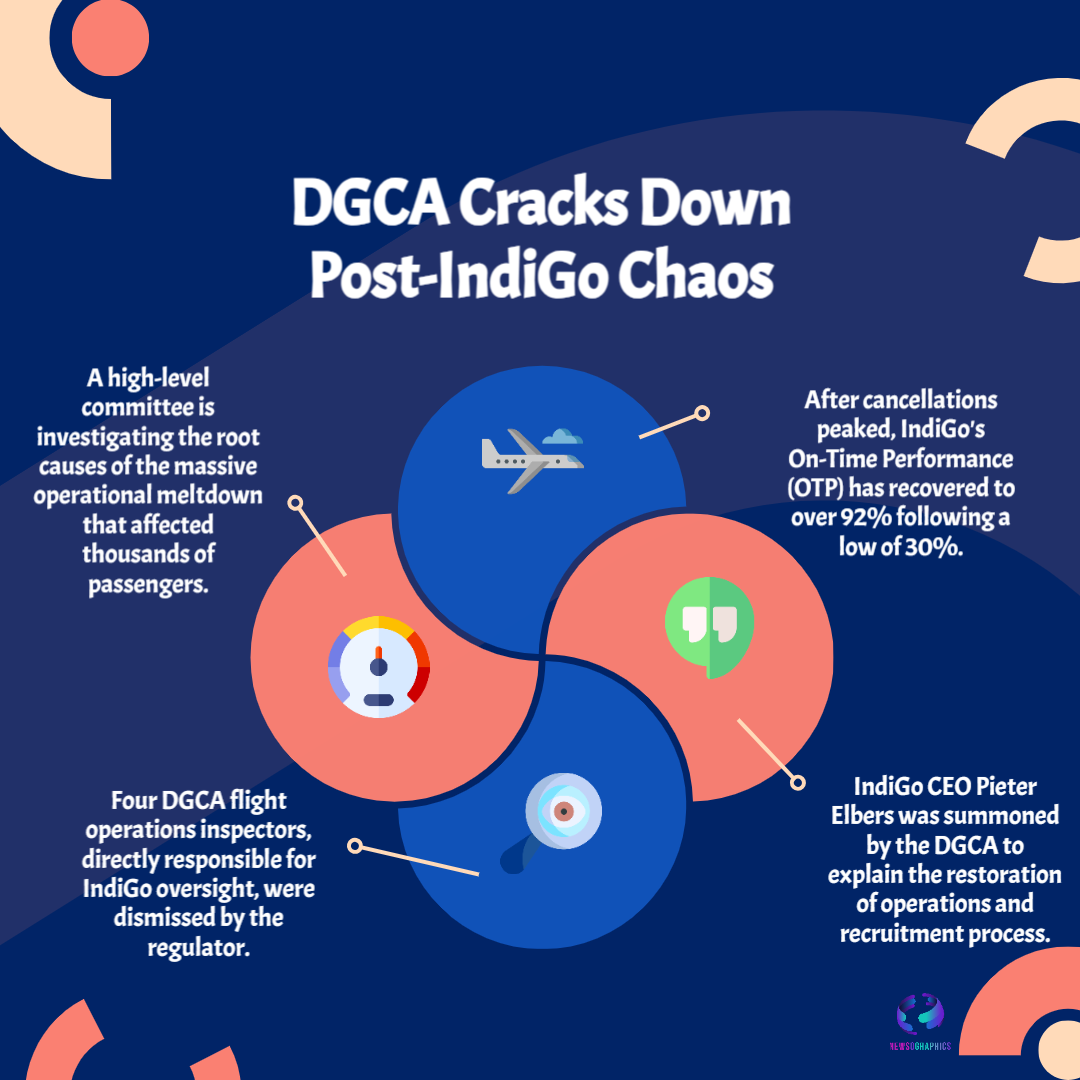
In an unprecedented disciplinary move, the Directorate General of Civil Aviation (DGCA) has dismissed four Flight Operations Inspectors (FOIs). These officials were responsible for evaluating airline operations, monitoring crew rosters, and ensuring compliance with safety and duty-time regulations.
What Prompted the Action?
According to sources familiar with the matter, the inspectors failed to flag early indicators of instability in IndiGo’s crew-management systems. These warning signs included:
- Persistent pilot fatigue concerns
- Rapid escalation of crew shortages
- A widening mismatch between scheduled flights and available manpower
- Inadequate adaptation to updated duty-time limitations
The DGCA concluded that the oversight gap contributed to the cascading cancellations, making accountability measures unavoidable.
Inside the Oversight Breakdown
Flight Operations Inspectors play a critical role in ensuring airlines maintain robust operational controls. Their mandate spans audit reviews, spot checks, simulator evaluation, and monitoring flight-duty compliance.
The IndiGo meltdown revealed vulnerabilities in this chain — specifically:
H3: Failure to Anticipate Pilot Capacity Stress
Fatigue-related disruptions are predictable when airlines stretch utilization or when rosters tighten. Inspectors reportedly missed assessing the risk in time.
H3: Insufficient Response to Operational Red Flags
Even as IndiGo’s cancellations accelerated, the regulatory evaluation process did not promptly escalate concerns or mandate corrective measures.
H3: Gaps in Compliance Reporting
Documentation and performance indicators from the airline were not adequately scrutinized, leading to delayed risk detection.
IndiGo Under Scrutiny: Management Called to Account
Parallel to the inspector dismissals, the DGCA summoned IndiGo’s senior leadership to detail recovery plans, pilot recruitment status, and operational reforms. The airline has been instructed to fortify crew scheduling, reassess its flight-duty matrices, and provide transparent reporting until stability is fully restored.
The summons signals a broader shift in regulatory posture — one where both the airline and the oversight apparatus are held equally accountable.
How This Action Reshapes Aviation Governance
The removal of four inspectors is not merely a personnel decision; it marks a significant recalibration in India’s aviation regulatory environment.
H3: A Message of Zero Tolerance
The DGCA is establishing a precedent that oversight failures carry real consequences, particularly when public interest is affected.
H3: Strengthening Audit and Monitoring Protocols
Industry sources indicate that the regulator is preparing to introduce tighter audit cycles, independent verification layers, and stronger enforcement triggers.
H3: Boosting Public and Passenger Confidence
By acting decisively, the DGCA aims to reassure passengers that systemic issues are being addressed rather than ignored.
The Road Ahead for IndiGo — and for Indian Aviation
The airline is now under pressure to rebuild trust through reliable operations and improved crew-management frameworks. At the same time, the DGCA must demonstrate that enhanced oversight can prevent similar crises.
The incident stands as a pivotal moment: a reminder that operational turbulence at the country’s largest airline can ripple across the entire aviation ecosystem, and that regulators must remain vigilant to safeguard passenger interests.