

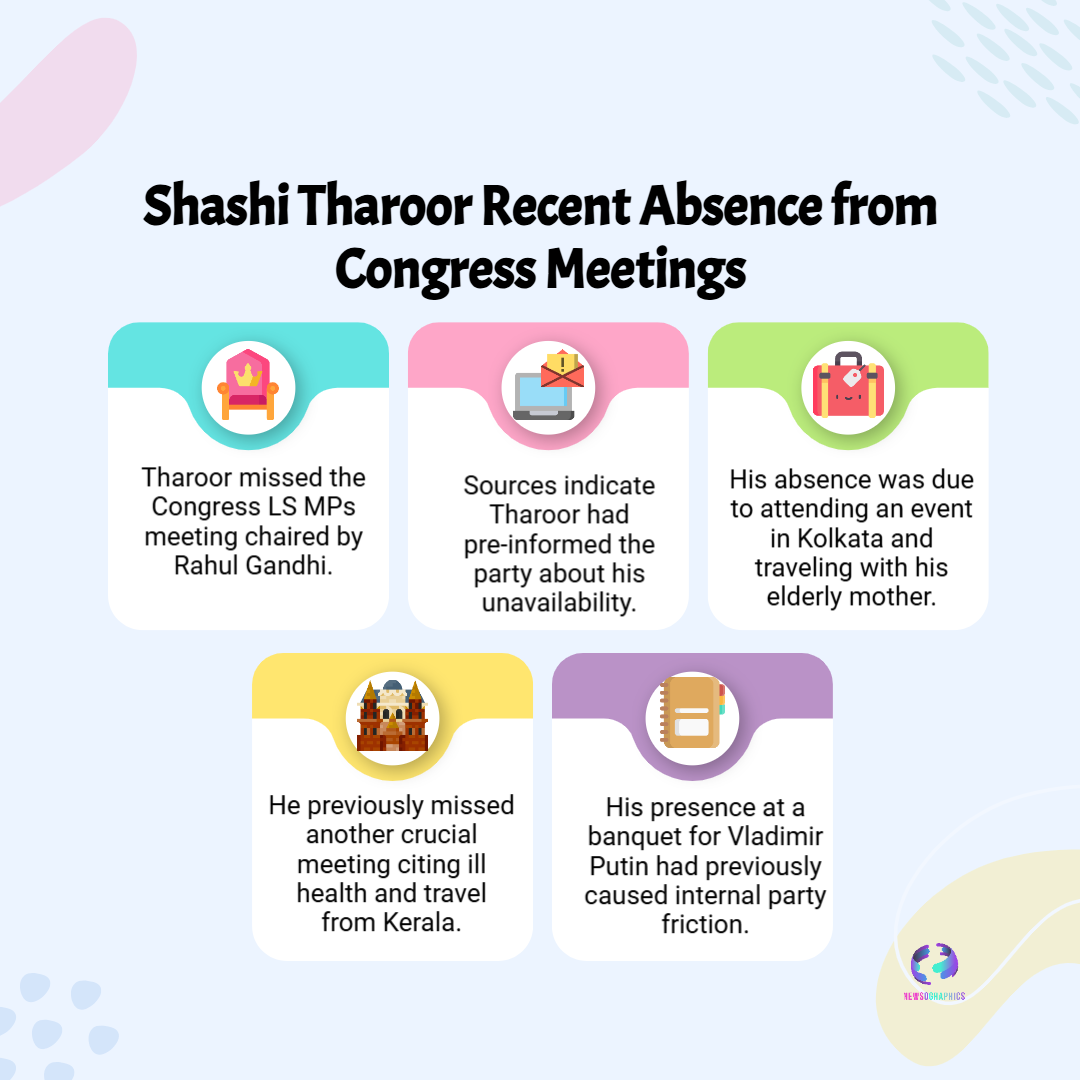
Shashi Tharoor’s absence from a crucial Congress meeting has sparked renewed conversation about internal dynamics, leadership coordination, and strategic cohesion within the party. Here’s what his decision signifies.
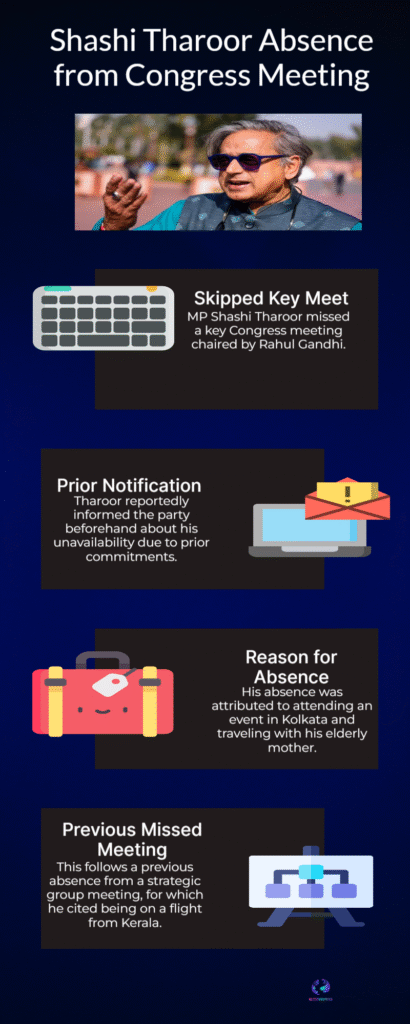
Shashi Tharoor’s Absence Congress meeting
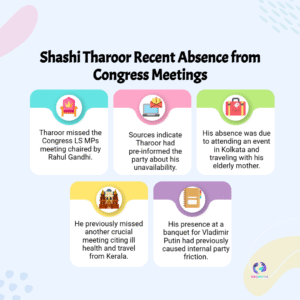
Shashi Tharoor’s decision to skip a key Congress meeting—one convened to align the party’s parliamentary strategy—has triggered fresh discussion about internal cohesion and the evolving power dynamics within the organisation. Although party sources indicated that he informed the leadership about his prior commitments, the timing and visibility of the absence make it politically significant.
This was not an ordinary gathering; it was part of a broader strategy review amid a charged parliamentary session. In such moments, every presence and absence is carefully watched.
The Meeting’s Context and Its Strategic Importance
A Gathering Called at a Crucial Parliamentary Moment
The meeting, chaired by senior leadership, was intended to strengthen the party’s stance on pressing national issues, streamline communication among MPs, and reinforce unified messaging in Parliament.
Tharoor’s absence from such a setting stands out not because attendance is mandatory, but because the meeting forms part of Congress’s efforts to project internal unity and clarity of purpose.
A Pattern of Missed Engagements
Observers have noted that this is not the first significant meeting he has skipped recently. While the reasons may be entirely logistical, repeated absences naturally draw scrutiny—especially within a party undergoing recalibration under a renewed leadership structure.
Why Tharoor’s Absence Is Politically Notable
His Role as a High-Visibility Voice
Tharoor occupies a unique space within the Congress: he is articulate, globally recognised, and often engages independently on issues of national interest. His positions, though aligned with Congress’s broad ideological framework, sometimes diverge in emphasis and tone.
Because of this distinct voice, his absence can feel amplified compared to that of others.
Signalling or Coincidence?
Political absences are often interpreted through a lens of intent, even when no such intent exists. In a period of internal churn and generational leadership shifts, any deviation from expected participation by a senior leader becomes a subject of political conversation.
While confirming he had notified the leadership, the timing inevitably fuels speculation about where he positions himself in the party’s evolving architecture.
The Party’s Reaction: Controlled but Watchful
No Public Reprimand, but Growing Curiosity
The Congress leadership has not expressed public dissatisfaction. This suggests an attempt to maintain discipline without escalating internal differences into public view.
Yet within political circles, the discussion is unavoidable. Repeated absences from strategic meetings often lead to questions about alignment, morale, or future ambitions.
Managing Perception Amid Larger Party Transitions
Congress is currently navigating ideological recalibration, organisational restructuring, and the need to rebuild electoral strength. Unified participation from senior leaders is a critical part of that effort, and any perceived fissure—real or imagined—can affect public narrative.
What This Means for Congress Going Forward
A Test of Leadership-Cadre Coordination
For the Congress leadership, the episode underscores the ongoing challenge of harmonising communication across its parliamentary ranks. Ensuring that every senior MP feels engaged, valued, and aligned with strategic priorities is essential, especially as the party seeks to strengthen its national relevance.
For Tharoor, a Moment of Perception Management
Tharoor’s political brand thrives on intellect, independence, and individual credibility. While these traits earn him admirers, they also require careful balancing to avoid being perceived as detached during pivotal moments for the party.
His future attendance—and public messaging—will likely be watched with interest.
Beyond the Meeting: Reading the Larger Political Landscape
Tharoor’s absence is not a crisis, but it is a reminder of the delicate dynamics within parties navigating transformation. For Congress, every senior leader’s engagement holds symbolic value, particularly those with national appeal and internal influence.