



The Supreme Court has raised serious concerns over procedural irregularities in the Madras High Court’s handling of the Karur stampede case. Here’s a detailed editorial analysis of what the remarks mean for the judiciary and the ongoing investigation.
Supreme Court’s Strong Remarks and Why They Matter
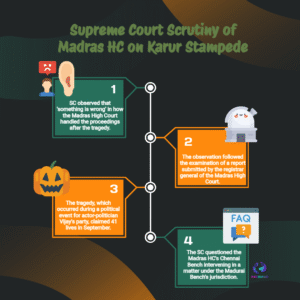
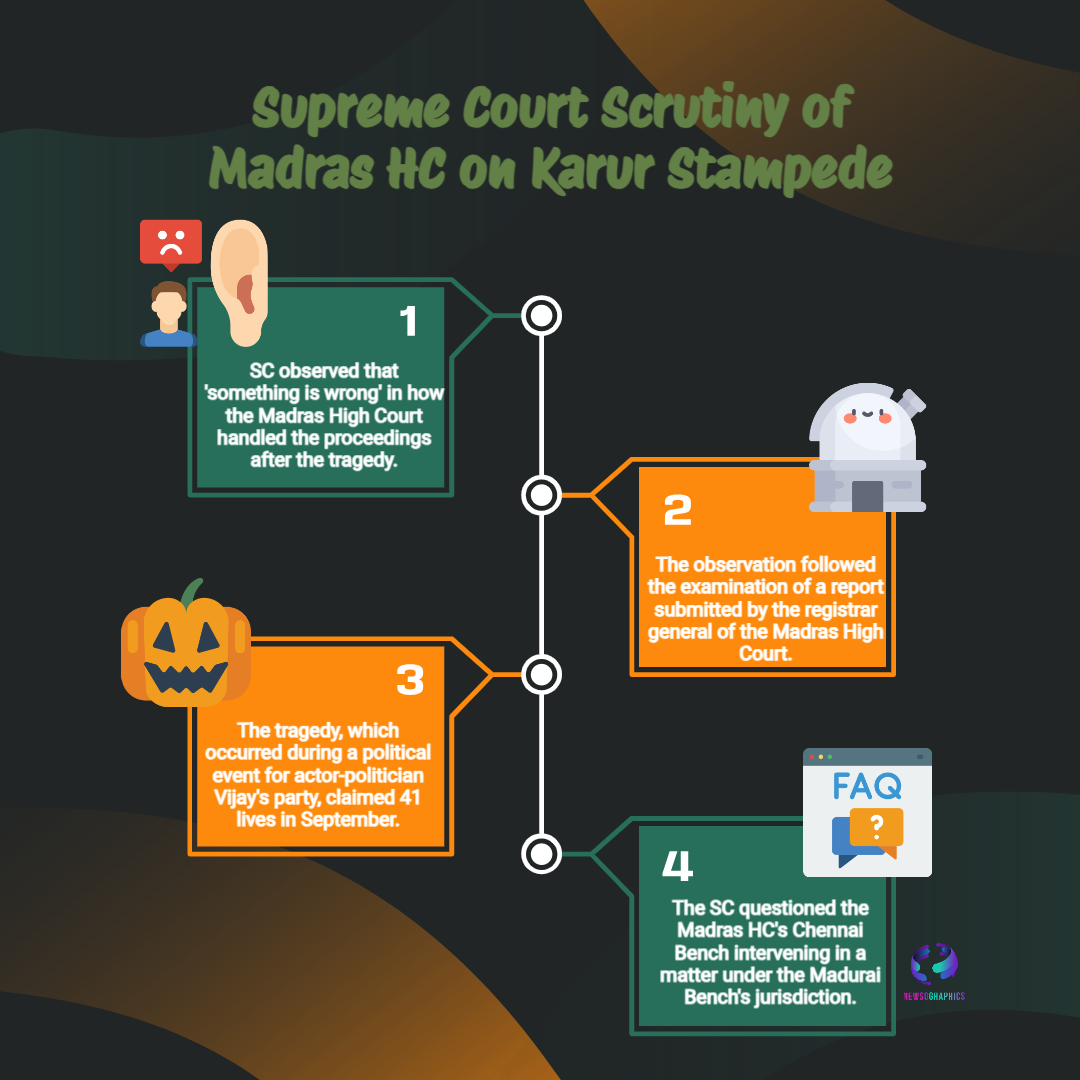
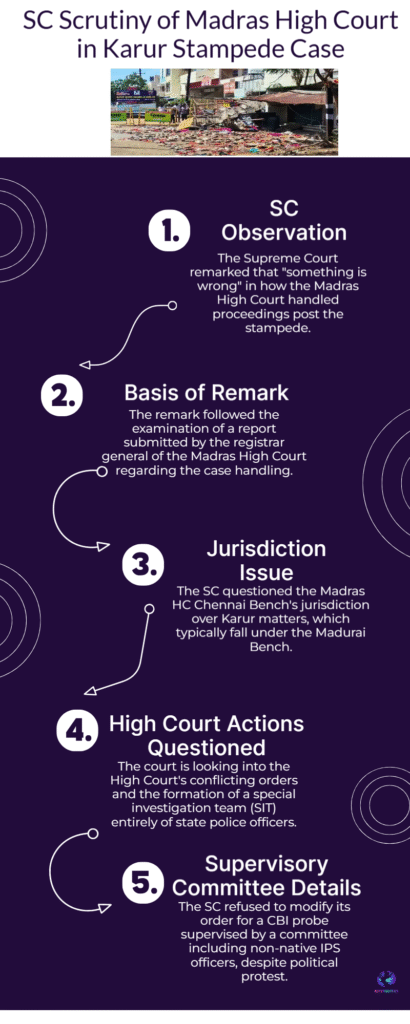
The Supreme Court’s observation that “something is wrong” with the Madras High Court’s handling of the Karur stampede case has sparked significant discussion across legal and political circles. The remark, made after reviewing a detailed report from the High Court’s Registrar General, signalled the apex court’s dissatisfaction with how the matter was processed at the Madras High Court level.
This intervention represents more than a procedural critique—it reflects concerns about judicial discipline, jurisdictional adherence, and internal administrative clarity.
What Triggered the Supreme Court’s Response
The Registrar General’s Report
The Supreme Court bench, after examining the Registrar General’s findings, noted discrepancies and irregularities in the way the Karur case was placed, processed, and handled within the High Court. These concerns compelled the judges to question whether established procedures had been deviated from and whether administrative instructions were followed appropriately.
Lack of Clarity on Case Handling
The apex court highlighted that the sequence of actions taken by the High Court raised red flags. These included questions about how the matter was listed, how it was moved between benches, and whether established norms were respected. The Court refrained from immediate conclusions but made clear that critical questions remained unanswered.
Why the Madras High Court’s Involvement Has Become Contentious
Jurisdictional Sensitivities
Karur falls under the territorial jurisdiction of the Madurai Bench of the High Court. However, proceedings and orders in this case emerged from the High Court’s principal seat in Chennai. The Supreme Court found this jurisdictional shift unusual and asked for clarity on the administrative rationale behind it.
Procedural Integrity at Stake
For the judiciary, procedural consistency is as important as judicial reasoning. Any deviation—intentional or accidental—can compromise perception of fairness. By pointing out anomalies, the Supreme Court is reinforcing the principle that the process of justice must be as transparent as the outcome.
The Larger Context: A Tragedy Under National Scrutiny
The Karur Stampede and Its Aftermath
The stampede in Karur, which led to multiple deaths and widespread injuries, triggered public demand for accountability. Petitions seeking a comprehensive investigation were filed soon after. Given the seriousness of the incident, the Supreme Court had earlier ordered a CBI-led probe monitored by an independent committee.
Balancing Sensitivity and Oversight
The apex court’s insistence on procedural clarity reflects its commitment to ensuring a neutral, credible investigation. Any murkiness in judicial handling—real or perceived—can undermine public trust, especially in high-impact cases like Karur.
Supreme Court’s Next Steps
Responses Sought From All Parties
The Court has circulated the Registrar General’s report to all concerned parties for their responses. This move ensures that any further action will be taken only after reviewing all perspectives and clarifications.
Continued Oversight of the Investigation
With previous directions already in place, the Supreme Court appears intent on maintaining close supervision over the ongoing probe. The Court’s remarks suggest it will not hesitate to intervene further if procedural anomalies persist.
What This Means for the Judiciary
Reinforcing Accountability Within Courts
The Supreme Court’s comments underscore its role not just as an appellate body but as a guardian of judicial propriety. Administrative irregularities, especially in sensitive cases, can have broader implications for the credibility of the institution.
A Reminder of Jurisdictional Discipline
By questioning how the case moved through the Madras High Court, the Supreme Court has highlighted the need for strict adherence to territorial and procedural norms. This serves as a quiet but firm reminder to High Courts across the country.
A Moment of Reflection and Correction
The Supreme Court’s sharp remark is less an indictment and more a call for introspection within the judiciary. As the Karur stampede investigation moves forward, clarity, transparency, and procedural discipline will be key to ensuring justice for the victims and preserving institutional trust.