


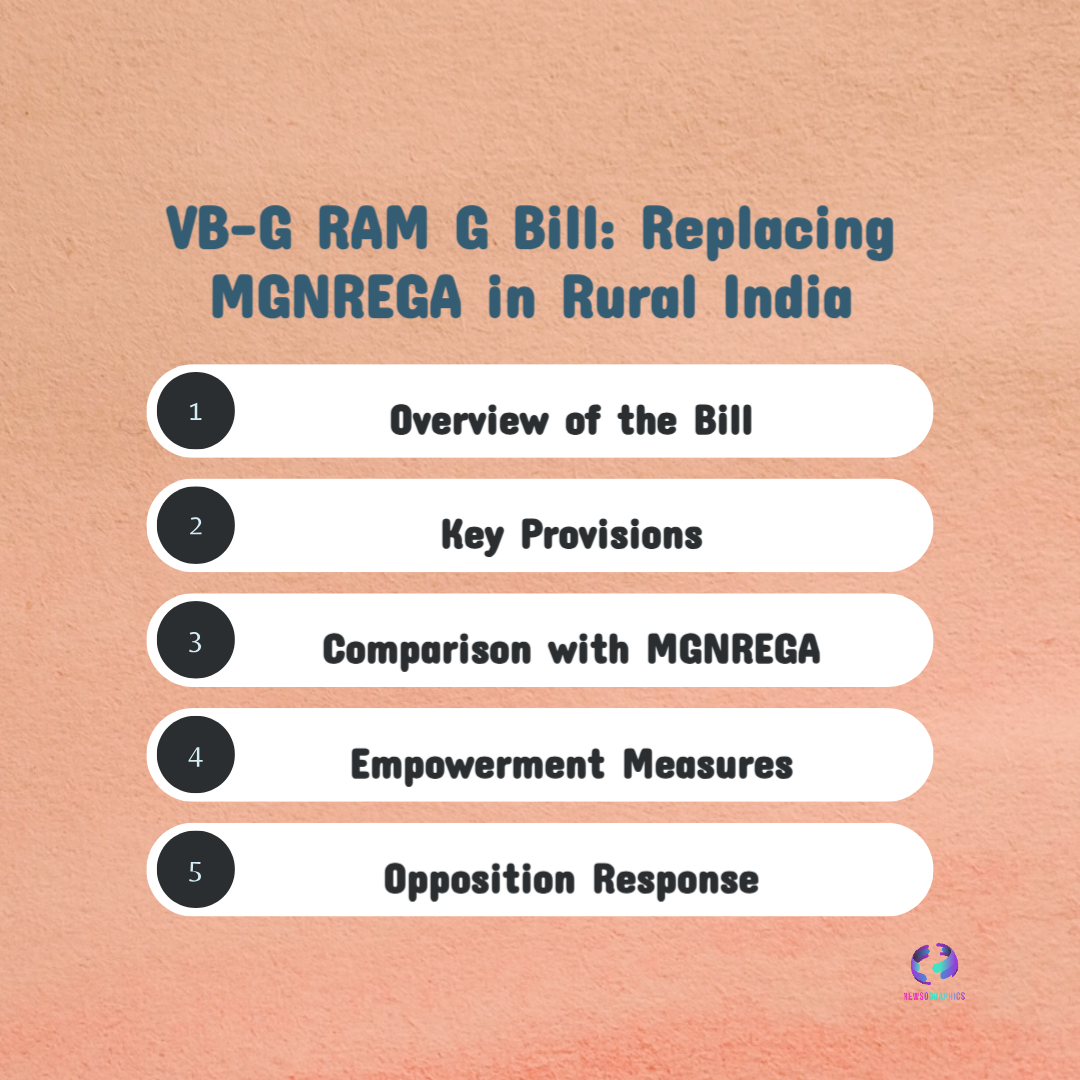
The VB G Ram G Bill has been passed by the Lok Sabha, proposing a new national framework to replace MGNREGA. Here’s what the Viksit Bharat Guarantee for Rozgar and Aajeevika Mission means for rural employment.
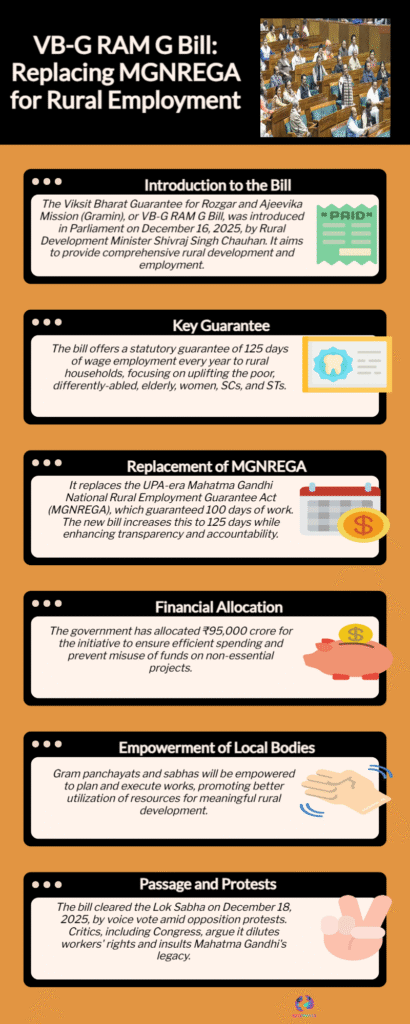
A New Chapter in India’s Rural Employment Policy
The passage of the VB G Ram G Bill in the Lok Sabha marks a significant shift in India’s approach to rural employment and livelihood security. Designed to replace the long-running Mahatma Gandhi National Rural Employment Guarantee Act (MGNREGA), the proposed framework introduces the Viksit Bharat Guarantee for Rozgar and Aajeevika Mission as a broader, restructured national initiative.
This legislative move reflects the government’s intention to modernize employment guarantees, align them with development outcomes, and integrate livelihood creation more directly into rural economic planning.
Why the Government Is Replacing MGNREGA
MGNREGA has been one of India’s most influential social security programs, offering wage employment to rural households for nearly two decades. However, the government has argued that evolving economic realities require a more flexible and productivity-oriented model.
The VB G Ram G Bill is positioned as a response to concerns around inefficiencies, delayed payments, limited skill development, and insufficient linkage between employment and long-term income generation. Rather than focusing solely on short-term wage work, the new bill emphasizes sustainable livelihoods alongside guaranteed employment.
Understanding the Viksit Bharat Guarantee Framework
At the heart of the VB G Ram G Bill is the Viksit Bharat Guarantee, a concept that expands the definition of rural employment. The framework seeks to combine job assurance with skill-building, asset creation, and livelihood diversification.
From Wage Employment to Livelihood Missions
Unlike MGNREGA’s primary focus on manual labor and public works, the new mission-based approach aims to support activities that generate ongoing economic value. These may include agriculture-linked work, rural enterprises, infrastructure tied to productivity, and community assets that support local economies.
Integration With Development Goals
The bill aligns employment guarantees with broader national development objectives. Rural jobs are no longer treated as isolated welfare measures but as instruments for economic transformation, targeting income stability, self-reliance, and local growth.
Key Structural Changes Proposed in the Bill
The VB G Ram G Bill introduces several structural departures from the existing MGNREGA framework.
Administrative Reorientation
The bill proposes a more centralized monitoring structure with outcome-based evaluation, while still allowing states flexibility in implementation. This shift is intended to improve accountability and reduce delays that have historically affected rural employment programs.
Focus on Skill and Productivity
Employment under the new mission is expected to incorporate skill development components, enabling workers to transition into higher-value activities over time. This represents a move away from purely unskilled labor toward employability and entrepreneurship.
Expanded Scope of Work
The bill broadens the types of permissible work, encouraging projects that contribute to rural infrastructure, agricultural resilience, and local enterprise support, rather than limiting employment to traditional public works.
Political and Policy Implications
The clearance of the VB G Ram G Bill has generated significant debate across political and policy circles. Supporters view it as a necessary modernization of rural welfare policy, while critics express concern over the dilution of a legally enforceable employment guarantee.
The transition from a rights-based framework under MGNREGA to a mission-oriented model raises questions about implementation consistency, funding commitments, and worker protections, especially during economic downturns.
What This Means for Rural Workers
For rural households, the bill signals a shift in how employment security is delivered. If implemented effectively, the new framework could offer more diverse income opportunities and long-term livelihood support. However, its success will depend on execution, transparency, and the ability to ensure that guaranteed work remains accessible to those who need it most.
The coming months will be critical as policy details, rules, and implementation mechanisms are clarified.
The Road Ahead
With Lok Sabha approval secured, the VB G Ram G Bill represents a defining moment in India’s rural employment landscape. Its promise lies in reimagining employment guarantees as engines of development rather than temporary relief measures.
As the transition unfolds, the balance between innovation and protection will determine whether the Viksit Bharat Guarantee can match—or surpass—the social impact of the program it seeks to replace.