




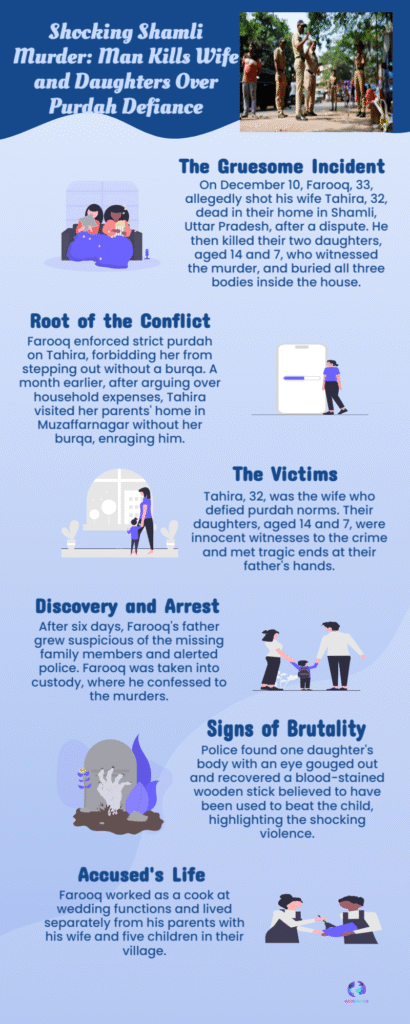
A shocking crime in Shamli as a man confesses to murdering his wife and daughters, allegedly angered by his wife stepping out without a burqa, exposing deep-rooted issues of control and violence.
A Confession That Shocked Shamli
A deeply disturbing crime has emerged from Shamli, where a man confessed to killing his wife and daughters, sending shockwaves across the district. The Shamli case has drawn attention not only for its brutality but also for the alleged reasoning cited during police interrogation, revealing the lethal consequences of control and intolerance within families.
The confession has placed the spotlight on entrenched social attitudes that can escalate into extreme violence behind closed doors.
Events Leading to the Crime
According to the investigation, tensions had been simmering within the household over issues of personal conduct and control. The situation reportedly escalated when the woman stepped out of the house without adhering to strict dress expectations imposed by her husband.
What followed was an act of violence that claimed the lives of not just the woman, but also her daughters, turning a domestic conflict into a triple homicide in Shamli.
Police Investigation and Arrest
Law enforcement officials moved swiftly after receiving information about the crime. During questioning, the accused allegedly admitted to the killings, providing details that are now central to the investigation.
Police have secured the crime scene, collected forensic evidence, and initiated legal proceedings. The accused remains in custody as investigators work to corroborate the confession with material evidence.
Children as Victims of Domestic Violence
The killing of the daughters has intensified public outrage, underscoring how domestic violence often engulfs the most vulnerable. Children, caught in the crossfire of rigid control and unchecked aggression, become silent victims of conflicts they have no role in creating.
The case has reignited conversations around the urgent need to recognize early warning signs within households where coercion and fear dominate daily life.
Beyond the Crime: A Reflection on Control and Patriarchy
While the legal process will determine culpability, the case reflects broader societal issues surrounding autonomy, gender control, and the misuse of cultural or moral codes to justify violence. Such incidents highlight how extreme interpretations of authority within families can strip individuals of agency and, in the worst cases, their lives.
The tragedy has prompted widespread condemnation and renewed calls for addressing domestic violence through stronger awareness, intervention, and enforcement mechanisms.
Legal Proceedings and Accountability
Authorities have emphasized that the case will be pursued with seriousness and sensitivity. Charges related to murder have been invoked, and the judicial process is expected to examine both the acts committed and the circumstances surrounding them.
The focus remains on ensuring accountability through due process, while safeguarding the integrity of the investigation.
A Grim Reminder of Hidden Violence
The Shamli killings stand as a stark reminder that some of the most brutal crimes occur within the private confines of homes, far from public view. They expose the dangerous intersection of control, intolerance, and violence, leaving lasting scars on families and communities.
As the investigation continues, the case has left the region grappling with grief, anger, and difficult questions about safety, equality, and justice within the household.