


A major wildlife tragedy unfolds in Assam as the Rajdhani Express derails after colliding with a herd of elephants, killing seven and reigniting concerns over rail safety in forest corridors.
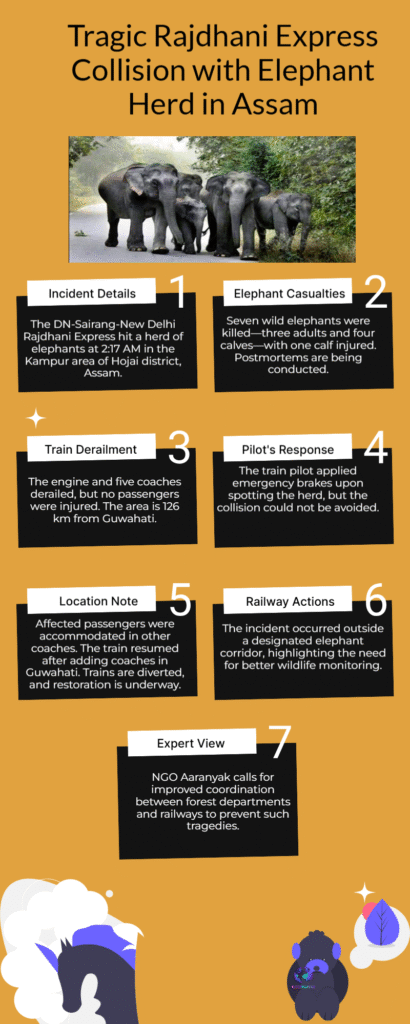
Collision on a Forest Corridor in Assam
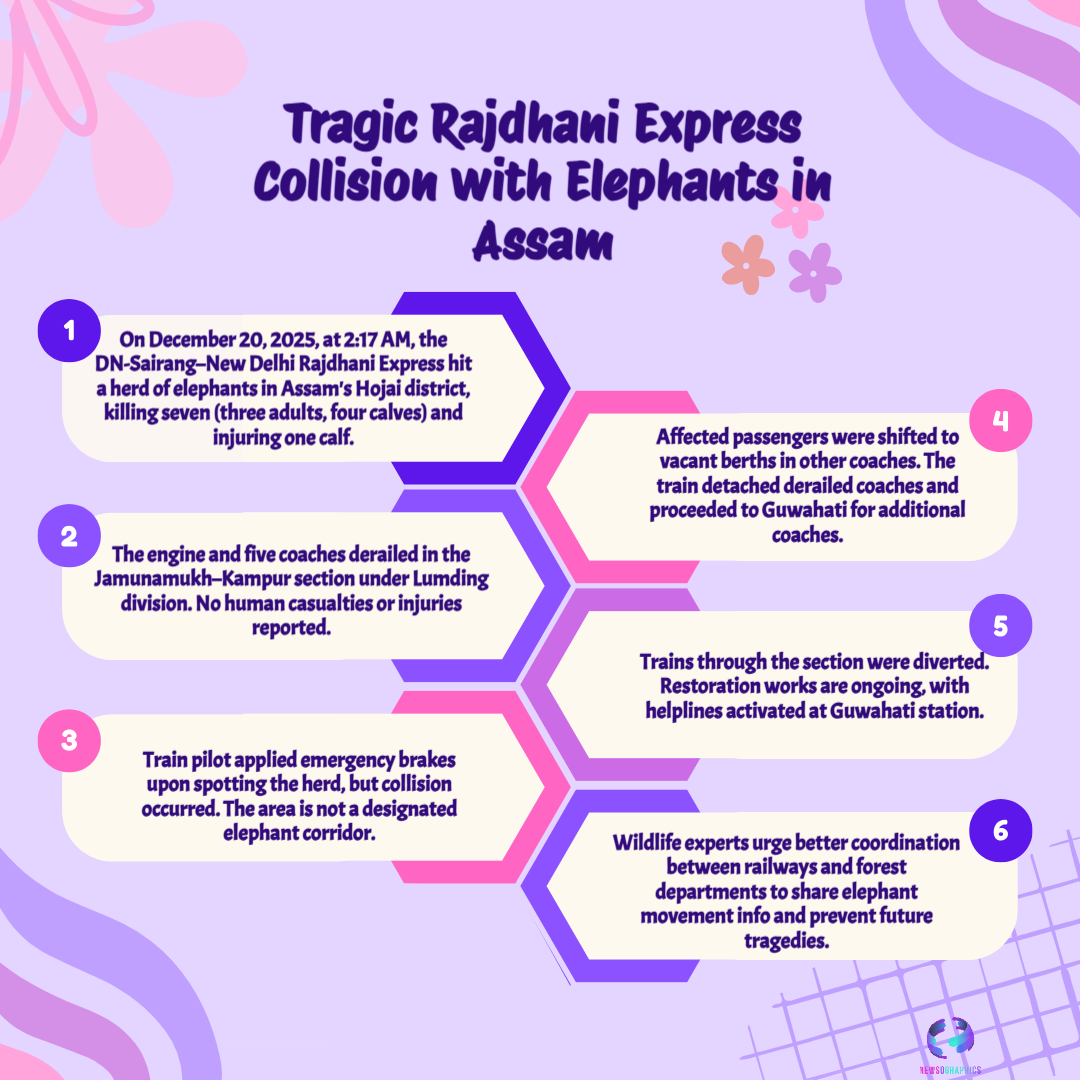
A tragic collision between a high-speed passenger train and a herd of elephants in Assam has once again exposed the fragile intersection between expanding transport infrastructure and wildlife habitats. The incident occurred when the Rajdhani Express, operating along a forest-adjacent stretch, struck a group of elephants crossing the railway track, leading to the derailment of several coaches and the death of seven animals.
Assam, home to one of India’s largest populations of wild Asian elephants, has long struggled with balancing connectivity and conservation. The stretch where the accident took place lies within a known elephant movement corridor, used seasonally by herds in search of food and water.
What Happened During the Rajdhani Express Derailment
The Rajdhani Express was moving through the section during low-visibility conditions when the train encountered the herd on the tracks. Despite emergency braking, the impact was unavoidable due to the train’s speed and the proximity of the animals. Multiple coaches derailed following the collision, though no passenger fatalities were reported.
Railway officials confirmed damage to the track and rolling stock, while forest authorities recovered the carcasses of seven elephants, including adults and juveniles, highlighting the scale of the loss.
Impact on Passengers and Rail Operations
While passengers escaped without serious injuries, the derailment caused significant disruption to rail services on the route. Train movement was suspended for several hours as emergency teams worked to restore the track, remove derailed coaches, and clear debris.
Indian Railways initiated standard safety protocols, deploying accident relief trains and technical teams. Services were gradually restored after inspections ensured track stability and passenger safety.
Assam’s Ongoing Human–Elephant Conflict
Assam has emerged as one of the most vulnerable states in India when it comes to human–elephant conflict. Rapid urbanisation, deforestation, and railway expansion have fragmented traditional elephant corridors, forcing herds to cross tracks more frequently.
Elephants are highly intelligent and habitual in their movement patterns. Once a corridor is disrupted, they often continue to use it, increasing the likelihood of such fatal encounters with trains, particularly during night hours or in dense vegetation zones.
Railway Lines Through Wildlife Habitats
Railway tracks cutting through forested regions have become a recurring flashpoint across India. In Assam and neighbouring northeastern states, multiple incidents over the years have resulted in elephant deaths due to train hits.
Despite measures such as speed restrictions, signage, and patrols in identified wildlife zones, enforcement remains inconsistent. High-speed trains like the Rajdhani Express reduce reaction time for both train drivers and animals, amplifying the risk.
Environmental and Ethical Concerns
The death of seven elephants in a single incident has triggered widespread concern among conservationists and environmental groups. Elephants are a protected species and play a critical role in forest ecosystems, aiding seed dispersal and maintaining ecological balance.
Beyond environmental loss, such incidents raise ethical questions about development without adequate safeguards for wildlife. Each collision reflects systemic gaps rather than isolated failures.
Official Response and Administrative Action
Forest department officials and railway authorities conducted joint inspections following the accident. Preliminary assessments focused on identifying whether speed norms were adhered to and whether warning systems were functional in the affected stretch.
Compensation procedures for wildlife loss were initiated as per norms, while higher-level reviews were expected to examine long-term preventive strategies in vulnerable corridors.
The Larger Pattern of Wildlife–Train Accidents
This Assam derailment fits into a broader national pattern where railway lines intersect critical wildlife habitats. From elephants in the Northeast to deer and cattle in central India, rail-related animal fatalities continue despite policy interventions.
Experts have repeatedly stressed the need for technological solutions such as animal detection systems, real-time alerts for loco pilots, elevated tracks, and underpasses in high-risk zones.
A Stark Reminder for Infrastructure Planning
The Rajdhani Express derailment in Assam stands as a stark reminder that infrastructure growth without ecological integration carries heavy costs. As India expands its rail network and increases train speeds, safeguarding wildlife corridors can no longer remain secondary.
The loss of seven elephants in a single moment underscores the urgency of rethinking how railways coexist with forests—not as obstacles to progress, but as essential ecosystems demanding protection alongside development.