



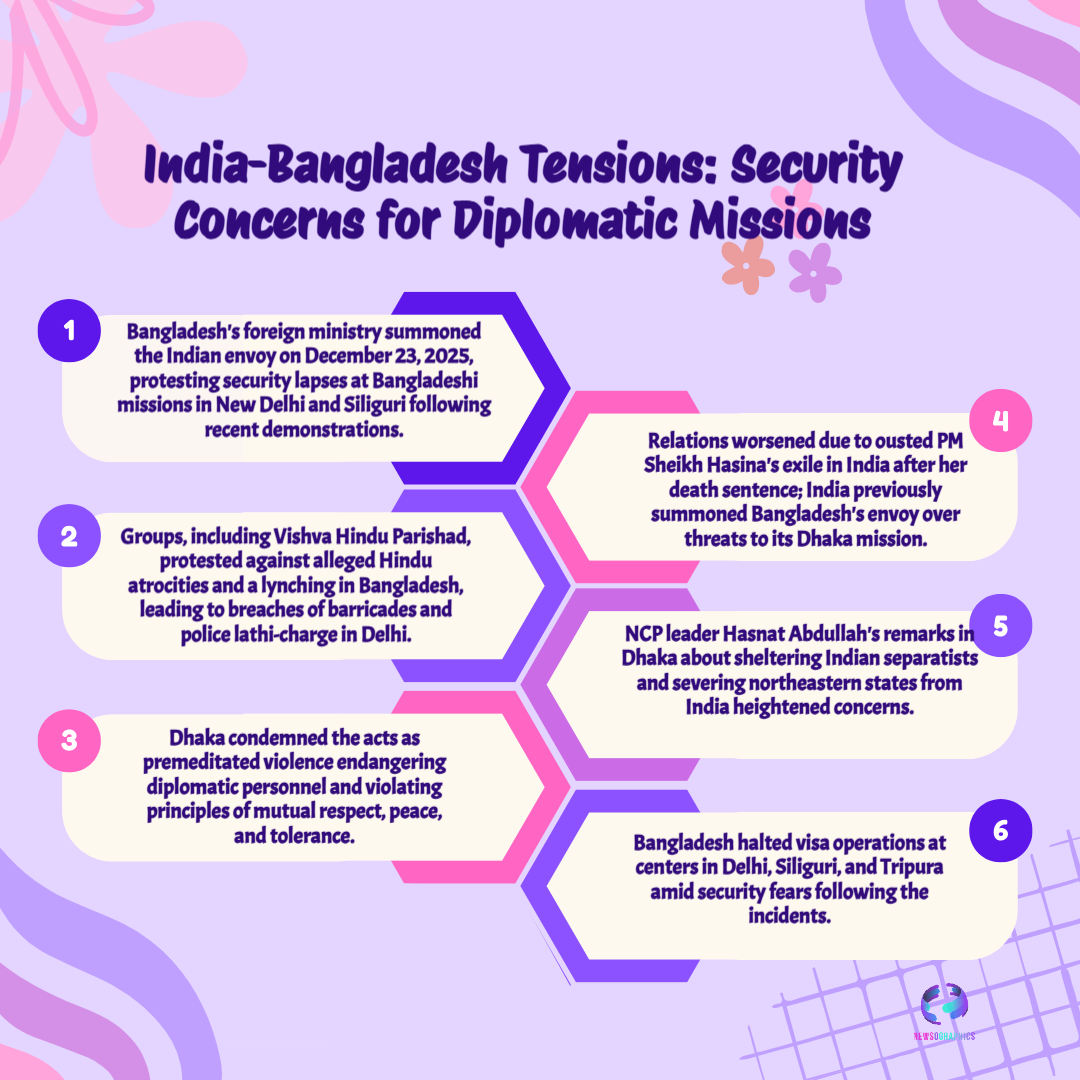
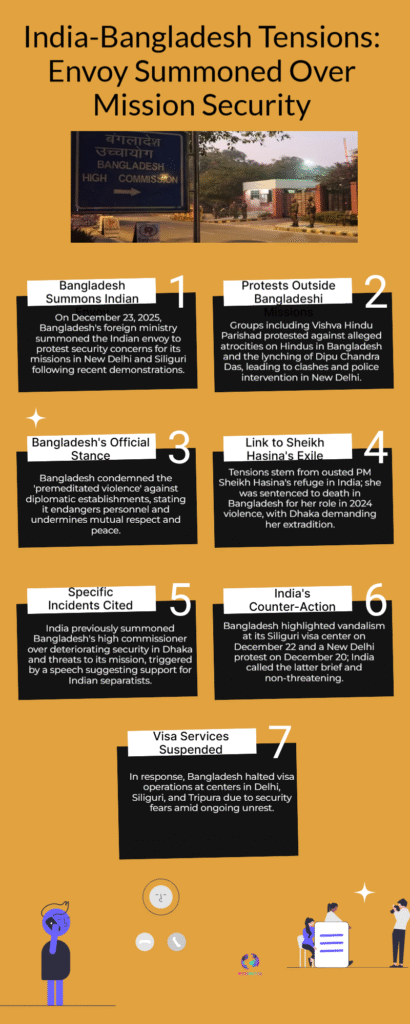
Bangladesh summons the Indian envoy to address security concerns surrounding diplomatic missions, highlighting regional sensitivities and evolving India-Bangladesh relations.
A Diplomatic Signal in a Sensitive Moment
Bangladesh’s decision to summon the Indian envoy has emerged as a notable diplomatic development, underscoring the seriousness with which Dhaka views security concerns linked to diplomatic missions. Such moves are rarely routine; they function as calibrated signals within international relations, conveying unease without escalating into overt confrontation.
The timing of the summons reflects a broader atmosphere of regional sensitivity. As South Asia navigates overlapping political, security, and social pressures, even procedural diplomatic actions acquire heightened significance.
Security of Diplomatic Missions as a Core State Responsibility
Norms and Expectations Under International Practice
The protection of foreign diplomatic missions is a foundational obligation under international diplomatic norms. Host countries are expected to ensure safety, dignity, and uninterrupted functioning of embassies and consulates, irrespective of domestic political currents.
When concerns arise, formal diplomatic communication becomes the primary channel for resolution. A summons, in this context, signals that Bangladesh considers the issue substantial enough to warrant direct clarification and reassurance.
Context of Heightened Vigilance
Recent periods have seen increased vigilance around diplomatic premises across the region. Political demonstrations, public anger, or misinformation can quickly transform into security risks, prompting governments to reassess and reinforce protective measures. Bangladesh’s action reflects this environment of caution rather than an isolated administrative step.
Reading the Message Between Dhaka and New Delhi
Diplomatic Language and Strategic Restraint
Summoning an envoy does not automatically imply hostility. It often represents a structured expression of concern, allowing both sides to restate positions while preserving diplomatic decorum. Bangladesh’s approach suggests an intent to address issues through established channels rather than public escalation.
India, for its part, occupies a central place in Bangladesh’s foreign policy calculus. The relationship is marked by cooperation across trade, connectivity, and security, alongside periodic moments of friction.
Bilateral Relations Under Public and Regional Scrutiny
India-Bangladesh ties are closely watched, both domestically and regionally. Actions taken by either side resonate beyond immediate diplomatic circles, shaping narratives about regional stability and mutual trust. In this context, even routine diplomatic engagements are interpreted through a wider geopolitical lens.
Domestic Considerations Shaping External Postures
Internal Stability and External Messaging
Domestic conditions often influence how governments engage externally. When internal security or political stability is under scrutiny, reaffirming control over diplomatic security becomes part of asserting state authority. Bangladesh’s move can be read as an assertion of responsibility amid a complex internal landscape.
Such actions also serve a domestic audience, reinforcing the state’s commitment to upholding international obligations while maintaining sovereignty.
Managing Perception and Credibility
For any government, credibility in protecting foreign missions is intertwined with its international standing. Addressing concerns promptly and formally helps prevent reputational damage and reassures other diplomatic partners operating within the country.
Broader Regional Implications
South Asia’s Interlinked Diplomatic Environment
South Asian diplomacy operates within a tightly interwoven framework where bilateral issues often carry regional implications. Developments between Bangladesh and India inevitably attract attention from neighbouring states and global partners engaged in the region.
Security-related diplomatic exchanges highlight the fragile balance between domestic pressures and regional cooperation, a balance that defines much of South Asia’s political reality.
Continuity Amid Episodic Tensions
Despite episodic tensions, India and Bangladesh have historically demonstrated an ability to compartmentalise issues and sustain long-term engagement. Diplomatic summonses, while serious, often function as mechanisms to prevent misunderstandings from hardening into lasting disputes.
A Measured Moment in Ongoing Diplomacy
Bangladesh’s decision to summon the Indian envoy over security concerns reflects the structured, rule-bound nature of modern diplomacy. It signals concern without rupture, caution without escalation. In an era of rapid information flow and heightened sensitivities, such formal engagements remain essential tools for maintaining stability.
As both countries navigate this episode, the emphasis remains on communication, reassurance, and continuity—elements that have long underpinned the complex yet resilient relationship between Dhaka and New Delhi.