



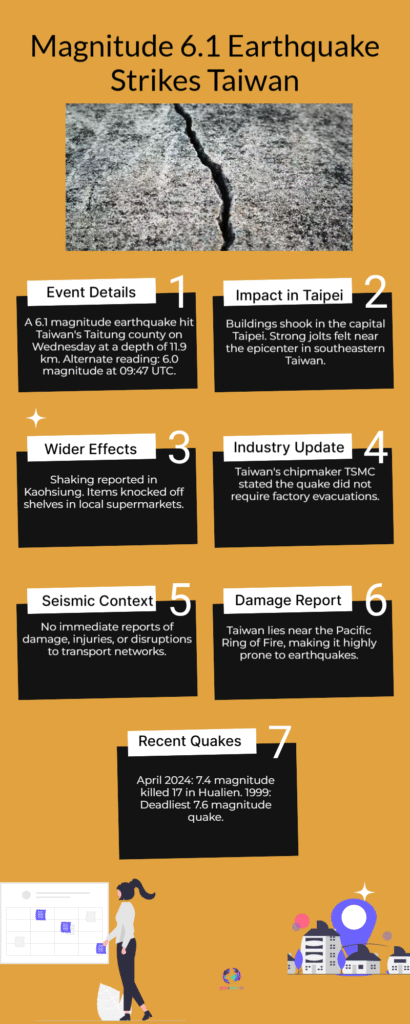
A magnitude 5.7 earthquake struck Taiwan, sending strong tremors through Taipei and nearby regions, highlighting the island’s seismic vulnerability and preparedness framework.
Seismic Activity Returns to Focus in Taiwan
Taiwan once again experienced the reality of its seismic geography as a moderate earthquake sent tremors through the island, with noticeable shaking reported in Taipei. The event, measured at magnitude 5.7, served as a reminder of the persistent tectonic forces shaping daily life in this part of East Asia. While not extreme in scale, the quake was strong enough to be widely felt, briefly disrupting routine activities and drawing immediate public attention.
Earthquakes of this intensity occupy a critical middle ground—powerful enough to unsettle urban centers, yet typically below the threshold of widespread structural damage when preparedness measures are in place.
The Nature of the Tremors
Shaking Across Urban Landscapes
Residents in Taipei reported buildings swaying and household items rattling as the tremors passed through the city. High-rise structures, designed to flex rather than resist rigidly, amplified the sensation of movement, making the quake particularly noticeable in dense residential and commercial zones.
Depth and Distribution
Moderate earthquakes often derive their impact not only from magnitude but also from depth and proximity to populated areas. In this case, the tremors spread across multiple districts, underscoring how even mid-range seismic events can have a broad perceptual footprint in urban environments.
Taiwan’s Seismic Reality
Positioned Along Active Fault Lines
Taiwan sits near the boundary of tectonic plates within the Pacific Ring of Fire, a region known for frequent earthquakes and volcanic activity. This geological positioning ensures that seismic events, both minor and significant, remain a recurring feature of the island’s natural environment.
A History of Adaptation
Over decades, repeated exposure to earthquakes has shaped Taiwan’s approach to urban planning, construction standards, and public awareness. Each tremor, regardless of scale, reinforces institutional memory and public responsiveness.
Preparedness and Infrastructure Resilience
Engineering for Movement
Modern buildings in Taiwan are constructed with seismic considerations at their core. Flexible structural designs, reinforced frameworks, and stringent building codes are intended to absorb and dissipate energy rather than resist it outright, reducing the risk of collapse during moderate quakes.
Public Awareness and Response
Earthquake drills, early-warning systems, and widespread public education have normalized rapid response behaviors. Even during unexpected tremors, these ingrained practices help limit panic and guide people toward safer actions.
Urban Life Briefly Interrupted
Momentary Disruptions
Such earthquakes often lead to temporary pauses in transportation systems, office operations, and daily routines. Elevators may halt briefly, trains slow as a precaution, and residents step outdoors until stability is confirmed.
Psychological Impact Over Physical Damage
In many cases, the most immediate effect is psychological rather than structural. The sudden movement of buildings and the uncertainty that follows can leave a lingering sense of unease, even when damage is minimal.
A Reminder of Constant Vigilance
The magnitude 5.7 earthquake serves as another chapter in Taiwan’s ongoing relationship with seismic activity. While the island’s preparedness has significantly reduced risks, each tremor reinforces the importance of resilient infrastructure and collective awareness.
In a region where the ground itself can shift without warning, such events are not anomalies but part of a larger geological rhythm—one that Taiwan continues to navigate with a blend of engineering discipline and social readiness.