
Eknath Shinde’s pointed remark amid the reunion of Uddhav and Raj Thackeray highlights shifting alliances, legacy politics, and renewed political messaging in Maharashtra.
A Political Reunion That Rekindles Old Equations
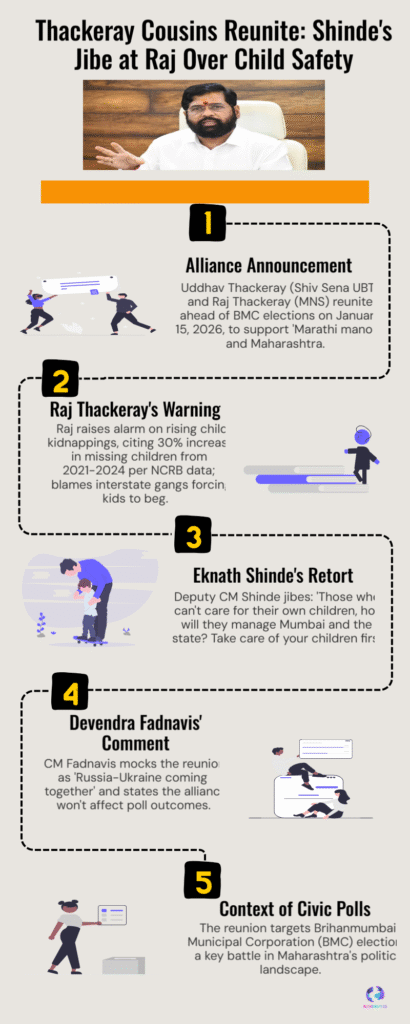
The renewed public alignment between Uddhav Thackeray and Raj Thackeray has once again stirred Maharashtra’s political waters. Long separated by ideological positioning and personal distance, the cousins appearing on the same political wavelength carries symbolic weight. Their reunion reopens conversations around legacy, voter consolidation, and the enduring influence of the Thackeray name in the state’s politics.
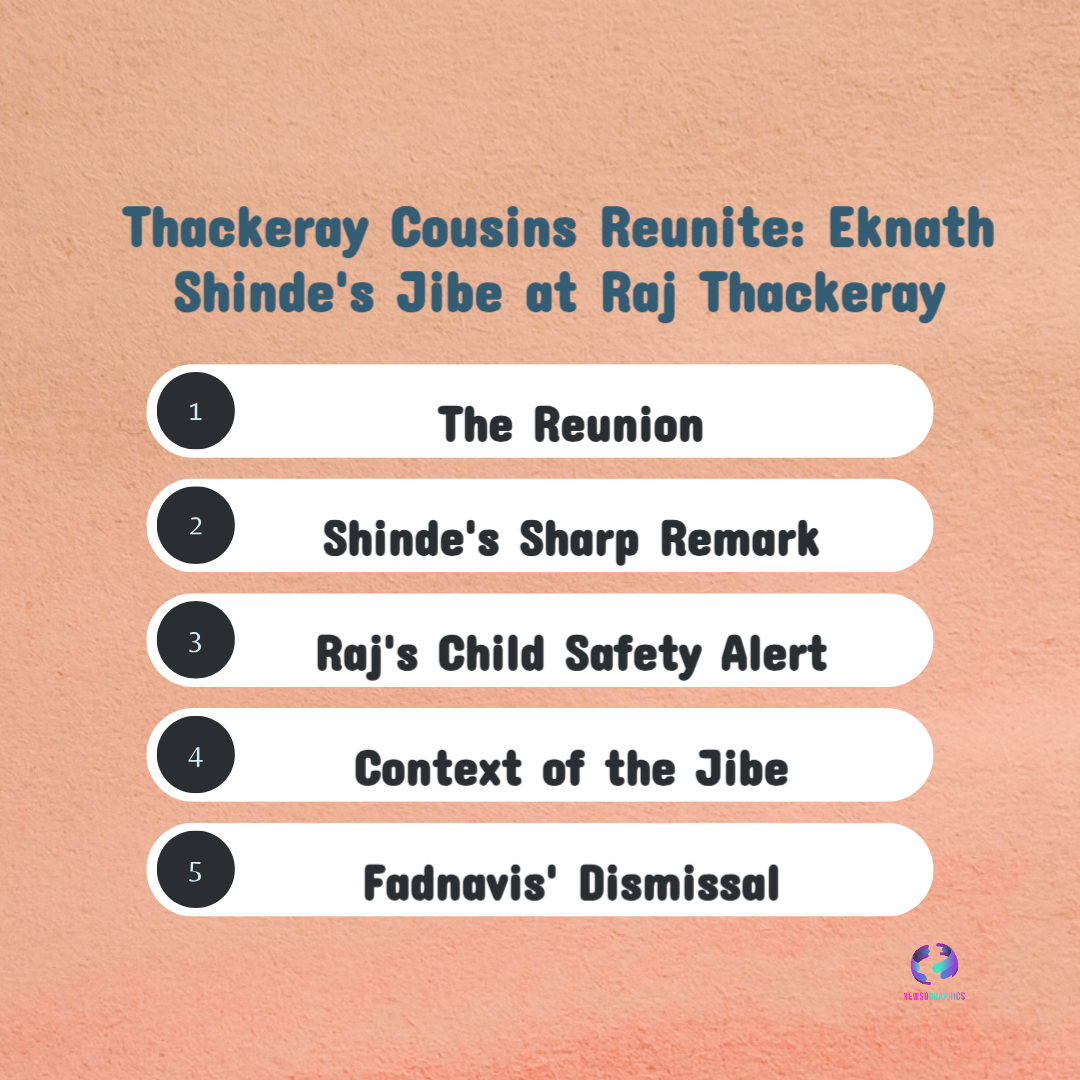
In response, Chief Minister Eknath Shinde pointed remark cut through the symbolism, reframing the moment as a contest of governance priorities rather than family unity.
Shinde’s Remark and Its Political Undertone
A Calculated Statement
Shinde’s comment urging political rivals to “take care of your children first” was more than a personal jibe. It functioned as a rhetorical pivot, shifting attention from opposition optics to questions of responsibility, performance, and political credibility. Such language is designed to resonate beyond party lines, appealing to voters who increasingly evaluate leadership through outcomes rather than lineage.
Reasserting the Ruling Narrative
By intervening verbally at this juncture, Shinde reinforced his position as a leader focused on administration and stability. The remark implicitly contrasted emotional reunions with the practical demands of governance, a recurring theme in his political messaging since the Shiv Sena split.
The Thackeray Legacy Back in Focus
Symbolism Over Structure
The Thackeray cousins’ reunion carries strong emotional symbolism, especially among core supporters who associate the family name with Marathi identity and regional assertion. However, symbolism alone does not immediately translate into organizational cohesion or electoral machinery, both of which remain fragmented.
Managing Divergent Political Paths
Uddhav and Raj Thackeray have historically pursued distinct political trajectories. Any visible convergence invites scrutiny over how ideological differences and past rivalries will be reconciled, and whether unity can extend beyond appearances into sustained coordination.
Maharashtra’s Shifting Political Landscape
Post-Split Realignments
The fragmentation of Shiv Sena fundamentally altered Maharashtra’s power structure. New alliances, rebranded factions, and recalibrated loyalties have reshaped the political map. In this environment, reunions and remarks alike become signals in a larger strategic contest.
Competitive Messaging in a Polarized Arena
Statements like Shinde’s are part of a broader battle over narrative dominance. As opposition figures attempt to project unity, the ruling side seeks to underline continuity, administrative focus, and electoral legitimacy.
Public Perception and Political Theatre
Beyond Personal Barbs
While sharp remarks often dominate headlines, their real impact lies in how they frame political choice. Shinde’s comment functions less as an insult and more as a challenge—redirecting voter attention from personalities to performance.
Media, Messaging, and Momentum
In a media-saturated political environment, brief statements can shape week-long discourse. The interplay between a high-profile reunion and an equally pointed response illustrates how symbolism and sound bites drive momentum in modern Indian politics.
What the Moment Signals Going Forward
The Thackeray cousins’ reunion and Shinde’s swift jibe together encapsulate the current phase of Maharashtra politics—emotionally charged, strategically calibrated, and deeply competitive. Legacy, leadership, and governance are being weighed simultaneously, with each public gesture interpreted through an electoral lens.
As alliances evolve and narratives harden, such moments are less about personal exchanges and more about positioning. In Maharashtra’s crowded political arena, every word, reunion, and retort contributes to a larger contest over authority, relevance, and the future direction of the state.