





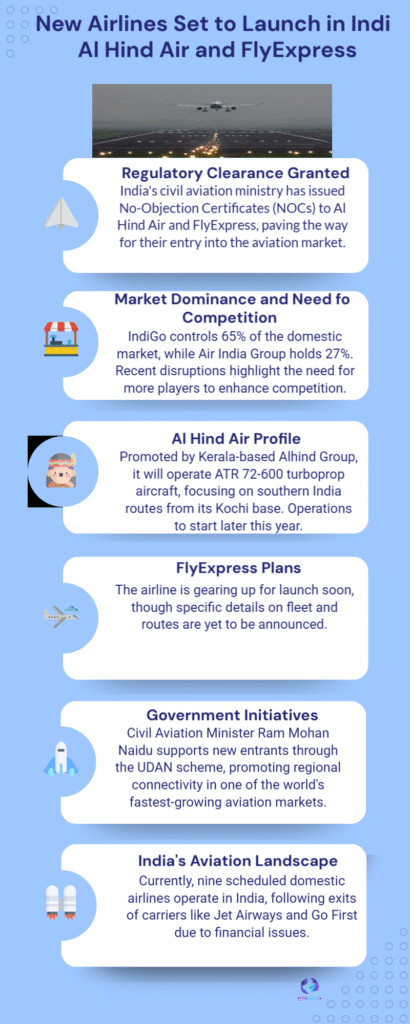
Two new airlines, Al Hind Air and FlyExpress, are preparing to begin operations in India, reflecting renewed confidence, competition, and expansion in the country’s fast-evolving aviation sector.
A New Chapter for India’s Aviation Sector
India’s aviation landscape is poised for a notable expansion with the planned entry of two new carriers, Al Hind Air and FlyExpress. Their arrival signals renewed entrepreneurial interest in a sector that has undergone consolidation, regulatory recalibration, and post-pandemic recovery. As air travel demand continues to rise across metropolitan and regional routes, the introduction of fresh operators reflects confidence in the long-term growth trajectory of Indian aviation.
The development also highlights how India’s skies are becoming increasingly competitive, with new business models and route strategies taking shape alongside established carriers.
Al Hind Air and FlyExpress: Emerging Profiles
Al Hind Air’s Operational Vision
Al Hind Air is positioned as a full-service airline with ambitions to tap into both domestic and international segments. Its planned operations suggest a focus on connecting Indian cities with overseas destinations, particularly routes with strong passenger demand driven by trade, tourism, and diaspora travel. The airline’s branding and positioning indicate an attempt to carve out a distinct identity in a market dominated by hybrid and low-cost players.
Behind the scenes, regulatory clearances, fleet acquisition, and crew training have been progressing steadily, marking a critical preparatory phase before commercial takeoff.
FlyExpress and the Regional Connectivity Angle
FlyExpress is expected to emphasize efficiency and regional reach, aligning with India’s broader push to enhance air connectivity beyond major hubs. By targeting underserved routes and secondary airports, the airline aims to benefit from growing demand in tier-two and tier-three cities. This approach mirrors a structural shift in Indian aviation, where growth is no longer confined to a handful of metros.
The airline’s operational strategy appears tailored to shorter-haul routes, balancing cost discipline with network expansion.
Regulatory Clearance and Readiness
Approvals and Compliance Milestones
The entry of new airlines is contingent on a rigorous regulatory process involving safety audits, financial scrutiny, and operational preparedness. Both Al Hind Air and FlyExpress have advanced through key stages of approval, reflecting compliance with India’s evolving civil aviation framework. These clearances are designed to ensure stability and reliability in a sector that has previously seen turbulence from undercapitalized ventures.
Regulatory oversight has become more structured, aiming to prevent disruptions while encouraging healthy competition.
Infrastructure and Fleet Planning
Airport infrastructure expansion across India has created room for new entrants, with modernized terminals and upgraded airstrips supporting higher traffic volumes. Fleet planning by the new airlines is aligned with this infrastructure push, focusing on aircraft types suitable for their respective route strategies. The emphasis on operational efficiency is expected to be central to their early performance.
Competitive Impact on the Aviation Market
Intensifying Competition in the Skies
The addition of two carriers will inevitably intensify competition, particularly on price-sensitive routes. Established airlines may respond by recalibrating schedules, fares, and service offerings. For passengers, increased competition often translates into greater choice and improved connectivity, especially as new airlines seek to establish market presence.
At the same time, competition places pressure on operational discipline, making sustainability a defining challenge for newcomers.
Market Timing and Demand Trends
The timing of these launches coincides with sustained growth in passenger traffic, driven by economic activity, tourism revival, and improved regional access. India’s position as one of the fastest-growing aviation markets globally provides a supportive backdrop, though cost volatility and operational complexity remain persistent factors.
New entrants are stepping into a market that rewards scale and efficiency, testing their ability to adapt quickly.
Broader Implications for Indian Aviation
Employment and Skill Development
New airline operations generate employment across multiple layers, from pilots and cabin crew to ground staff and maintenance professionals. The expansion contributes to skill development and workforce absorption in an industry that relies heavily on specialized expertise.
This growth also strengthens ancillary sectors such as airport services, logistics, and training institutions.
A Signal of Sectoral Confidence
The planned launch of Al Hind Air and FlyExpress serves as a broader signal of confidence in India’s aviation ecosystem. It reflects faith in regulatory stability, passenger growth, and infrastructure readiness. While challenges remain, the willingness of new players to invest underscores the sector’s evolving maturity.
Fresh Wings in an Expanding Sky
The impending entry of Al Hind Air and FlyExpress marks a significant moment for Indian aviation. Beyond the headlines, it represents a convergence of opportunity, ambition, and structural growth. As these airlines prepare to take to the skies, their journeys will be closely watched, not just as individual ventures, but as indicators of where India’s aviation sector is headed in its next phase of expansion.