

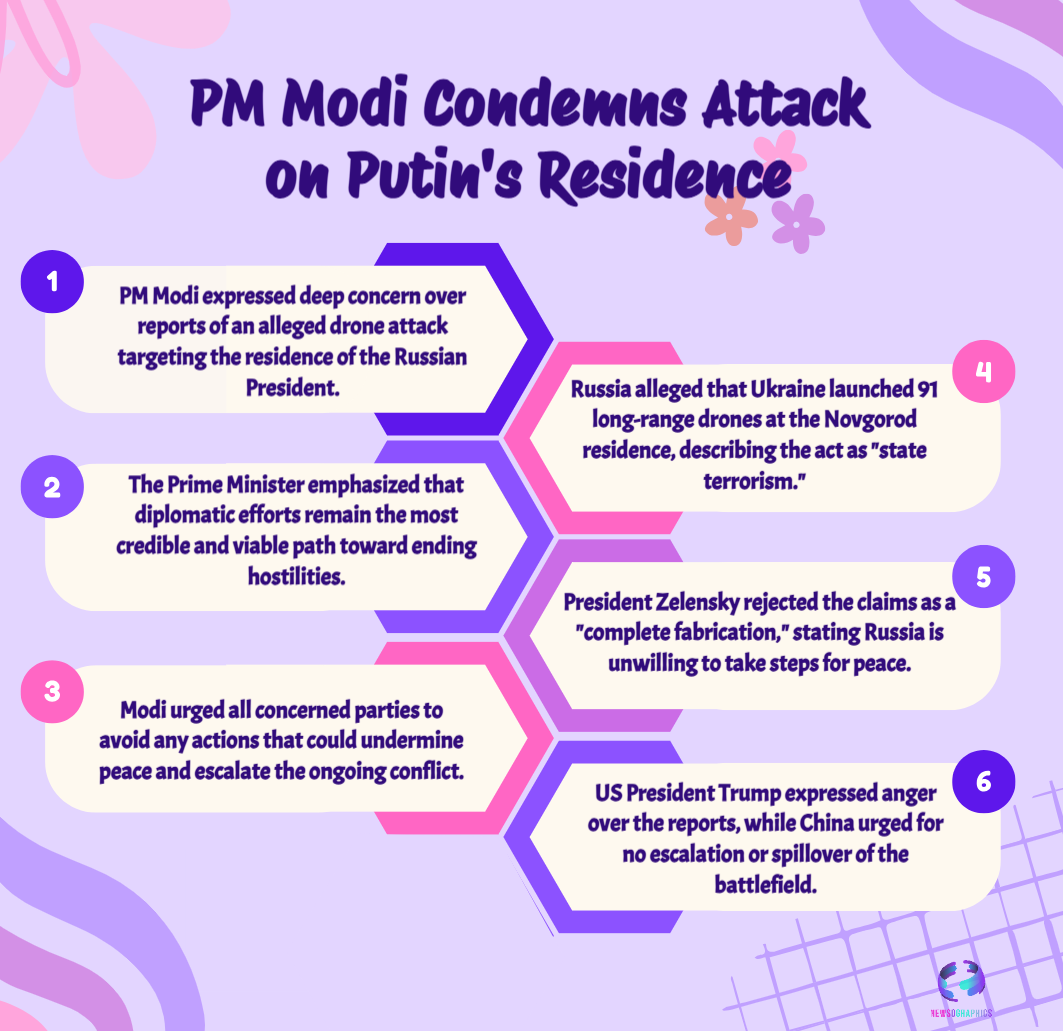
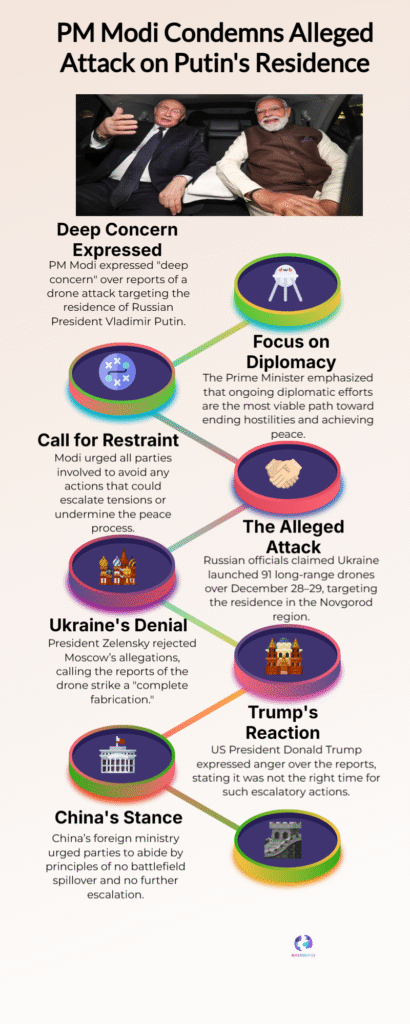
PM Modi strongly condemns the attack on Russian President Vladimir Putin’s residence, urging restraint and warning against actions that undermine global peace and stability.
India’s Firm Response to Escalating Tensions
India has expressed clear disapproval following reports of an attack targeting the official residence of Russian President Vladimir Putin. PM Modi statement underscored India’s consistent position against violence and destabilizing actions, particularly those involving heads of state and sovereign institutions.
The response reflects New Delhi’s broader diplomatic posture that emphasizes restraint, dialogue, and respect for international norms, even amid heightened geopolitical uncertainty.
Message Rooted in Principles of Sovereignty
At the core of India’s condemnation lies a strong defense of sovereignty and security. Attacks on leadership residences are widely viewed as direct challenges to state authority and international order. By denouncing such acts, India reaffirmed its long-standing opposition to political violence in all forms.
Respect for National Institutions
India’s position aligns with its belief that national institutions and leadership must be safeguarded from acts that threaten stability. Such incidents risk widening conflicts and undermining diplomatic channels that remain critical during periods of strain.
Rejection of Escalatory Tactics
PM Modi statement also carried a cautionary tone, warning against actions that fuel escalation. India has consistently argued that provocative measures only deepen divides and reduce the space for negotiation and peaceful resolution.
India–Russia Relations in a Shifting Global Landscape
India and Russia share a historically resilient relationship spanning decades of strategic, economic, and diplomatic cooperation. New Delhi response reflects both this bilateral context and a broader commitment to global stability rather than alignment with conflict-driven narratives.
While global alliances are increasingly polarized, India has maintained an independent foreign policy approach, engaging with multiple power centers while advocating for balanced and peaceful outcomes.
Peace as a Central Diplomatic Pillar
Prime Minister Narendra Modi emphasis on peace is not situational but structural. India has repeatedly used international platforms to call for cessation of hostilities, protection of civilians, and respect for international law.
Dialogue Over Disruption
PM Modi condemnation reinforced India’s preference for dialogue over disruption. Acts targeting leadership symbols are often seen as attempts to derail diplomatic efforts, making reconciliation more difficult.
Stability in an Interconnected World
In an era of global interdependence, localized incidents can have far-reaching consequences. India’s statement highlighted the need for responsible conduct, recognizing that instability in one region reverberates across economies and security frameworks worldwide.
Broader Implications for Global Security
The incident and India’s response draw attention to the fragility of global security mechanisms. As conflicts evolve beyond traditional battlefields, symbolic targets increasingly become focal points, raising concerns about normalization of political violence.
India’s condemnation serves as a reminder that maintaining international order requires collective adherence to restraint, even during periods of strategic rivalry.
India’s Consistent Diplomatic Voice
New Delhi’s reaction fits within a consistent diplomatic pattern—condemning violence, urging peace, and avoiding rhetoric that inflames tensions. PM Modi approach has positioned India as a steady voice advocating stability amid an increasingly volatile international environment.
PM Modi calling for actions that uphold peace rather than undermine it, India reaffirmed its role as a proponent of dialogue-driven solutions, emphasizing that sustainable security can only emerge from responsibility and restraint.