

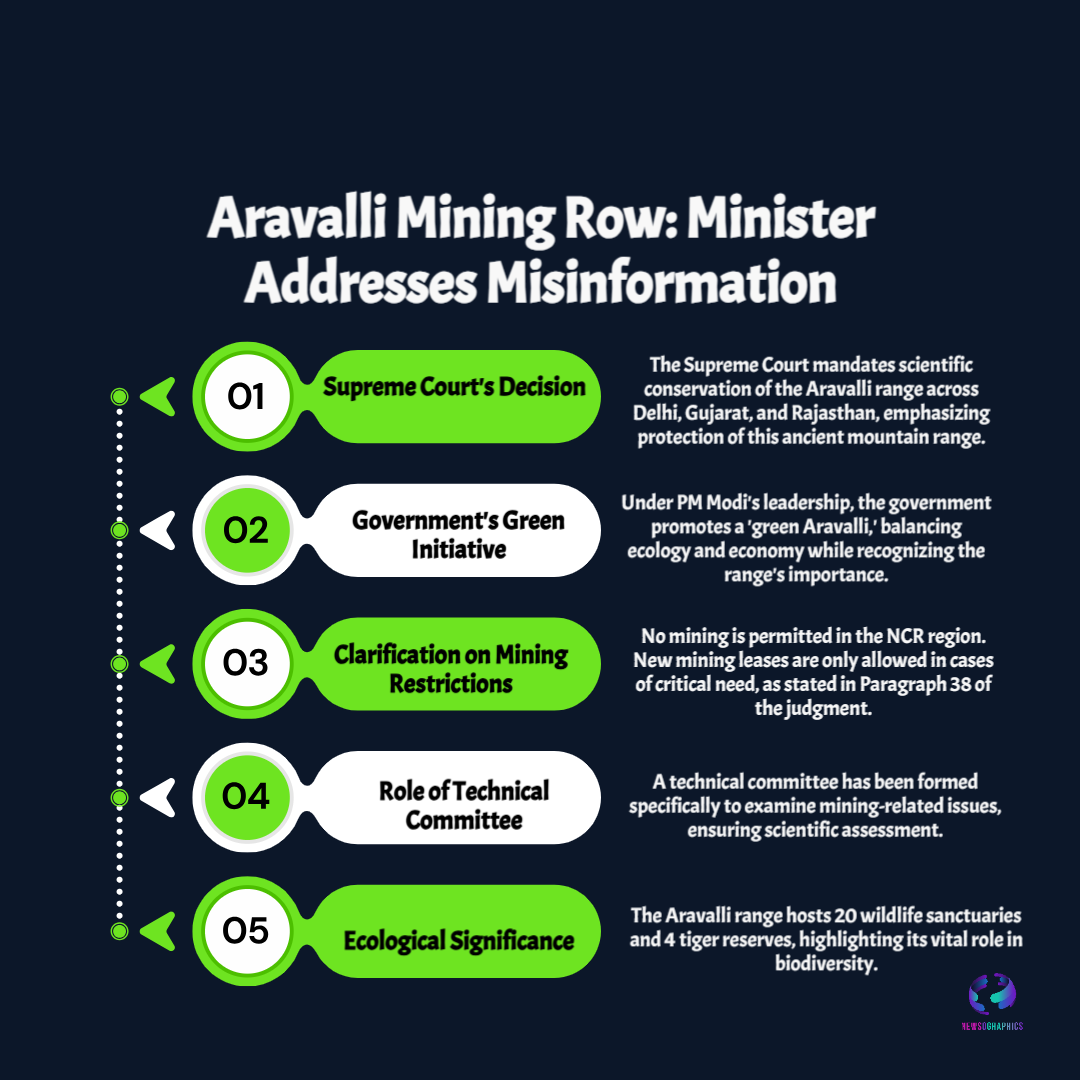
The Centre rejects claims of unchecked mining in the Aravallis, asserting that environmental protection and economic needs are being addressed together amid a growing political and ecological debate.
The Aravalli Debate Returns to the Spotlight
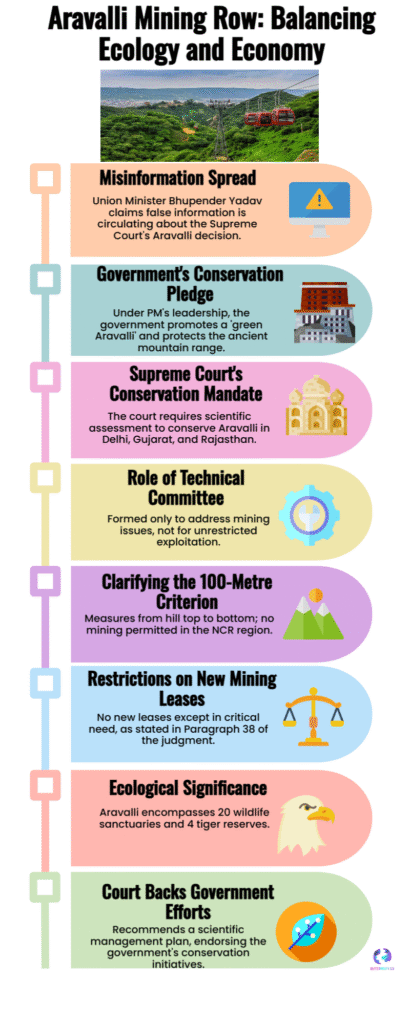
A renewed controversy over mining activity in the Aravalli Range has pushed environmental governance back into the national conversation. Government representatives have strongly countered claims of ecological dilution, arguing that misleading narratives are being circulated around policy decisions related to the ancient hill system.
The statement comes amid heightened scrutiny from environmental groups, opposition leaders, and civil society voices who view the Aravallis as a fragile ecological shield for north India.
Government Pushback on Alleged Misinformation
According to the government, recent assertions suggesting indiscriminate mining or regulatory rollback do not reflect policy intent or administrative reality. Officials maintain that legal frameworks governing extraction remain intact and that enforcement mechanisms continue to operate within environmental safeguards.
The emphasis, they argue, is on correcting the record rather than dismissing ecological concerns—positioning the debate as one distorted by selective interpretation rather than factual erosion of protections.
Ecology and Economy: The Framing of Balance
Environmental Safeguards as Policy Anchors
Authorities have reiterated that the Aravallis are recognized as an ecologically sensitive zone, critical for groundwater recharge, biodiversity preservation, and climate moderation across adjoining regions. Regulatory oversight, environmental clearances, and monitoring processes are presented as non-negotiable pillars of decision-making.
Economic Considerations in Resource Governance
At the same time, the government frames mineral extraction as part of a broader economic ecosystem that supports livelihoods, infrastructure development, and industrial supply chains. The stated objective is calibrated activity—where permissible operations coexist with conservation imperatives rather than override them.
Why the Aravallis Matter Beyond Borders
Stretching across multiple states, the Aravalli range plays a pivotal role in shaping environmental outcomes far beyond its immediate geography. From influencing air quality in urban clusters to acting as a natural barrier against desertification, its degradation carries regional consequences.
This interdependence explains why policy signals around the hills trigger outsized reactions, particularly when environmental stress in north India is already under strain.
Political Undertones of an Environmental Issue
Environmental policy in India increasingly intersects with political positioning. In the Aravalli case, accusations of weakening protections quickly transform into broader critiques of governance priorities, while official rebuttals seek to reinforce administrative credibility.
The clash reflects a familiar pattern: ecological concerns becoming arenas for ideological contestation, where narratives compete as fiercely as data.
Regulatory Complexity and Public Perception
Layers of Law and Oversight
Mining and environmental regulation in India involves overlapping statutes, judicial interventions, and state–centre coordination. This complexity often creates space for confusion, which officials argue is being exploited to amplify alarmist interpretations.
Communication Gaps and Trust Deficits
Public trust hinges not only on policy substance but also on clarity. The government’s assertion of misinformation highlights an underlying challenge—bridging the gap between technical regulation and public understanding in matters of environmental governance.
The Larger Question of Sustainable Development
The Aravalli mining row ultimately feeds into a larger national dilemma: how to pursue development without irreversibly damaging natural capital. The government’s insistence on aligning ecology with economy reflects an attempt to articulate a middle path, even as critics question whether such balance is achievable in practice.
Conclusion: A Contest of Narratives Over a Fragile Landscape
The controversy surrounding mining in the Aravallis is less about a single policy decision and more about competing visions of sustainability. As the government dismisses claims of ecological compromise as misinformation, the debate underscores the fragile equilibrium between growth and conservation.
In this contest of narratives, the Aravallis stand not just as a geological formation, but as a symbol of how India negotiates its environmental future under the weight of economic ambition and ecological responsibility.