



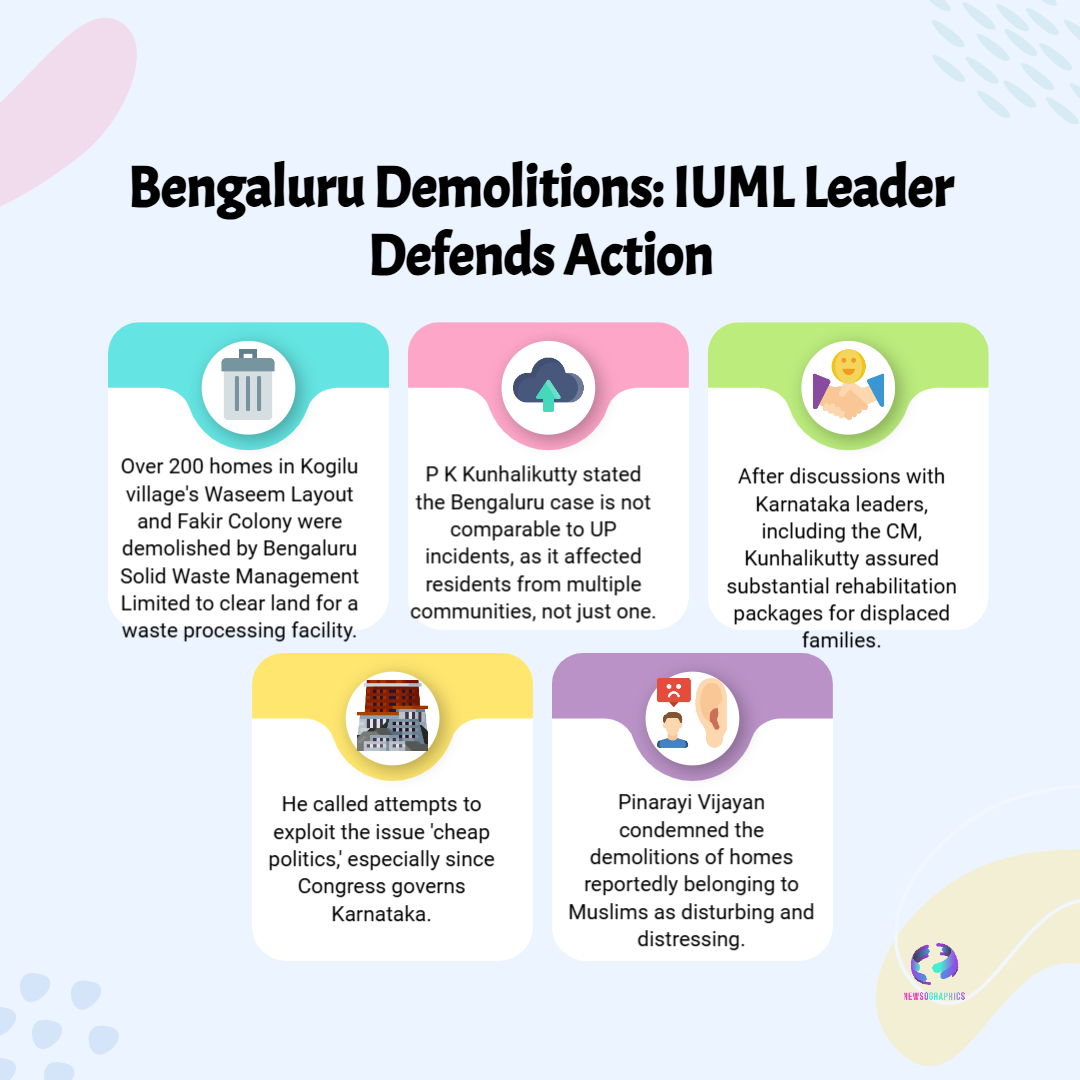
A Muslim League leader has defended recent demolitions in Bengaluru, asserting they cannot be compared with similar incidents in Uttar Pradesh amid political debate.

Demolitions Trigger a Fresh Political Debate
Recent demolition drives in Bengaluru have ignited a political exchange that extends beyond municipal action and into broader narratives of governance and intent. As images and reports circulated, comparisons were swiftly drawn with similar actions undertaken in Uttar Pradesh. These parallels, however, have been firmly rejected by a senior Muslim League leader, who described the comparison as inaccurate and misleading.
The response reflects the sensitivity surrounding demolition drives, particularly when they intersect with identity, legality, and political symbolism.
Position Taken by the Muslim League Leadership
The Muslim League leader defending the Bengaluru actions emphasized contextual distinction. According to the statement, the demolitions in Karnataka’s capital were framed as administrative measures rooted in local laws and civic regulations, rather than ideologically driven exercises. By pushing back against the comparison, the leader sought to decouple Bengaluru’s actions from narratives that have accompanied demolitions elsewhere.
This defense underscores an attempt to keep the focus on procedural grounds rather than political optics.
Why the UP Comparison Resonates Nationally
The Weight of Precedent
Uttar Pradesh has become a frequent reference point in discussions around demolition drives due to their visibility and the debates they sparked nationwide. As a result, any similar action in another state is quickly viewed through that lens. The Muslim League leader’s remarks aimed to dismantle this reflexive framing.
Divergent Administrative Contexts
Bengaluru’s urban challenges—rapid expansion, unauthorized constructions, and infrastructural strain—were highlighted as distinct from the law-and-order narratives often associated with demolitions in other regions. The insistence on context reflects an effort to reframe the conversation around municipal governance rather than political messaging.
Civic Authority and the Question of Legality
At the heart of the debate lies the question of legality. Demolition drives are often justified by civic bodies as enforcement of zoning laws or responses to encroachments. In Bengaluru, officials have pointed to urban planning requirements and court directives as the basis for action.
The Muslim League leader’s defense aligns with this administrative rationale, suggesting that legality, rather than selective targeting, should remain the central metric for evaluating such actions.
Political Undercurrents and Public Perception
Despite official explanations, public perception rarely rests on legality alone. Demolitions have become politically charged symbols, often interpreted as statements of power. The leader’s remarks acknowledge this reality while attempting to redirect attention toward procedural fairness.
The episode illustrates how urban governance decisions can quickly escalate into state and national political debates, shaped as much by perception as by policy.
Minority Politics and Narrative Control
The involvement of a Muslim League leader adds another layer to the discourse. By defending the demolitions while rejecting broader comparisons, the statement reflects an effort to balance community concerns with institutional processes. It signals an attempt to prevent the consolidation of a narrative that frames all demolition drives as uniform or politically motivated.
This positioning highlights the complexity faced by political actors operating within minority politics while engaging with state actions.
Bengaluru at the Intersection of Growth and Governance
Bengaluru rapid urbanization continues to test the limits of governance. Demolition drives, while controversial, are often presented as corrective measures within an overstretched urban framework. The current debate, amplified by political प्रतिक्र reactions, reflects the tension between development imperatives and social sensitivities.
As voices across the spectrum weigh in, the city once again finds itself at the center of a national conversation—one where distinctions, intent, and context are as contested as the actions themselves.