



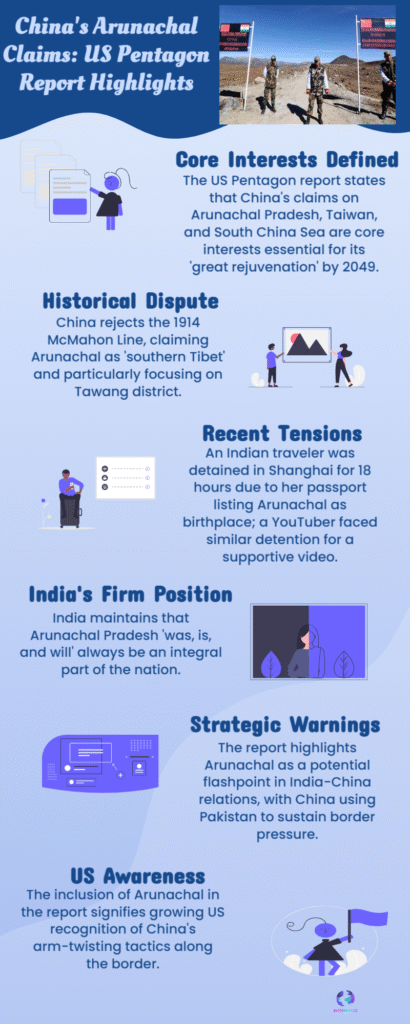
A US Pentagon report draws attention to China’s renewed claim over Arunachal Pradesh as a core interest, revealing deeper strategic implications for India, regional security, and Indo-Pacific geopolitics.
A Renewed Assertion With Strategic Weight
China’s reiteration of its claim over Arunachal Pradesh as part of its so-called “core interests” has once again placed the eastern sector of the India-China boundary at the center of geopolitical attention. Highlighted in a recent assessment by the United States Department of Defense, the claim reflects not merely a territorial dispute but a broader strategic posture shaping Beijing’s regional conduct.
The characterization of Arunachal Pradesh in this language elevates the issue beyond routine diplomatic disagreement. Within China’s strategic vocabulary, “core interests” denote matters tied closely to sovereignty, regime legitimacy, and long-term national objectives, leaving little room for compromise.
Understanding the Significance of ‘Core Interests’
The Political Meaning Behind the Phrase
China reserves the term “core interests” for issues it considers non-negotiable. Historically, this framing has been applied to regions such as Taiwan, Tibet, and Xinjiang. Extending similar terminology to Arunachal Pradesh signals an attempt to harden China’s negotiating stance and normalize its territorial narrative on the global stage.
This rhetorical shift also serves a domestic purpose, reinforcing nationalist sentiment and portraying territorial claims as inseparable from China’s historical identity and security imperatives.
Diplomatic and Strategic Messaging
By embedding the claim within official discourse noted by international observers, Beijing projects consistency and resolve. The message is aimed not only at India but also at external powers increasingly engaged in the Indo-Pacific, indicating that China views the eastern Himalayan region through a strategic, not merely cartographic, lens.
The Pentagon Report and Its Broader Implications
A Window Into Regional Security Assessments
The Pentagon’s report situates the Arunachal Pradesh claim within a wider evaluation of China’s military modernization, regional ambitions, and evolving doctrines. The inclusion of India-specific references underscores Washington’s assessment that the India-China boundary remains a potential flashpoint with consequences beyond bilateral relations.
Rather than focusing on a single incident, the report frames the claim as part of a pattern, reflecting how territorial assertions intersect with military posture, infrastructure development, and diplomatic signaling.
Indo-Pacific Context and Power Balances
The attention drawn by the report reinforces the perception that the India-China boundary dispute is intertwined with Indo-Pacific stability. As major powers recalibrate their strategies, unresolved territorial claims acquire amplified significance, influencing alliances, defense planning, and regional diplomacy.
India’s Position and Historical Context
Consistent Rejection of Chinese Claims
India has long maintained that Arunachal Pradesh is an integral and inalienable part of its territory, grounded in administrative control, democratic processes, and historical continuity. Beijing’s claims, periodically reiterated under different formulations, have been firmly rejected by New Delhi across successive governments.
The eastern sector, while relatively stable compared to other parts of the boundary, carries symbolic importance for India’s sovereignty and national cohesion.
Border Dynamics Beyond Rhetoric
While statements and reports shape perceptions, the ground reality along the Line of Actual Control in the eastern sector has largely avoided the intensity seen elsewhere. Nevertheless, infrastructure buildup, patrol activities, and diplomatic exchanges indicate that strategic caution governs both sides’ actions, even as rhetoric remains uncompromising.
Regional and Global Repercussions
Signal to Neighbours and Partners
China’s articulation of core interests in the Indian context resonates beyond bilateral ties. Neighbouring countries and strategic partners interpret such language as indicative of Beijing’s broader approach to territorial issues, influencing regional alignments and security calculations.
For India, the international acknowledgment of these claims in global assessments brings both diplomatic visibility and strategic complexity.
A Persistent Fault Line in Asian Geopolitics
The Arunachal Pradesh issue exemplifies how historical disputes continue to shape modern geopolitics. As great-power competition intensifies, long-standing boundary disagreements acquire renewed relevance, acting as pressure points in an already complex regional environment.
An Assertion That Echoes Beyond Borders
China’s renewed emphasis on Arunachal Pradesh as a core interest, as highlighted in the Pentagon report, underscores the enduring sensitivity of the India-China relationship. More than a cartographic disagreement, it reflects competing strategic visions, narratives of sovereignty, and regional influence. In an era of heightened geopolitical scrutiny, such assertions reverberate far beyond the mountains they reference, shaping perceptions, policies, and power equations across the Indo-Pacific.