

The G-RAM-G Bill has ignited sharp political reactions, with Congress CWC leaders warning of agitation and raising concerns over jobs, rural security, and policy direction.
G-RAM-G Bill Enters the Centre of Political Contestation
The introduction of the G-RAM-G Bill has rapidly shifted from a legislative development into a defining political confrontation. Framed by the government as a restructuring of rural employment and livelihood support, the bill has been received by the opposition as a fundamental departure from the social security architecture built around MGNREGA.
As the debate intensifies, the bill is no longer being examined only for its policy intent but for its broader implications on rural livelihoods, federal accountability, and the political economy of welfare in India.
Congress CWC Meeting Sets the Tone of Resistance
Unified Messaging From the Party Leadership
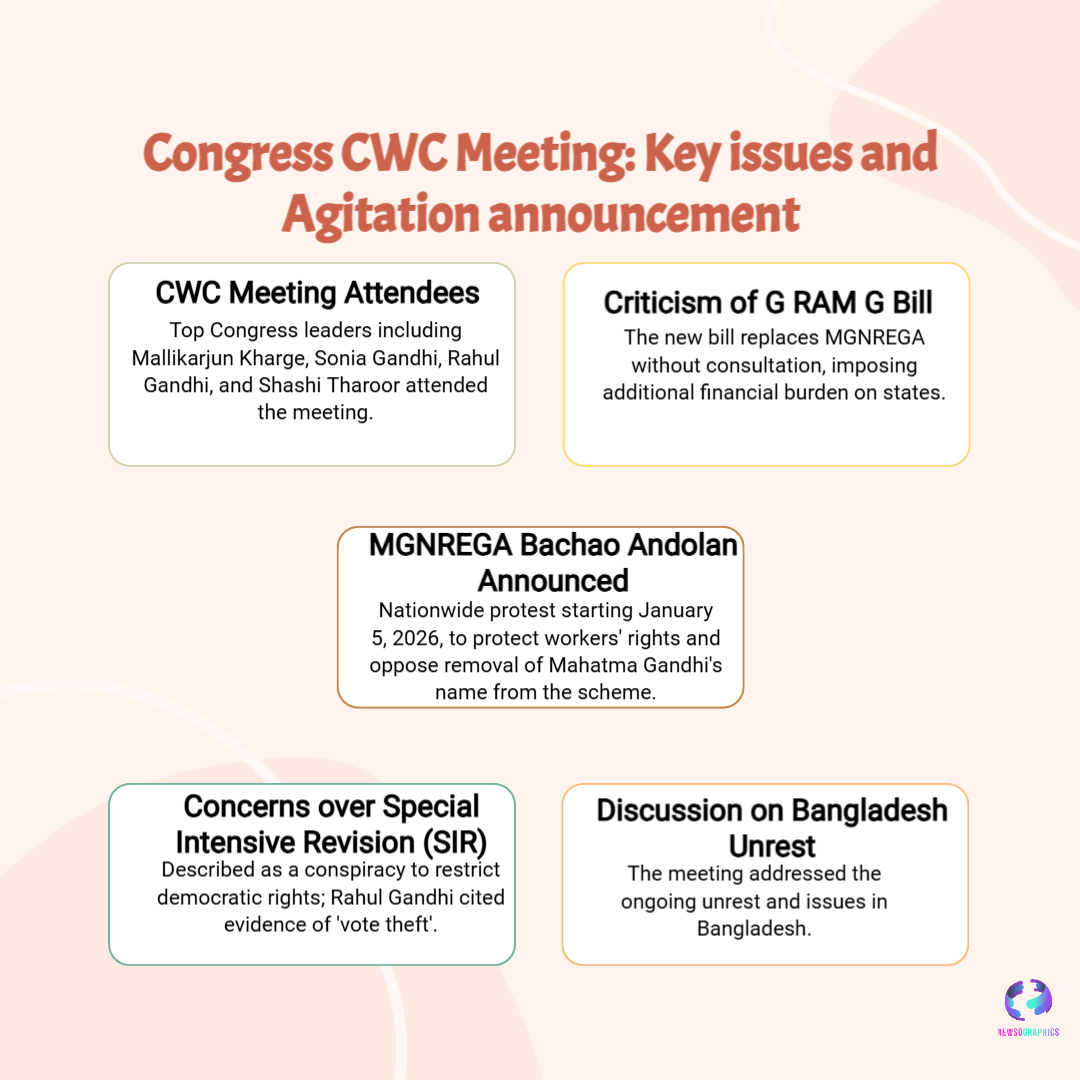
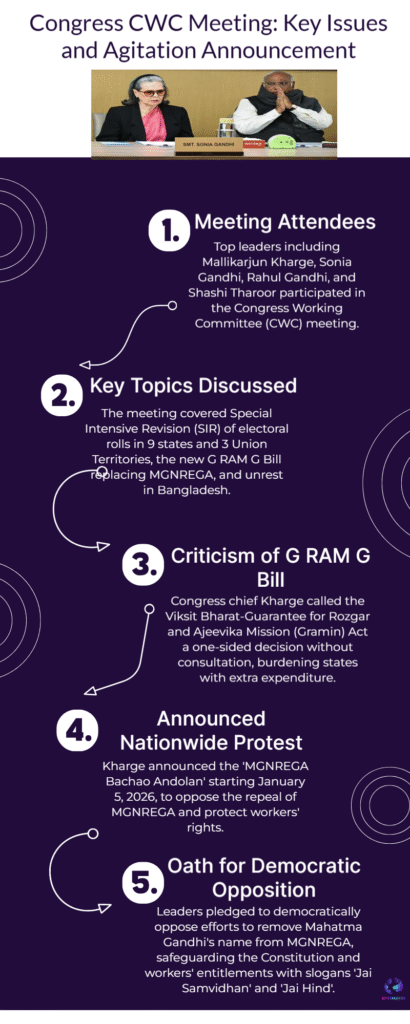
At the Congress CWC meeting, the G-RAM-G Bill emerged as a focal issue, shaping the party’s national messaging. Senior leaders emphasized that any dilution or replacement of MGNREGA would have direct consequences for rural employment security, particularly in economically vulnerable regions.
The Congress internal deliberations reflected an attempt to consolidate the party’s stance around livelihood protection, transforming policy disagreement into a clear political line.
Warning Signals of Mass Agitation
Congress president Mallikarjun Kharge’s warning of agitation marked a shift from parliamentary opposition to potential street-level mobilization. The language used signaled that the party views the bill not as a technical reform but as an ideological break with the rights-based welfare framework that MGNREGA represents.
MGNREGA and Its Symbolic Weight in Rural India
More Than an रोजगार Scheme
Over the years, MGNREGA has come to symbolize employment assurance, income stability, and state responsibility toward rural citizens. Any move perceived as replacing rather than reforming it carries emotional and political weight beyond budgetary calculations.
The G-RAM-G Bill’s positioning has therefore triggered anxieties that extend past implementation details, touching upon trust between the state and rural households.
Employment Security Versus Structural Reform
Supporters of the new framework argue for modernization and efficiency, while critics frame the debate as one between guaranteed rights and discretionary schemes. This contrast has become central to the political narrative surrounding the bill.
Role of Senior Leaders in Shaping the Narrative
Rahul Gandhi’s Emphasis on Rural Distress
Congress leader Rahul Gandhi interventions have focused on employment insecurity and the lived realities of rural workers. By foregrounding the potential impact on daily wage earners, his messaging aligns the opposition’s critique with broader concerns about inequality and economic resilience.
Shashi Tharoor and the Policy Framing
Shashi Tharoor’s remarks have added an institutional and constitutional layer to the debate, questioning whether replacing a statutory guarantee with a new framework weakens accountability. This dual approach—emotive and institutional—has given the opposition’s stance greater narrative depth.
Legislative Reform or Welfare Retrenchment?
Government’s Reform Argument
From the government’s perspective, the G-RAM-G Bill is presented as a recalibration aimed at integrating employment with broader livelihood missions. The emphasis lies on outcomes, skill development, and long-term sustainability.
However, the lack of consensus on transition safeguards has left room for political interpretation and resistance.
Opposition’s Charge of Welfare Dilution
The Congress frames the bill as a retreat from entitlement-based welfare. By positioning it as a replacement rather than an enhancement, critics argue that the reform risks weakening a safety net relied upon by millions.
Electoral Undercurrents and Rural Politics
Rural Voters as the Key Stakeholders
Rural employment schemes have historically shaped electoral outcomes. The G-RAM-G Bill’s political significance is amplified by its timing and the demographic it affects, making it a central issue in upcoming political contests.
Policy as Political Signal
Beyond legislative text, the bill functions as a signal of governance philosophy. Whether voters interpret it as reformist or regressive may influence broader perceptions of economic stewardship.
Conclusion: A Bill That Redefines the Welfare Debate
The G-RAM-G Bill has evolved into more than a legislative proposal—it has become a referendum on the future of rural welfare policy in India. As Congress leaders escalate resistance and the government defends its reform agenda, the debate underscores a deeper ideological divide over employment guarantees, state responsibility, and social security. The outcome of this confrontation will shape not only rural livelihoods but also the political contours of welfare governance in the years ahead.