


As parts of Delhi register an AQI of 333 — in the ‘very poor’ range — repeat smog episodes raise serious health concerns. We explore causes, data, and what residents need to know this winter.
When Smog Returned: December 2025’s Pollution Spike
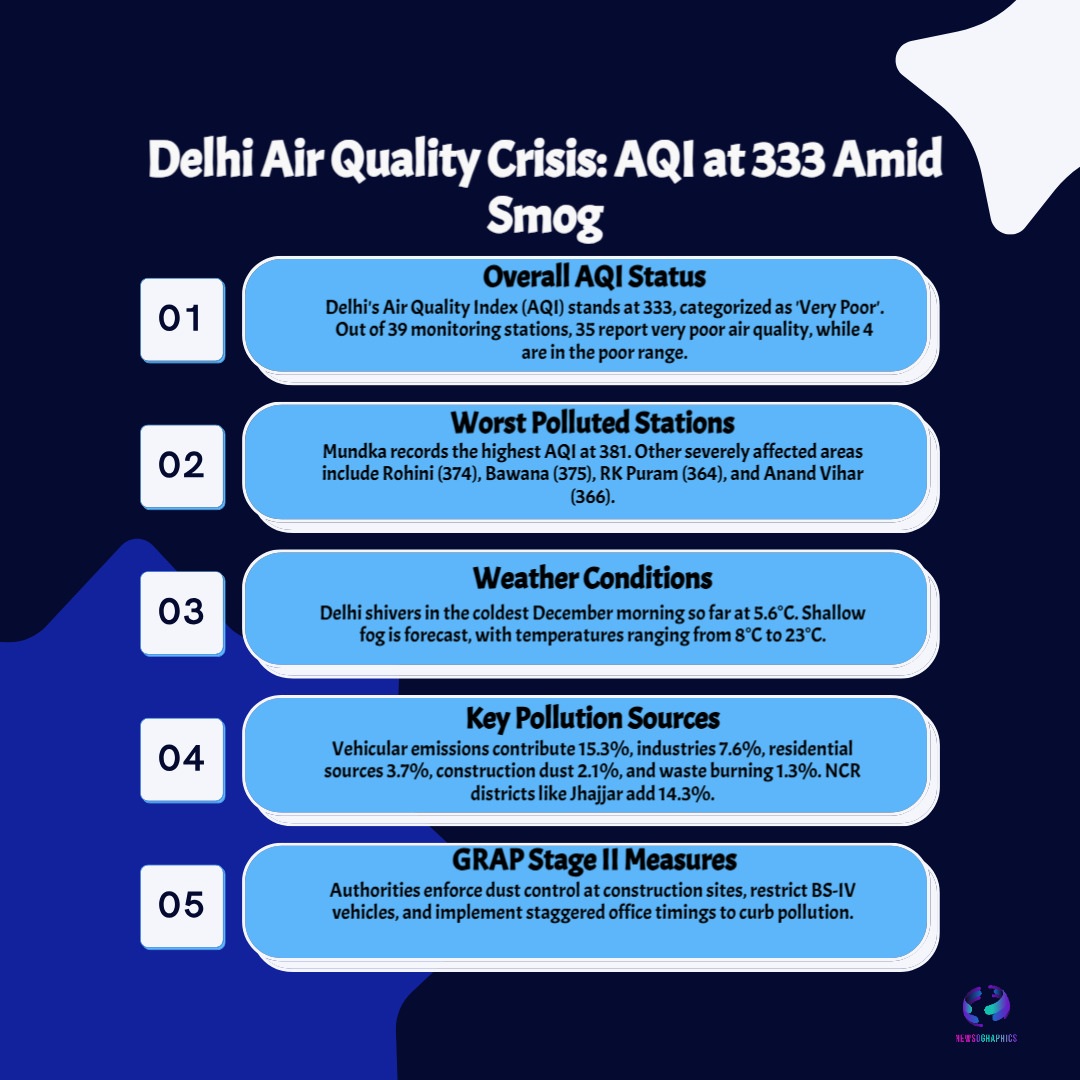
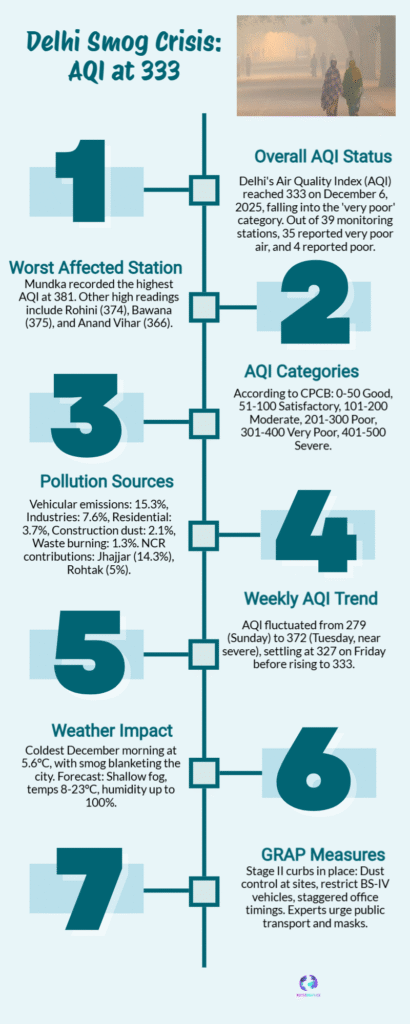
On December 6, 2025, the average air quality of Delhi plunged to an AQI of 333, placing the city firmly in the “very poor” category.
Of 39 monitoring stations across the city, 35 recorded “very poor” air quality; the remaining four reported “poor.” Some of the most polluted areas included Mundka (AQI 381), RK Puram (364), Rohini (374), Bawana (375), and Wazirpur (359).
A thick layer of smog blanketed the city at dawn — significantly reducing visibility and driving public concern about health risks.
What’s Fueling the Pollution Surge
According to recent analysis by Delhi’s Decision Support System, local pollution sources contributed significantly:
- Vehicular emissions accounted for ~15.3% of fine particulate pollution.
- Industries contributed ~7.6%, followed by residential emissions (~3.7%), construction dust (~2.1%), and waste burning (~1.3%).
- Despite some decline in stubble-burning from neighboring regions, pollution remained high due to local factors like traffic, construction activity, and emissions from homes and small industries.
Compounding the problem, the onset of cold weather — early December registered a low of 5.6 °C — suppressed dispersion of pollutants, trapping smog in the lower atmosphere.
Health Risk and Public Warning
Air quality at this level means very serious health implications: inhalable fine particles (PM2.5 and PM10) can aggravate or trigger respiratory issues, cardiovascular stress, and worsen chronic conditions. Over time, repeated exposure can cause long-term harm even to otherwise healthy individuals.
Experts and authorities urging caution — recommending minimal outdoor exposure, use of protective masks, and for vulnerable groups (children, elderly, people with respiratory/cardiac conditions) to stay indoors.
Policy Response: Is It Enough?
In reaction to the deteriorating air, the city has triggered Stage II of the Graded Response Action Plan (GRAP), which includes: restricting older/ more polluting vehicles, ramping up dust control at construction sites, and encouraging public transport and staggered office timings.
Why This Matters to Indian Cities — Beyond Delhi
Delhi’s crisis highlights broader trends many Indian metros will face: high population density, escalating vehicle counts, ongoing construction, and cold-season meteorology — a dangerous combination for smog.
- It reiterates how local sources (traffic, industry, construction, households) may matter even more than regional factors like agricultural stubble-burning.
- With winter-induced stagnant air, these urban emissions accumulate — making winter months repeatedly hazardous.
- For growing cities across India, proactive air-quality management (not just temporary “alert-level” responses) needs to become systematic.
What Residents Should Do: Practical Takeaways
- Monitor real-time AQI — stay indoors when levels are “very poor” or worse.
- Use high-quality masks (preferably N95 or equivalent) if you must go outside.
- Consider installing indoor air purifiers, especially if vulnerable individuals (children, elderly) live in the home.
- Avoid outdoor exercise or strenuous activity when smog is heavy.
- Support or demand stricter enforcement of dust-control, vehicular emissions norms, and industrial/residential emission regulations.
Final Thoughts
Delhi’s December-2025 smog episode is more than a seasonal recurring problem — it’s a stark warning. Unless pollution sources are controlled at the root, and urban-planning & environmental safeguards enforced consistently, residents will continue to face serious health hazards every winter.
The crisis isn’t just Delhi’s. It’s a signal for all fast-growing Indian cities to act — now — for cleaner air and healthier futures.