


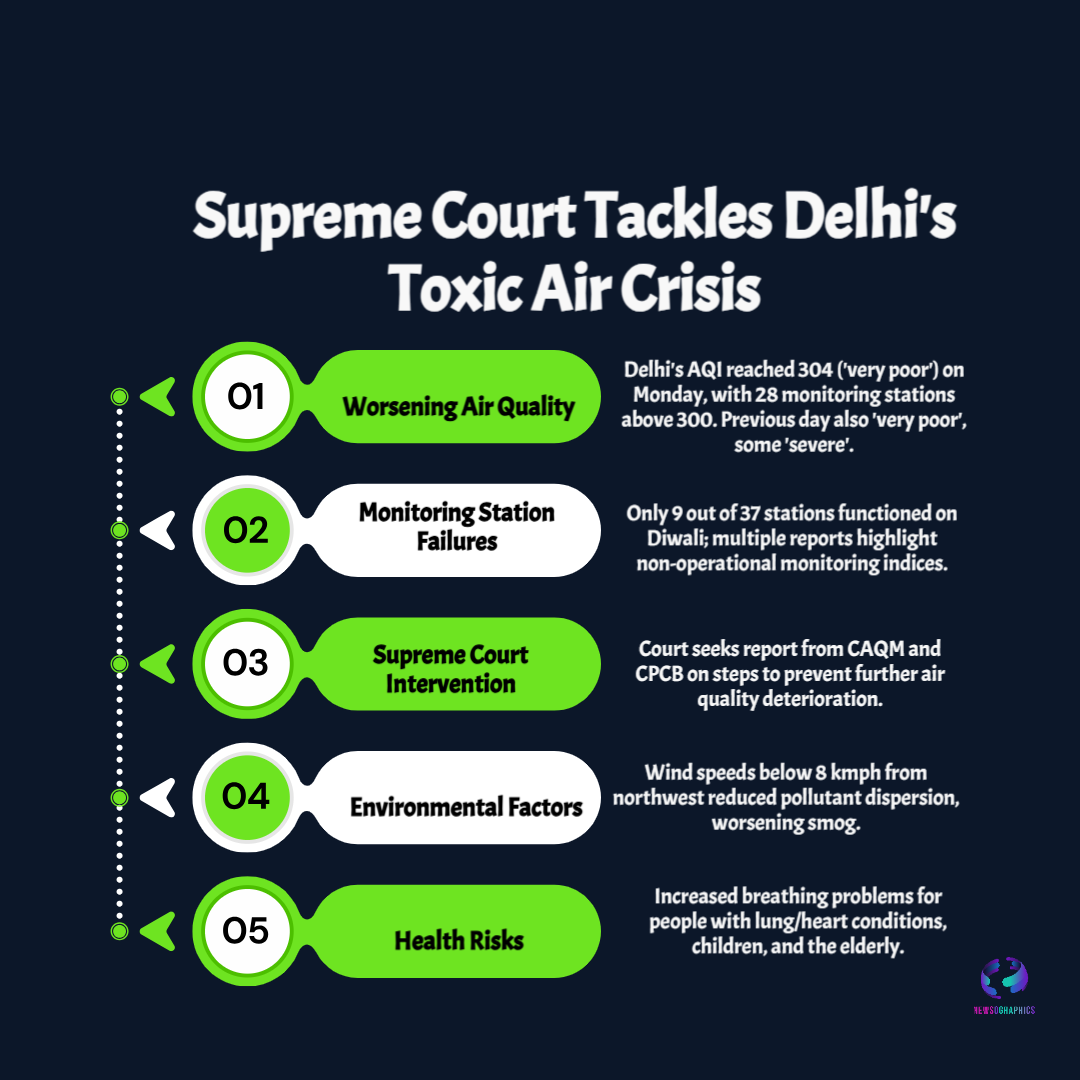
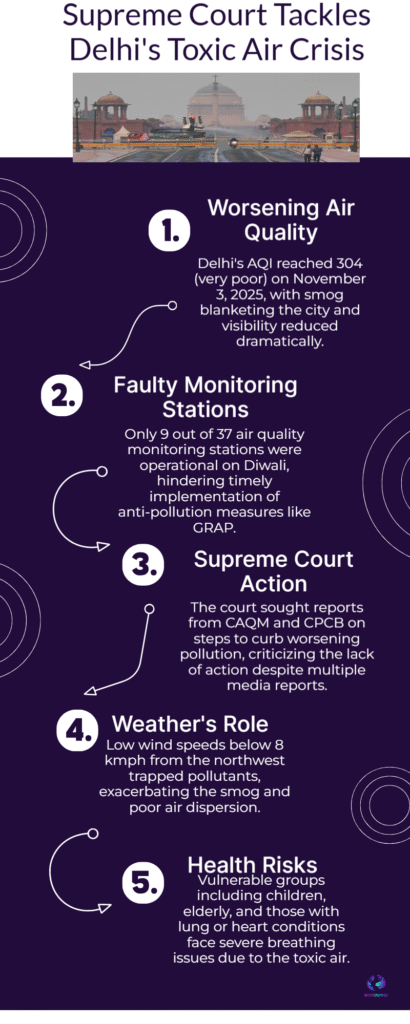
Delhi’s worsening air quality reached the Supreme Court as justices sought reports from CAQM and CPCB on stalled monitoring, failed mitigation measures and urgent steps to curb toxic winter smog.
Supreme Court Questions ‘Reports Without Action’ on Air Pollution
The Supreme Court on Monday heard multiple petitions demanding immediate action on Delhi’s toxic air, noting that “reports after reports” have produced little change on the ground. The bench has directed the Central Pollution Control Board (CPCB) and the Commission for Air Quality Management (CAQM) to submit a detailed status report outlining measures to prevent further deterioration of air quality in the national capital.
Petitioners told the court that several air quality monitoring stations in Delhi are not functioning, undermining timely data collection and emergency response. The hearing highlighted gaps in implementation — from non-operational monitoring instruments to delayed mitigation steps — even as Delhi enters the high-smog season that regularly pushes the city into hazardous AQI levels.
Lawyers and civil society groups argued that repeated reports and committees have failed to translate into tangible outcomes, such as stricter emission enforcement, timely action on crop burning in neighbouring states, or rapid deployment of pollution-control devices in hotspots. The court’s insistence on a concrete action plan signals judicial impatience with passivity and a demand for accountable, measurable steps from both central and state agencies.