



The demolitions of Muslim houses in Karnataka ignites a wider political confrontation, raising questions about governance, federal relations, and rule of law in southern India.

The Incident That Set Off a Wider Debate
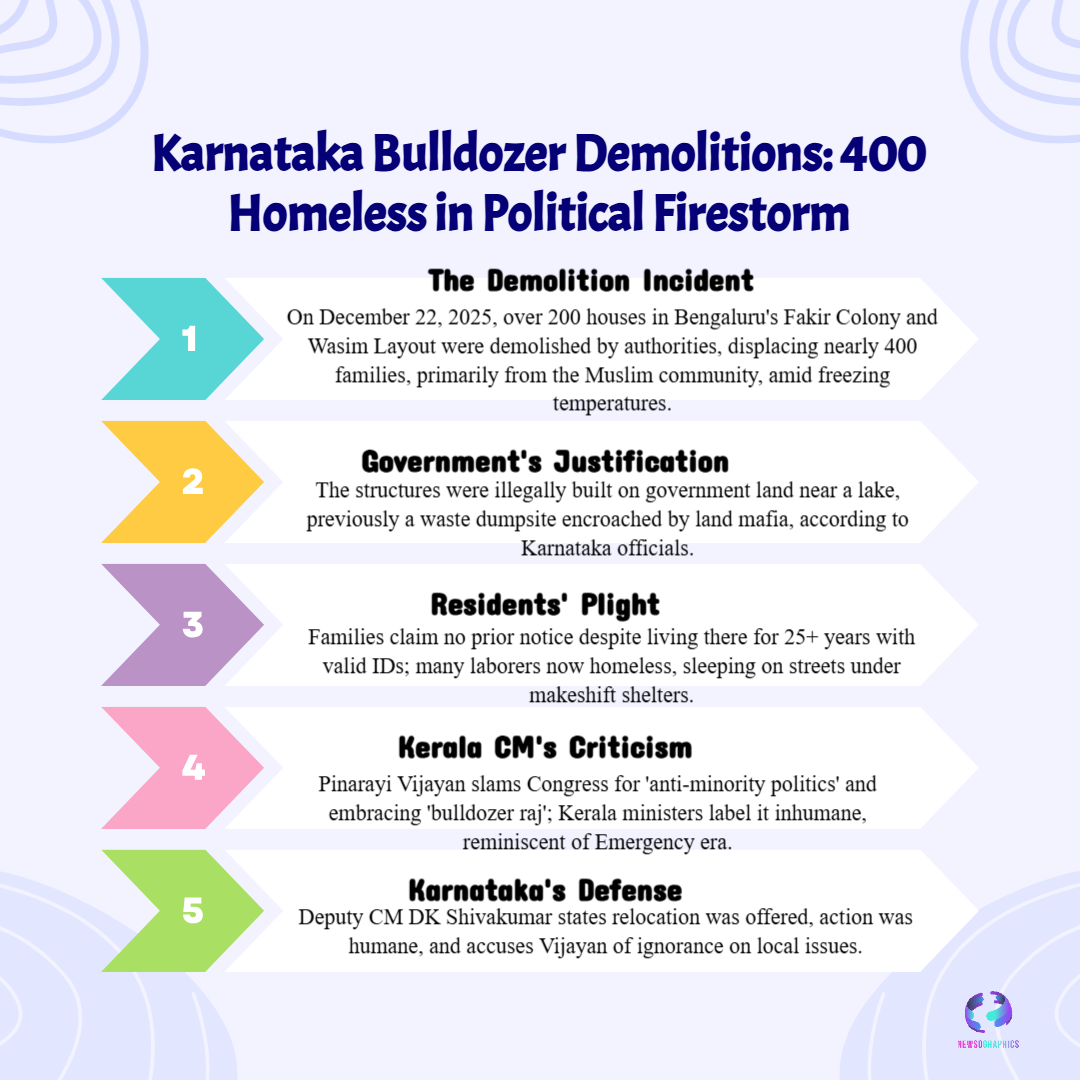
The demolition of residential structures in Karnataka, reportedly belonging to Muslim families, has moved swiftly from a local administrative action into a nationally debated political issue. What began as a law-and-order driven intervention soon evolved into a symbol-laden episode, drawing reactions well beyond state boundaries. The use of bulldozers, already a charged political image in recent years, amplified both public scrutiny and political response.
Beyond the immediate physical destruction, the episode has reopened unresolved questions about the boundaries between administrative enforcement and political messaging. The timing, optics, and selective perception surrounding such actions ensured that the matter would not remain confined to district-level governance.
Bulldozer Politics and Its Expanding Meaning
From Administrative Tool to Political Signal
Bulldozers, traditionally instruments of municipal enforcement, have increasingly been interpreted as markers of assertive governance. In Karnataka’s case, the machinery itself became a visual shorthand for state power, projecting decisiveness while simultaneously inviting allegations of excess.
This symbolic transformation has sharpened political divides. Supporters view demolitions as evidence of firm governance against illegality, while critics argue that such actions risk bypassing due process, particularly when minority communities are involved.
The Legal Versus Perceptual Divide
Even when administrative actions are rooted in statutory provisions, perception plays a decisive role in democratic politics. Demolitions carried out without transparent communication or clearly established procedural safeguards tend to blur the line between enforcement and intimidation, regardless of legal intent.
Political Reactions Beyond Karnataka
Kerala’s Intervention in a Neighboring State’s Affair
The controversy took an inter-state turn when Kerala Chief Minister Pinarayi Vijayan publicly criticized the Karnataka demolitions. His remarks framed the issue as not merely administrative but constitutional, invoking principles of secularism, minority protection, and the rule of law.
Such intervention underscored how governance decisions in one state can resonate politically in another, particularly when ideological contrasts between governments are pronounced. The response highlighted the increasingly nationalized nature of state-level actions.
Federalism Under Pressure
The episode also revived debate around cooperative federalism. While law and order remain state subjects, political commentary across borders reflects a climate where ideological alignment often overrides territorial restraint. This dynamic places federal equilibrium under strain, transforming local incidents into ideological flashpoints.
Minority Rights and the Question of Selectivity
Allegations of Disproportionate Impact
Central to the criticism has been the allegation that demolitions drives disproportionately affect Muslim communities. Whether statistically substantiated or not, such perceptions gain traction in a polarized environment where past precedents inform public interpretation.
The concern extends beyond property loss to the fear of collective stigmatization. When enforcement appears uneven or symbolically targeted, it risks reinforcing narratives of exclusion.
Due Process as a Democratic Safeguard
The debate has re-centered attention on due process as the cornerstone of democratic governance. Notices, hearings, and judicial oversight are not procedural formalities but essential safeguards, particularly in actions with irreversible consequences. Their absence or opacity invites political and legal challenge.
Electoral Undercurrents and Strategic Positioning
Governance as Campaign Messaging
Administrative assertiveness often intersects with electoral strategy. Actions portrayed as decisive can consolidate certain voter bases, even as they alienate others. The Karnataka demolitions are being interpreted through this prism, with opposition parties framing them as politically motivated rather than administratively necessary.
Opposition Consolidation and Narrative Building
For opposition leaders, such incidents provide focal points around which broader narratives of constitutional erosion and majoritarian governance are constructed. The controversy thus serves as both critique and rallying instrument.
The Broader Implications for Governance
Normalization of Extraordinary Measures
One of the lasting concerns emerging from the debate is the potential normalization of extraordinary enforcement measures. When exceptional actions become routine, the threshold for accountability shifts, altering the relationship between the state and citizens.
Institutional Credibility at Stake
Ultimately, the durability of democratic institutions depends on perceived fairness. Episodes like the Karnataka demolitions test that credibility, not only for the state government involved but for governance standards nationally.
Conclusion: A Local Action With National Consequences
The Karnataka house demolitions controversy illustrates how localized administrative decisions can ripple across India’s political and federal landscape. What might have remained a matter of municipal enforcement has become a lens through which issues of minority rights, federalism, and governance philosophy are being contested. As political reactions continue, the episode stands as a reminder that in a deeply interconnected democracy, no action exists in isolation.