




An editorial examination of a Hubballi case involving minors, exploring juvenile crime, legal frameworks, digital misuse, and the broader societal implications.
The Hubballi Incident and Its Immediate Context
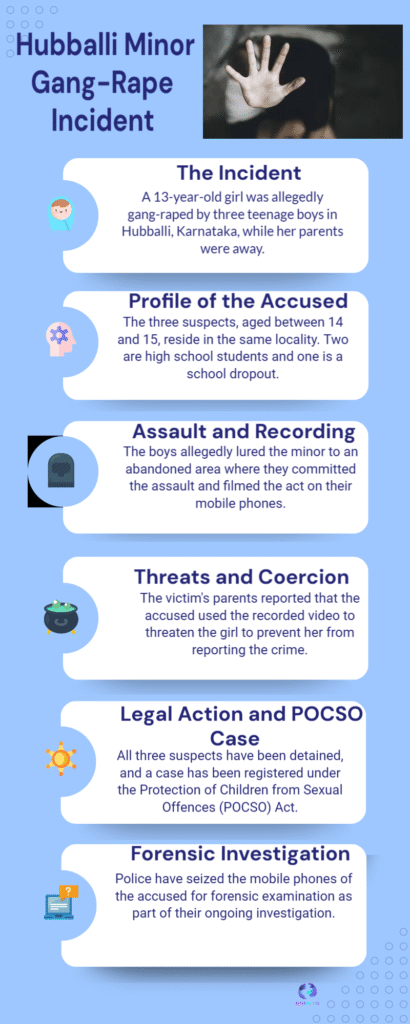
A recent case from Karnataka has once again brought the issue of crimes involving minors into sharp public focus. The Hubballi case, involving teenage boys accused of assaulting a young girl, underscores a troubling intersection of youth violence, peer influence, and the misuse of technology.
What distinguishes this incident from many others is not only the age of those involved, but the deliberate recording of the act, a factor that deepens the gravity of the offence and complicates both legal and social responses.
Juvenile Crime and the Evolving Legal Lens
Age, Accountability, and the Law
India juvenile justice framework is designed to balance accountability with rehabilitation. When offences involve minors on both sides—accused and victim—the legal process becomes layered, requiring careful navigation between punitive action and corrective intervention.
The Hubballi case highlights how the justice system increasingly faces crimes that do not fit older assumptions about juvenile behaviour, particularly when intent, coordination, and concealment are evident.
Detention and Protective Custody Measures
Authorities moved swiftly to detain the accused juveniles under existing child protection and criminal statutes. Such steps are intended not only to secure evidence and prevent further harm, but also to initiate structured legal oversight that limits informal or retaliatory responses from the community.
Digital Exposure and the Amplification of Harm
Recording Violence as a Social Signal
The act of filming an assault transforms a crime into a performative act. In Hubballi case involving minors, this digital layer magnifies trauma and extends the violation beyond the physical moment. The camera becomes both a tool of coercion and a means of social dominance.
This pattern reflects a broader shift in youth crime, where digital validation and peer circulation intensify the severity of offences.
Technology Outpacing Social Preparedness
While legal frameworks increasingly recognise digital evidence, social institutions—schools, families, and community networks—often lag in addressing how technology reshapes adolescent behaviour. The Hubballi case illustrates how unchecked digital access can intersect with immaturity and group psychology in destructive ways.
Child Protection and Institutional Responsibility
Safeguarding the Victim
In cases involving minors, the priority shifts decisively toward protection and confidentiality. Medical care, psychological support, and controlled legal proceedings are essential to prevent secondary victimisation. Public discourse, when unrestrained, risks compounding harm rather than fostering accountability.
Role of Schools and Community Structures
Youth crime rarely emerges in isolation. It reflects gaps in supervision, communication, and early intervention. Educational institutions and local authorities often become reactive participants after harm has occurred, revealing the need for stronger preventative frameworks.
Social Signals and Collective Disquiet
Public Outrage and Moral Reckoning
Incidents involving children trigger intense public emotion, not only because of the crime itself but because they challenge assumptions about safety and innocence. In Karnataka, the case has reignited debates around moral erosion, peer influence, and the adequacy of existing deterrents.
Beyond Individual Blame
While individual culpability is central to justice, such cases also expose systemic vulnerabilities. The convergence of group behaviour, digital exposure, and inadequate social mediation suggests broader societal accountability rather than isolated deviance.
Reading the Case as a Warning Marker
The Hubballi minor assault case stands as a stark indicator of changing patterns in youth-related crime. It reveals how age no longer functions as a reliable proxy for vulnerability or innocence, and how technology can accelerate harmful behaviour before social systems can respond.
More than a singular crime, the episode reflects a moment of reckoning—where law, society, and institutions must confront uncomfortable realities about children growing up in environments shaped by digital immediacy, weakened supervision, and fragmented moral boundaries.