



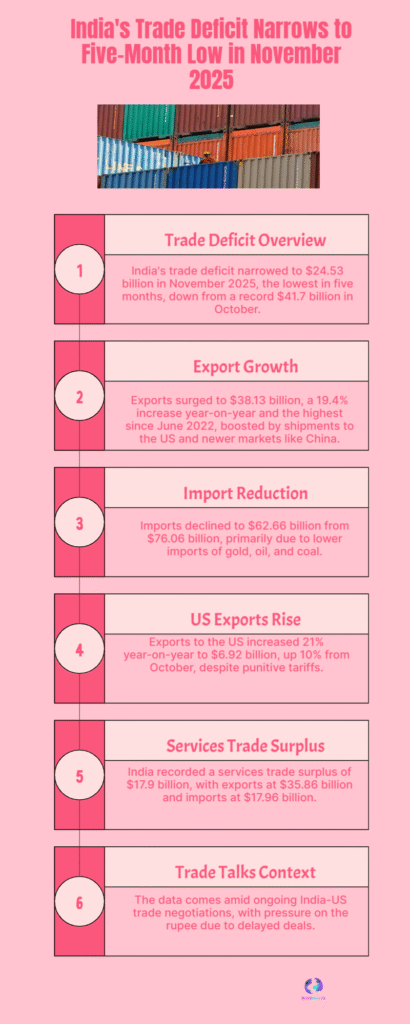
India’s trade deficit eased to a five-month low in November as exports to the United States strengthened, reflecting shifting global demand and resilient trade dynamics.
A Notable Shift in India’s Trade Balance
India’s trade deficit narrowed to a five-month low in November, marking a meaningful shift in the country’s external trade position. The improvement was driven primarily by a pickup in exports to the United States, alongside a moderation in import growth. Together, these factors offered a breather after months of pressure from volatile commodity prices and uneven global demand.
Trade data for November suggests that India’s exporters are beginning to find firmer footing in key overseas markets, even as broader global trade conditions remain uncertain. The narrowing deficit signals a more balanced flow of goods, which can help stabilize currency movements and improve macroeconomic confidence.
Strengthening Demand from the United States
Exports to the United States emerged as a key contributor to November’s improved trade numbers. Several Indian export categories, including engineering goods, pharmaceuticals, and select manufactured products, showed renewed traction in the American market.
This momentum reflects both steady consumer demand in the US and a gradual realignment of supply chains, where Indian manufacturers are gaining space amid diversification away from single-country sourcing. For exporters, the US continues to represent a high-value market with relatively stable demand compared to other regions facing sharper slowdowns.
Sectoral Performance and Export Mix
While no single sector accounted for the entire improvement, the export basket benefited from a combination of value-added goods and traditional strengths. Engineering exports, in particular, have been supported by infrastructure-related demand, while pharmaceuticals maintained consistent shipments due to their essential nature.
The diversification of export categories has helped cushion India against sudden drops in any one segment, contributing to a more resilient overall export profile.
Imports Show Signs of Moderation
On the import side, growth remained contained in November. Lower or stable prices for certain commodities, combined with cautious domestic demand, helped prevent a sharp rise in import bills. Energy imports, a major driver of trade deficits in the past, did not exert the same level of pressure during the month.
This moderation is significant because imports often react quickly to global price swings. A period of relative calm can provide policymakers with space to focus on longer-term trade competitiveness rather than short-term volatility.
Global Context and External Pressures
India’s improving trade balance comes against a complex global backdrop. Slowing growth in parts of Europe and uneven recovery in Asia continue to weigh on international trade flows. At the same time, geopolitical uncertainties and shifting monetary policies influence currency movements and capital flows.
Within this environment, India’s ability to sustain export growth to large markets like the United States is closely watched. A narrower trade deficit does not eliminate external risks, but it does suggest that India is navigating global headwinds with some degree of flexibility.
Implications for the Economy
A lower trade deficit can have several positive implications for the broader economy. It reduces pressure on the current account, supports currency stability, and can improve investor sentiment. For businesses, stronger exports often translate into better capacity utilization and improved earnings visibility.
However, the sustainability of this trend will depend on external demand conditions and domestic cost competitiveness. Temporary gains driven by a single market or short-term price movements may not be sufficient on their own.
Outlook: Cautious Optimism Ahead
November’s trade figures offer cautious optimism rather than a definitive turning point. Continued strength in exports to the United States could help anchor India’s trade performance in the coming months, especially if supported by stable commodity prices and steady domestic production.
As global trade patterns continue to evolve, India’s challenge will be to build on this momentum through diversified markets, higher-value exports, and efficient supply chains. The narrowing trade deficit in November provides a constructive signal, but its durability will be tested by developments in the global economy.