

In Dec 2025, India and the US jointly called on the UN to impose asset freezes, arms embargoes and travel bans on Pakistan-based terror groups and their proxies — a major move in global counter-terror efforts.
What’s Happening: The Call for Stricter UN Action
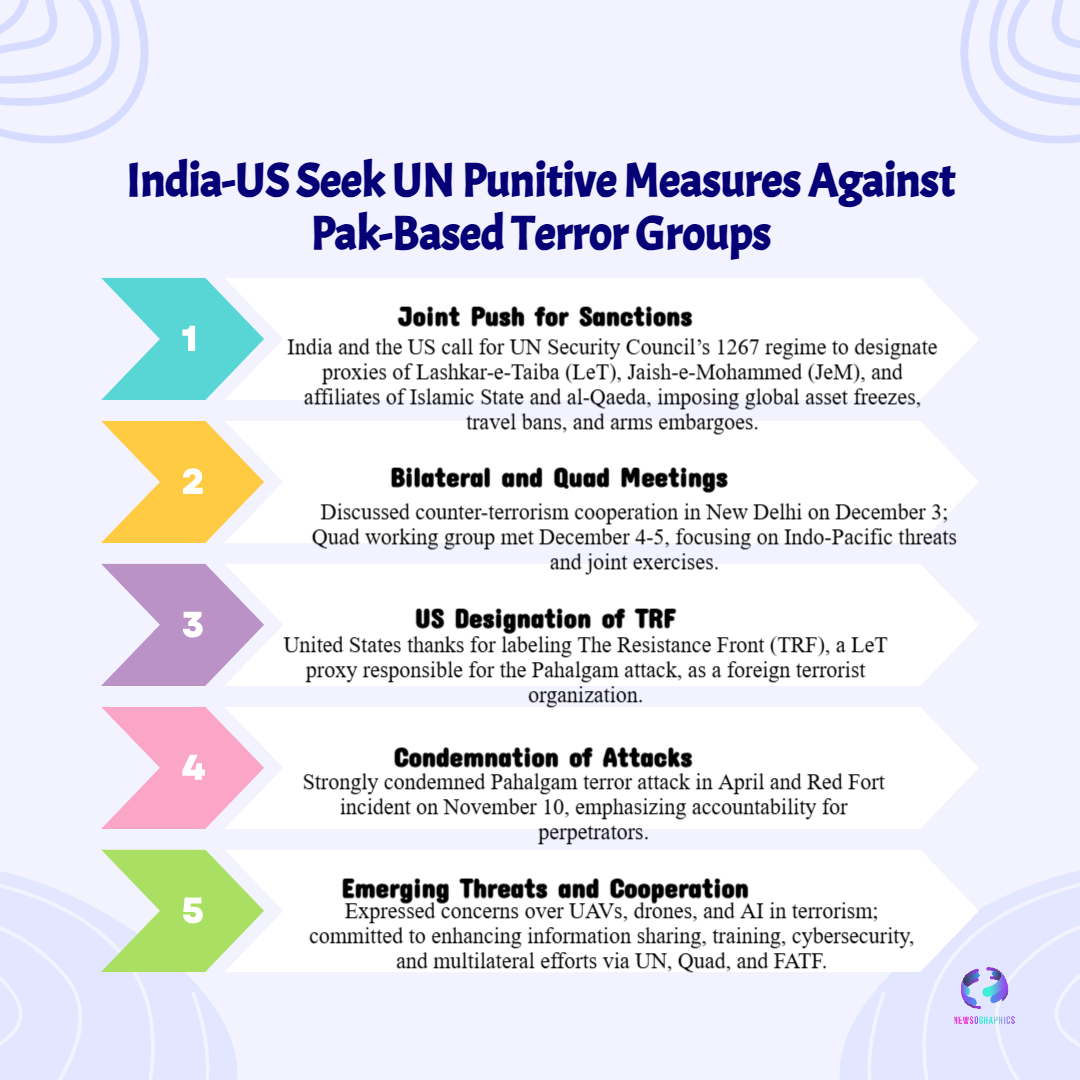
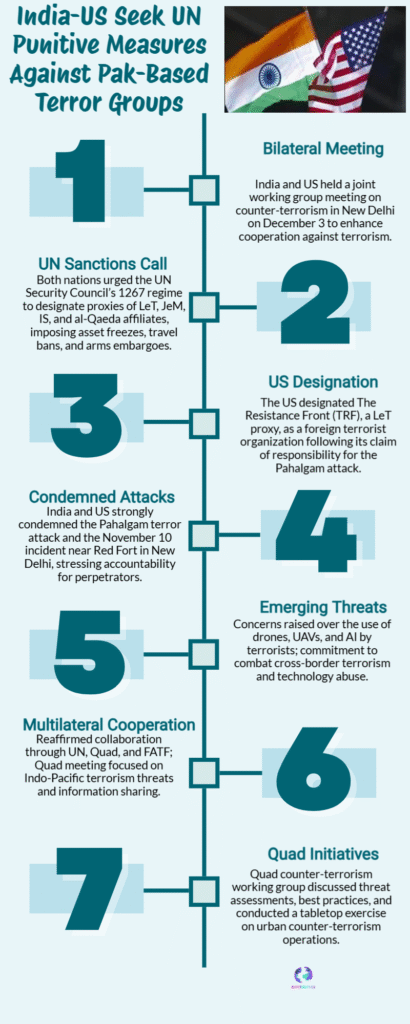
- On December 6, 2025, India and the United States issued a joint statement calling on the United Nations to impose additional punitive measures under the “1267 sanctions regime” on Pakistan-based terror outfits such as Lashkar‑e‑Taiba (LeT) and Jaish‑e‑Mohammed (JeM), as well as their proxy groups, financiers, backers and affiliates.
- The measures sought include global asset freezes, travel bans, and an arms embargo on these organisations and their networks — aiming to choke their finances, international mobility and access to weapons.
- The demand also extends to additional designations for affiliates of Islamic State (ISIS) and Al‑Qaeda under the same UN sanctions framework.
Why This Matters — Strategic and Global Security Implications
⚠️ Putting Terror Finance and Logistics Under International Scrutiny
By targeting not just the core groups but their financiers, backers and proxy networks, these sanctions aim to sever supply lines — financial, logistical and operational — essential for terror operations. The global freeze on assets and restrictions on travel and arms would significantly limit the groups’ capacity to fund attacks, recruit overseas or procure weapons.
🌐 Elevates Counterterrorism from Bilateral to Multilateral Action
With both India and the US pushing the UN to act, the move signals a push to make counter-terrorism enforcement a global responsibility rather than an India-Pakistan bilateral issue. It creates pressure on other UN member states to comply and tighten scrutiny over terror-linked individuals/entities.
🔎 Recognition of Evolving Terror Threats: Proxies, Financing & Technology Use
The joint statement emphasised that terror threats have evolved — including the use of proxies, complex financial networks, and emerging technologies (like drones or AI) for militant purposes. The expanded UN sanctions call matches this evolving threat environment.
What It Means for India — Short-Term & Long-Term Gains
- India strengthens its diplomatic stance on cross-border terrorism, taking the fight to international fora rather than limiting it to regional security or military responses.
- By involving the UN, India may pave the way for broader consensus on global terror financing norms — potentially reducing safe havens or external support for terror groups.
- On a strategic level, the push signals to Pakistan and any proxy networks that international isolation — not just bilateral pressure — is on the table.
Challenges & Uncertainties: Will the Push Succeed?
- For sanctions to be effective, the UN — including all major powers — must agree, implement, and enforce them rigorously. Given the geopolitical complexity, consensus may be hard.
- Terror networks may attempt to evade sanctions by rebranding, using shell entities, or shifting financing methods — meaning enforcement and intelligence coordination must be strong and ongoing.
- Sanctions alone may not dismantle terror infrastructure; complementary measures — intelligence sharing, policing, regional cooperation — remain crucial.
Why the 2025 Push Could Mark a Turning Point
This joint effort by India and the US represents one of the most assertive attempts in recent years to internationalize the fight against groups long accused of destabilizing regional security. By using the UN sanctions mechanism, they aim to elevate counterterrorism from national or regional policing to a global security priority — one with teeth, if backed by international cooperation.
If successful, this could shift the global baseline for how terror groups and their networks are treated: not as regional nuisances, but as global threats needing coordinated, multilateral disruption.