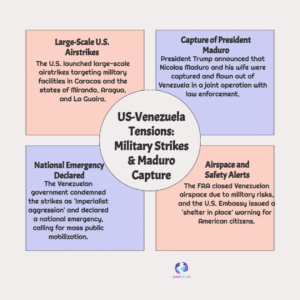



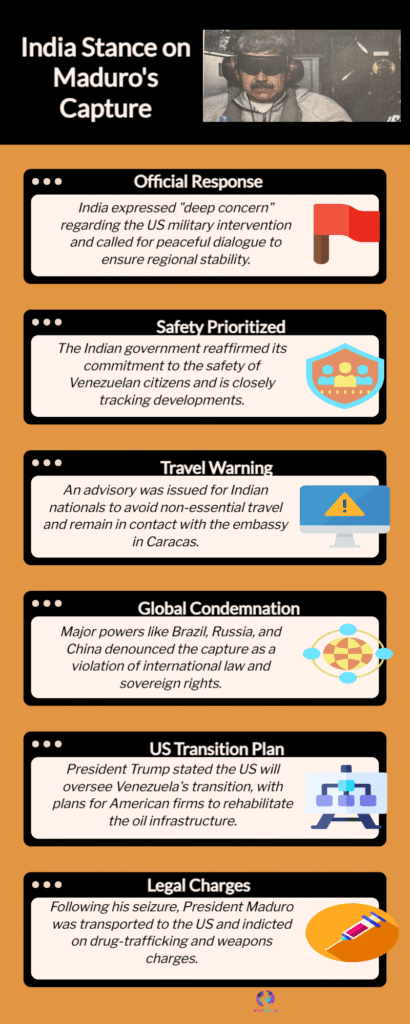
India reacts with strong diplomatic caution after former US President Donald Trump’s remarks on capturing Venezuela’s President Nicolás Maduro, underscoring principles of sovereignty and international law.
India Statement That Sparked International Attention
India Comments attributed to Donald Trump regarding the possible capture of Venezuelan leader Nicolás Maduro have drawn widespread attention across diplomatic and political circles. India remarks, made in a charged political context, quickly moved beyond domestic discourse and entered the realm of international concern due to their implications for state sovereignty and accepted global norms.
India statements, even when rhetorical, tend to resonate internationally because they involve the fate of a sitting head of state and touch upon the use of force or coercion beyond national borders.
Sovereignty and the Limits of Political Rhetoric
At the core of the reaction lies the principle of sovereignty, a cornerstone of international relations. Suggestions involving the capture of a foreign leader raise fundamental questions about legality, jurisdiction, and the boundaries of political speech. In the modern diplomatic environment, words from influential figures are often interpreted as signals, shaping perceptions and sometimes policy expectations.
The episode illustrates how political rhetoric can blur lines between expression and implied action, especially when it references direct intervention in another country’s leadership.
Venezuela’s Prolonged Political Crisis
Venezuela’s internal turmoil has persisted for years, marked by economic collapse, political fragmentation, and international disagreement over legitimacy and governance. Against this backdrop, external statements about President Maduro carry heightened sensitivity. They risk reinforcing entrenched positions, complicating mediation efforts, and amplifying uncertainty within an already fragile political landscape.
The controversy surrounding the remarks reflects how Venezuela remains a focal point for broader ideological and geopolitical contestation.
International Law and Norm-Based Order
Global reactions to the statement highlight enduring concerns about adherence to international law. The idea of capturing a sitting president intersects with norms governing non-intervention, due process, and the peaceful resolution of disputes. Even hypothetical or provocative language can challenge these norms by normalising the notion of unilateral action.
For many observers, the situation underscores the importance of restraint and clarity in political communication, particularly when addressing conflicts that involve multiple international stakeholders.
Broader Geopolitical Implications
Beyond Venezuela, the remarks contribute to a wider debate about the tone and direction of global politics. In an era defined by rapid information flow and heightened polarisation, statements by prominent political figures can escalate tensions far beyond their original audience.
The incident serves as a reminder that global stability is influenced not only by actions but also by words, especially when they touch on power, intervention, and leadership.
A Moment Reflecting Contemporary Global Politics
The reaction to Trump’s comments encapsulates the delicate balance between political expression and diplomatic responsibility. While the remarks themselves may not translate into policy, their impact illustrates how rhetoric can reverberate across borders, shaping narratives and raising concerns about respect for international norms.
In this sense, India is less about a single country’s response and more about the collective sensitivity of a global system where sovereignty, legality, and stability remain deeply interconnected.