

The Delhi High Court has held the Centre and IndiGo responsible after domestic airfares surged up to ₹40,000 amid mass flight cancellations triggered by new crew-rest rules and pilot shortages. Key takeaways from the ruling, regulatory failures and what this means for passengers.
Introduction
The past week has been tumultuous for India’s civil aviation sector. Amid a wave of flight cancellations by IndiGo — India’s largest domestic airline — travellers witnessed domestic airfares soaring artificially to as high as ₹40,000–₹65,000. On 10 December 2025, the Delhi High Court issued a strong rebuke to both the government and the airline, directing compensation for stranded passengers and demanding accountability for regulatory lapses. What exactly went wrong, and what are the broader implications for Indian aviation?
What triggered the IndiGo crisis?
New crew-duty norms and sudden shortage of pilots
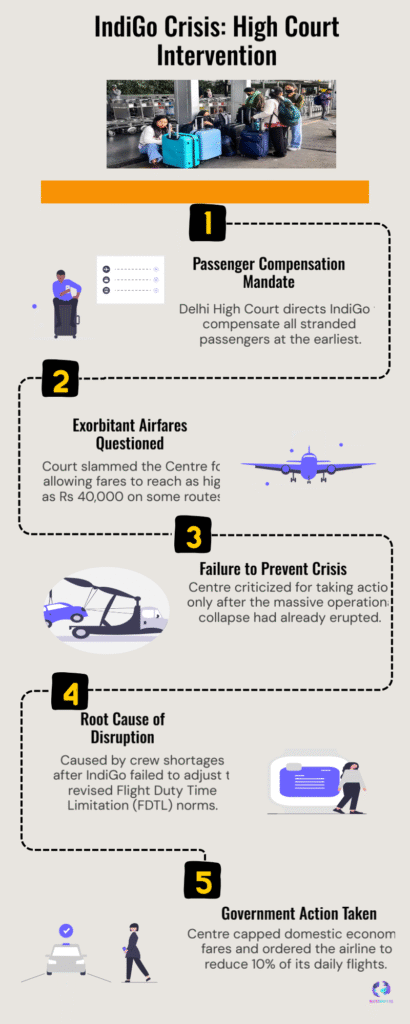
At the core of the disruption are revised crew rest and duty regulations — specifically the Flight Duty Time Limitation (FDTL) norms — that came into effect from 1 November 2025. These rules mandate stricter rest periods and limit night flying, intended to reduce fatigue and improve flight safety. Many airlines, particularly IndiGo, were however unprepared. Crew rostering fell short, leading to a sharp drop in available cockpit crews and forcing the airline to cancel hundreds of flights daily.
Domino effect: cancellations, fatigue and fare surge
With the cancellations, demand for the remaining flights surged. But supply could not keep pace. Airlines — including those other than IndiGo — reportedly raised fares steeply. On certain busy routes (e.g. Delhi–Mumbai), one-way tickets reached ₹65,460, indicating a 3–4x increase over typical fares.
The spike in prices and chaotic cancellations left thousands of passengers stranded at airports without clear communication, alternative travel plans, refunds or luggage delivery.
What the Delhi High Court said — and why it matters
On 10 December 2025, a division bench led by Chief Justice Devendra Kumar Upadhyaya delivered a scathing judgment on both the airline and the government. Among the court’s key observations and directives:
- The court called the entire situation “alarming,” pointing out that the crisis was not just about inconvenience to passengers, but had broader economic repercussions.
- It questioned how other airlines were allowed to hike fares to ₹35,000–₹40,000 during the crisis. “You allowed the situation to precipitate,” the court rebuked.
- It mandated that the airline compensate passengers stranded due to the cancellation of thousands of flights.
- The court also sought a detailed report from the government on what steps had been taken to ensure airline staff treated stranded passengers properly, with refunds, baggage delivery, and basic care.
- Finally, it demanded clarity on why the crisis was allowed to erupt in first place — specifically why the authorities did not foresee the manpower shortfall or prevent fare exploitation.
The next hearing is scheduled for 22 January 2026.
Government and Regulatory Response so far
Fare-caps & forced schedule cuts
In response to the fare surge, the Ministry of Civil Aviation (MoCA) directed a temporary cap on domestic economy-class fares, attempting to curb exploitative pricing. Initially, the cap was set around ₹7,500–₹18,000 depending on distance.
Simultaneously, regulators ordered the abridgement of the winter schedule for IndiGo — slashing its flights by 5–10%. On some days, this meant over 200 flights cancelled daily.
Regulatory review and slot reallocation threats
The Directorate General of Civil Aviation (DGCA), together with the Ministry of Civil Aviation, has launched a review of the crisis. There are indications the government may reallocate IndiGo’s flight slots to rival carriers, as a part of punitive response or to balance the market.
Some pilot unions and experts, however, argue that the crisis was “artificially created” by IndiGo — to pressure the government into reversing or easing FDTL norms.
Why this crisis is more than “just airline mismanagement”
Exposure of structural fragility in Indian aviation
The disruption exposed how heavily the domestic air travel market depends on a single airline. With market-leader IndiGo controlling a large share of flights, a single operational failure cascades into a nationwide crisis.
It also revealed inadequate long-term workforce planning — despite regulatory rollouts (like FDTL norms) announced well in advance, there was insufficient pilot recruitment and roster adjustments.
Economic and societal ripple effects
Besides stranding thousands of passengers, the crisis impacted business travel, tourism, time-sensitive commitments like medical visits or weddings — many of which were disrupted. The court’s mention of “broader economic impact” underlines this ripple effect.
Regulatory accountability and consumer rights
The High Court’s ruling marks a significant moment in affirming passenger rights and regulatory accountability. By demanding compensation and judicial scrutiny, the court sends a strong signal that systemic failures — whether due to corporate mismanagement or lax oversight — cannot be swept under the rug.
What happens next — What to watch
- The upcoming hearing on 22 January 2026 will be crucial: the court may demand a detailed government-led investigation into how the crisis unfolded and whether negligence or procedural lapses occurred.
- The fate of newly implemented FDTL norms: whether they are rolled back, modified, or strictly enforced will set a precedent for aviation safety vs. operational feasibility.
- Whether flight-slots are permanently reallocated from IndiGo could reshape competitive dynamics in Indian aviation, potentially reducing overreliance on a single carrier.
- Wider push for systemic reforms — better manpower planning, stricter oversight on fare surges, assured passenger compensation and protection — could emerge, altering airline-passenger dynamics.