



IndiGo rises to the top of India’s international aviation market as domestic flight disruptions reshape airline capacity, routes, and competitive dynamics.
Shift in India’s Aviation Landscape
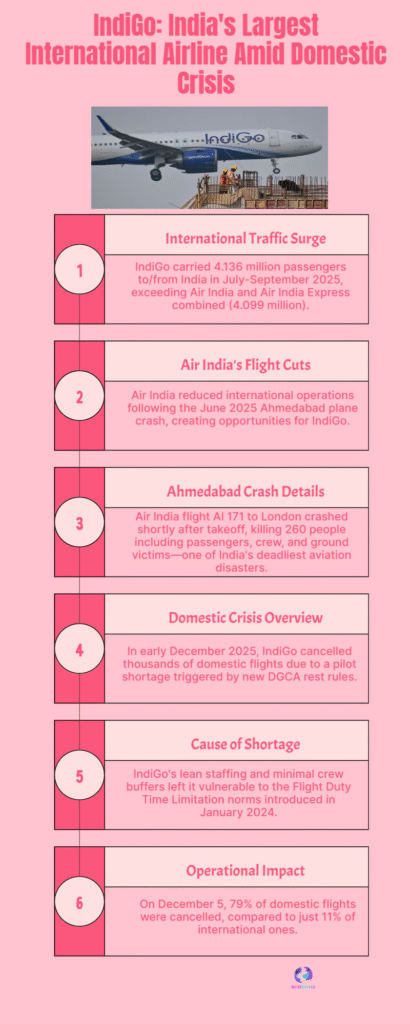
IndiGo has emerged as India’s largest international airline, marking a significant shift in the country’s aviation sector at a time when domestic operations are facing sustained disruptions. The development reflects changing capacity deployment across airlines and highlights how international routes have become a strategic anchor amid operational pressures at home.
The airline’s growing international footprint has allowed it to consolidate market share even as domestic flight schedules across the industry remain under strain.
Factors Behind IndiGo’s International Rise
Strategic Focus on Overseas Routes
IndiGo’s expansion into international markets has been driven by a deliberate focus on short- and medium-haul destinations with strong passenger demand. By steadily adding overseas routes and increasing frequencies, the carrier has strengthened its presence beyond Indian borders.
This strategy has proven particularly effective as airlines reassess network priorities in response to aircraft availability and operational challenges.
Operational Consistency Amid Industry Constraints
While parts of the domestic aviation sector grapple with fleet and scheduling disruptions, IndiGo’s operational consistency on international routes has helped it maintain capacity. This reliability has translated into higher utilization of its international fleet, reinforcing its leadership position.
Domestic Flight Disruptions Reshape Competition
Pressure on Domestic Capacity
Domestic air travel has faced intermittent disruptions due to a combination of operational constraints and logistical challenges. Reduced aircraft availability and rescheduled services have limited growth on home routes, prompting airlines to rebalance their networks.
As a result, international operations have gained increased importance in sustaining overall traffic and revenues.
Competitive Realignment Among Airlines
The current environment has altered competitive dynamics within the industry. Airlines with stronger international networks are better positioned to absorb domestic volatility, while others remain focused on stabilizing core operations.
IndiGo’s scale and route diversity have enabled it to capitalize on this realignment.
Implications for Passengers and the Market
Expanded International Connectivity
For travelers, IndiGo’s rise as the largest international carrier translates into wider connectivity options and more direct routes. Increased capacity on overseas sectors has helped meet demand for international travel, particularly on regional and high-traffic corridors.
Pricing and Market Stability
Greater international capacity can also influence fare trends by introducing competitive pricing on select routes. While market conditions remain fluid, sustained international operations provide a measure of stability during periods of domestic uncertainty.
What IndiGo’s Growth Signals for Indian Aviation
IndiGo’s position underscores a broader shift in how Indian airlines are navigating operational challenges. International markets are no longer peripheral but central to growth strategies, especially when domestic conditions are unpredictable.
As the aviation sector works through its current constraints, the balance between domestic recovery and international expansion is expected to define the next phase of competition. IndiGo’s ascent illustrates how strategic focus and scale can reshape leadership in a rapidly evolving market.