


As IndiGo cancels over 1,000 flights across India, the government steps in — capping airfares, ordering refunds by December 7, and demanding directions to restore normalcy. What travellers need to know.
What Triggered the Crisis
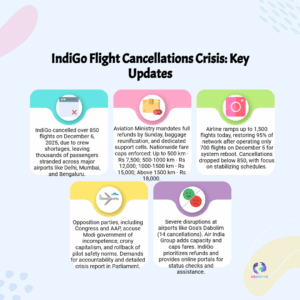
In early December 2025, IndiGo — the largest domestic airline in India — began cancelling hundreds of flights daily. After over 1,000 flights were cancelled on a single day, the knock-on impact disrupted travel plans for thousands of passengers across the country.
The airline attributed these cancellations to operational challenges following new regulations around pilot and crew duty-time limitations. As rosters struggled to accommodate these new norms, IndiGo faced a sudden shortage of available crew — leading to widespread flight disruptions.
On Saturday, the crisis entered its fifth day, prompting the government to step in.
Government Response: Airfare Caps, Refund Deadlines, and Oversight
🔹 High-Level Intervention
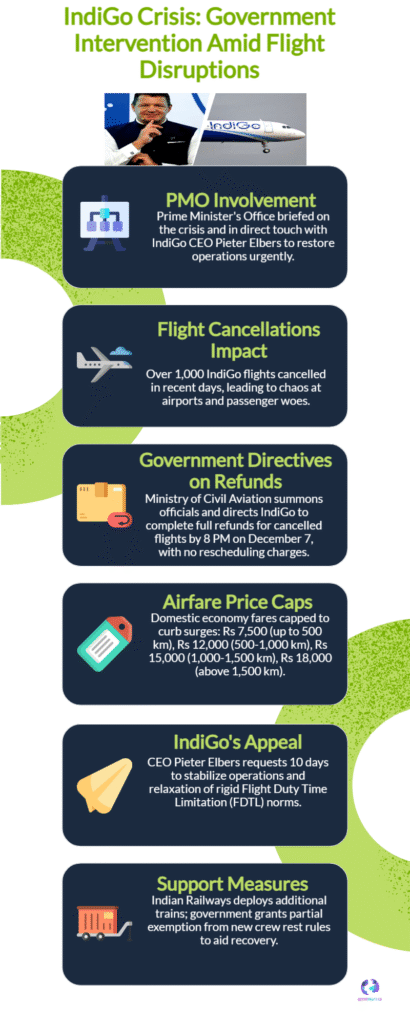
- The office of the country’s Prime Minister (PMO) was briefed on the crisis, and the government asked the airline’s top management to restore operations “at the earliest.”
- A 4-member panel under the Directorate General of Civil Aviation (DGCA) has been constituted to investigate the root causes, focusing on crew rostering, compliance, and planning lapses.
🔹 Passenger Relief Measures
- The Ministry of Civil Aviation (MoCA) ordered IndiGo to clear all pending refunds for cancelled or disrupted flights by 8:00 PM on Sunday, December 7, 2025.
- Rescheduling fees were to be waived, and passengers were given the option of a full refund or free rebooking.
- The government capped domestic economy-class airfares, to prevent price gouging that followed acute seat shortages and spiking demand. For example: fares capped at ₹7,500 for routes up to 500 km, ₹12,000 for 500–1,000 km, ₹15,000 for 1,000–1,500 km, and ₹18,000 for distances beyond 1,500 km (excluding business or special-category flights).
- Airlines were instructed to ensure delivery of any separated baggage within 48 hours, set up dedicated passenger-support/refund cells, and maintain transparent communication with affected customers.
What This Means for Passengers
- If your flight with IndiGo was cancelled, you are entitled to a full refund or free rebooking — you should check the “Manage Booking” section on IndiGo’s site or app for options.
- No rescheduling fee should be charged for disrupted flights — the waiver is valid until the situation stabilises.
- With fare caps, avoid paying inflated last-minute fares — capped rates apply to economy-class travel across domestic routes (with specified distance bands) during the crisis period.
- It’s advisable to confirm flight status and refund eligibility well ahead of travel — especially if you booked close to mid-December, when operations may still be stabilizing, according to IndiGo’s own estimates.
Broader Implications: Aviation, Regulation, and Passenger Rights
The IndiGo fiasco underscores several structural issues in India’s aviation sector:
- Regulatory changes — like new pilot duty-time norms — need to be backed by robust operational planning and workforce sizing. Rolling out such changes without preparation can lead to systemic breakdowns rather than smoother operations.
- The crisis triggered significant consumer disruption, forcing the government to invoke exceptional regulatory powers: fare caps, mandatory refunds, and oversight — setting a precedent for how sizeable airlines may be regulated in future crises.
- It also raises questions about market concentration: when one airline carries a dominant share of domestic traffic, any disruption at that carrier can ripple across the entire travel ecosystem, amplifying chaos for passengers nationwide.
- Finally, this episode highlights the importance of legally backed passenger rights: refund guarantees, rebooking options, and protections against price gouging seem to have been critical relief measures — and might become reference points for future airline-consumer regulation.
What to Watch for in the Coming Days
- Will the inquiry by DGCA lead to concrete accountability or policy changes regarding crew rostering and workload norms?
- As operations stabilize, will other airlines ramp up capacity — or will travel demand shift temporarily away from IndiGo?
- Will the government consider long-term safeguards (beyond temporary fare caps) to prevent such disruption: e.g. diversification of carriers, stricter oversight, or smoother regulatory rollouts?
- For travellers: monitor refund processing deadlines, baggage return schedules, and fare ceilings — and consider alternative travel modes (rail, other airlines) if your itinerary remains uncertain.
The 2025 IndiGo crisis is more than a short-term disruption — it’s a stress test for India’s aviation infrastructure, consumer protection framework, and regulatory readiness. For passengers, staying informed about refunds, fare caps, and evolving flight-status updates will be crucial in the coming days.