


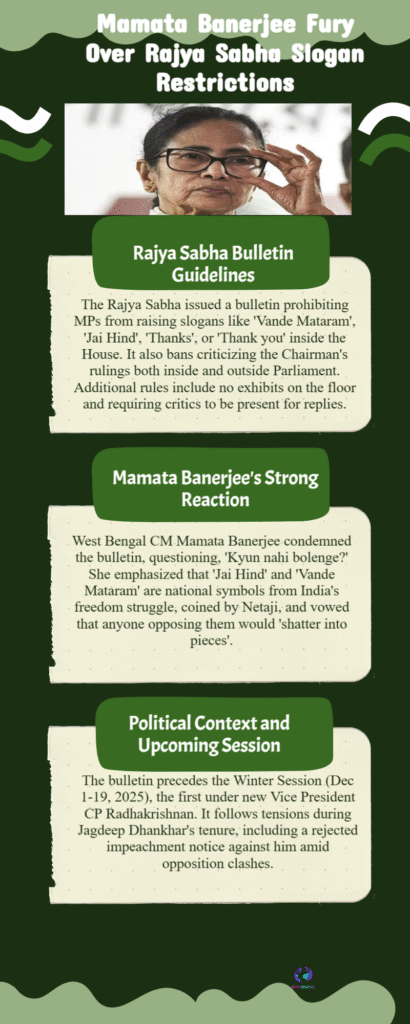
West Bengal CM Mamata Banerjee vehemently attacks the ‘curb’, framing it as an attack on freedom and national identity. A major political firestorm erupts after the Rajya Sabha Secretariat re-issues a parliamentary bulletin prohibiting Vande Mataram and Jai Hind slogans in the House.
Mamata Banerjee Vande Mataram Rajya Sabha Controversy
A fresh and explosive political controversy has erupted, pitting the administrative machinery of the Parliament against one of the nation’s most vocal opposition leaders, West Bengal Chief Minister Mamata Banerjee. The trigger is a seemingly innocuous, yet highly charged, advisory released by the Rajya Sabha Secretariat ahead of the crucial upcoming Winter Session. The bulletin, detailing essential parliamentary decorum and etiquette for Members of Parliament (MPs), explicitly reminded lawmakers to refrain from raising any slogans—including the revered phrases ‘Vande Mataram’ and ‘Jai Hind’—inside the Upper House.
Mamata Banerjee, head of the Trinamool Congress (TMC), responded with visible and immediate fury from Kolkata, challenging the rationale behind restricting what she termed the ‘slogans of India’s freedom struggle.’ Her emotional outburst, captured by the phrase, “Kyun nahin bolega?” (Why won’t we say it?), has instantly converted a procedural notice into a heated debate about national pride, political expression, and the sanctity of parliamentary rules.
Addressing the media, the veteran politician powerfully asserted that both ‘Jai Hind’ and ‘Vande Mataram’ are more than just slogans; they represent the national song and the very essence of the nation’s struggle for independence. “These are our national songs, the slogans of our freedom. ‘Jai Hind’ is Netaji Subhas Chandra Bose’s slogan. Whoever dares to clash with this idea will be shattered into pieces,” she warned, indicating that her party would not stand silent on this matter. She further raised the pertinent question of whether this administrative action, originating in Delhi, was an attempt to symbolically erase or undermine the cultural and political identity of West Bengal, a state deeply rooted in the history of these phrases.