




Meghalaya Police and BSF have dismissed reports alleging illegal entry of Bangladesh murder suspects into the state, calling the narrative misleading and unfounded.
Official Rebuttal to Circulating Claims
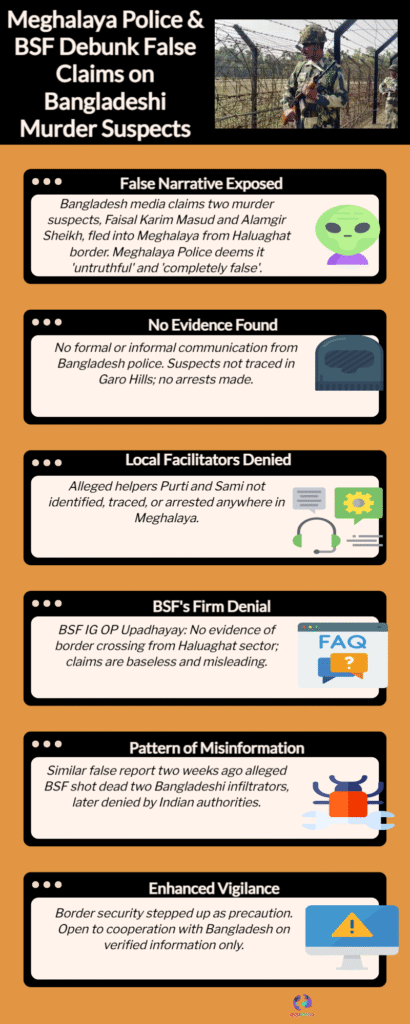
Authorities in Meghalaya have firmly pushed back against claims suggesting that suspects involved in a murder case in Bangladesh entered Indian territory through the state. Both the Meghalaya Police and the Border Security Force have termed the narrative speculative and misleading, stressing that no verified evidence supports such assertions. The rebuttal comes amid heightened public attention to border-related incidents and cross-border crime narratives.
Officials clarified that preliminary checks, intelligence inputs, and routine border surveillance have not indicated any unlawful entry linked to the said case. The insistence on facts over conjecture has been positioned as essential to maintaining public trust and avoiding unnecessary alarm.
The Context Behind the Narrative
The India–Bangladesh border in Meghalaya is frequently discussed in media and public discourse due to its terrain and socio-cultural ties across boundaries. Against this backdrop, unverified reports can gain traction quickly, especially when linked to serious crimes. Security agencies acknowledged that while vigilance remains high, not every allegation aligns with operational realities.
The present claims, according to officials, emerged without corroboration from ground-level intelligence or cross-border coordination mechanisms. This gap between rumor and verification prompted the joint clarification.
Role of Border Surveillance and Coordination
Multi-Layered Monitoring Systems
The BSF emphasized that border management in Meghalaya involves continuous patrolling, electronic surveillance, and coordination with local police units. These systems are designed to detect unusual movement and respond swiftly to credible threats. In the current instance, none of these layers flagged activity matching the circulating claims.
Intelligence Sharing Channels
Cross-border intelligence sharing with Bangladeshi counterparts forms another pillar of monitoring. Officials indicated that no alerts or requests linked to the alleged suspects were communicated through official channels, reinforcing the conclusion that the narrative lacked substance.
Addressing Public Concerns and Misinformation
Authorities highlighted the broader impact of unchecked misinformation, particularly in sensitive regions. Speculative reports can strain community relations, create anxiety, and undermine confidence in law enforcement. By issuing a clear denial, the Meghalaya Police and BSF sought to reaffirm transparency and accountability.
The statement also underscored that genuine security concerns are addressed through established procedures, not media conjecture. Any confirmed cross-border criminal activity, officials noted, would trigger coordinated action rather than public ambiguity.
Border Security Beyond Headlines
While dismissing the specific claims, agencies reiterated their ongoing commitment to border security. Meghalaya’s border areas continue to see routine reviews, infrastructure upgrades, and personnel deployment adjustments based on evolving assessments. The denial was framed not as complacency but as a fact-based response rooted in operational checks.
Maintaining Credibility in Security Reporting
The episode has renewed calls within official circles for responsible reporting on security matters. Authorities urged that narratives involving cross-border crime be grounded in verification, given their potential diplomatic and social implications. In regions where borders intersect with daily life, accuracy remains as critical as vigilance.
By rejecting the false narrative, Meghalaya Police and the BSF have sought to close the gap between rumor and reality, reinforcing that border security discourse must rest on evidence rather than assumption.