

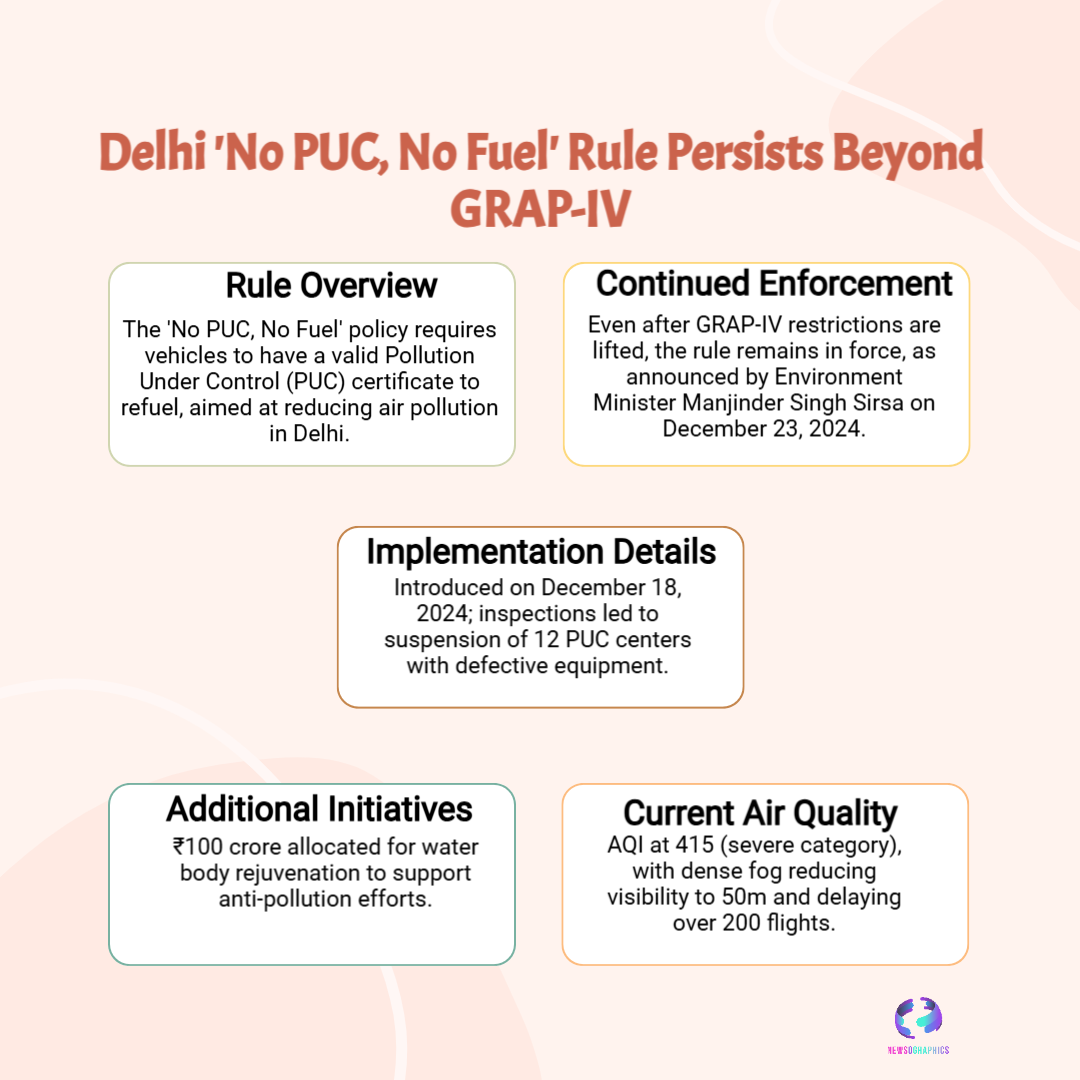
Delhi confirms the continuation of the ‘No PUC, No Fuel’ rule beyond GRAP-IV restrictions, reinforcing long-term air pollution control and compliance measures.
A Policy That Outlives Emergency Measures
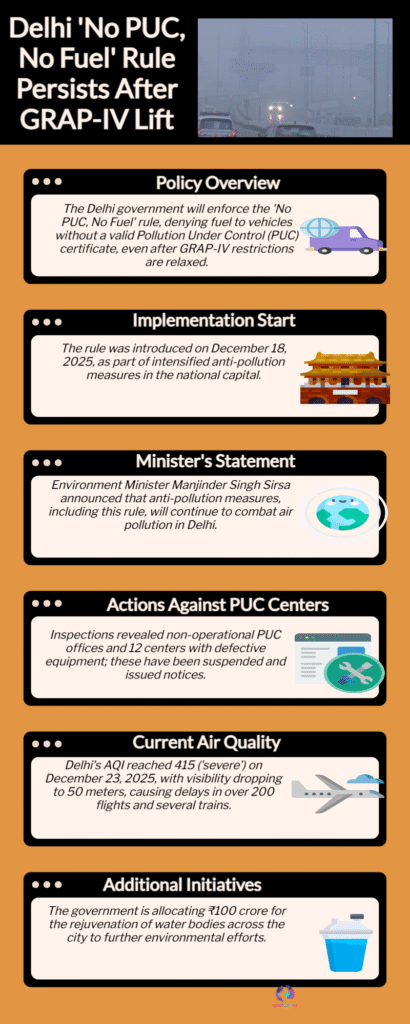
Delhi’s decision to retain the ‘No PUC, No Fuel’ rule even after the lifting of GRAP-IV restrictions signals a shift from episodic crisis management to sustained environmental regulation. While GRAP stages are designed as temporary responses to acute air quality deterioration, the continuation of this rule embeds compliance into everyday civic life.
The move reflects an acknowledgement that air pollution in the capital is not merely seasonal or episodic but structural, requiring persistent enforcement rather than short-term clamps.
Understanding the Role of PUC in Pollution Control
What the PUC Framework Represents
The Pollution Under Control (PUC) certification system functions as a baseline regulatory tool, intended to ensure that vehicles on the road adhere to emission norms. By linking fuel access directly to valid certification, authorities effectively transform a compliance document into an operational necessity.
This linkage elevates the PUC from a periodic formality to a daily checkpoint, altering how vehicle owners perceive emission responsibility.
From Paper Compliance to Practical Enforcement
Historically, weak enforcement diluted the impact of PUC norms. The ‘No PUC, No Fuel’ mechanism introduces immediacy into compliance, reducing the gap between regulation and consequence. Fuel stations become enforcement nodes, decentralising oversight without expanding bureaucratic layers.
GRAP-IV and the Transition to Long-Term Controls
Emergency Response Versus Structural Policy
GRAP-IV represents the most stringent tier under the Graded Response Action Plan, activated during severe air quality episodes. Measures under this stage are intentionally disruptive, prioritising immediate relief over convenience.
By retaining the PUC-linked fuel restriction beyond GRAP-IV, Delhi signals that certain emergency tools are now being reclassified as permanent policy instruments, blurring the line between crisis response and routine governance.
Administrative Clarity and Policy Consistency
Continuity in enforcement offers administrative clarity. Frequent policy reversals often breed confusion and selective compliance. A stable rule framework reduces ambiguity for enforcement agencies, fuel retailers, and vehicle owners alike.
Impact on Urban Mobility and Public Behaviour
Behavioural Reset for Vehicle Owners
When fuel access becomes contingent on emission compliance, behavioural change follows. Vehicle owners are compelled to maintain engines, monitor emissions, and regularise documentation. Over time, this can recalibrate norms around vehicle upkeep in a city dominated by private transport.
Such behavioural shifts, though incremental, accumulate into measurable environmental outcomes.
Pressure Points in a Vehicle-Heavy City
Delhi’s dense vehicle population makes transport regulation politically sensitive. Any restriction affecting daily mobility resonates widely. By choosing a rule rooted in compliance rather than blanket bans, authorities attempt to balance environmental necessity with functional mobility.
Environmental Signalling and Policy Messaging
A Message Beyond Enforcement
The continuation of the rule serves a symbolic function as much as a regulatory one. It communicates that clean air policies are no longer negotiable or temporary. Environmental accountability is framed as a permanent civic obligation rather than a seasonal inconvenience.
This messaging aligns with broader national and global narratives around sustainable urban living.
Aligning Local Action With Broader Climate Goals
While the rule operates at a city level, it dovetails with wider emission reduction objectives. Urban transport remains a major pollution source, and sustained controls in a megacity like Delhi carry disproportionate environmental significance.
Governance, Compliance, and the Road Ahead
Delhi’s insistence on maintaining the ‘No PUC, No Fuel’ rule beyond GRAP-IV marks a governance choice rooted in continuity rather than reaction. It reflects an understanding that environmental recovery demands consistency, not just urgency.
As the city grapples with chronic air pollution, such measures redefine the relationship between policy and public behaviour. The rule’s endurance suggests that in Delhi’s environmental playbook, compliance is no longer episodic—it is the baseline.