


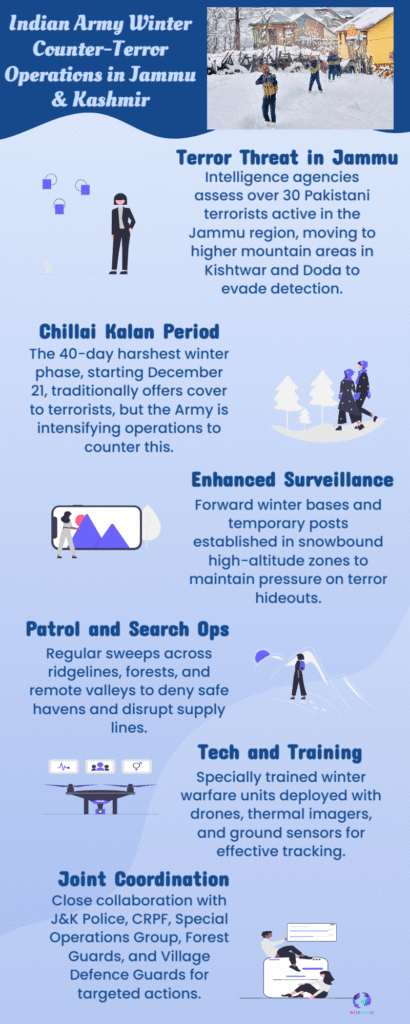
Indian Army intensifies winter operations in Jammu and Kashmir amid intelligence inputs indicating the presence of over 30 Pakistani terrorists during Chillai Kalan.
Winter Tightens the Security Lens in Kashmir
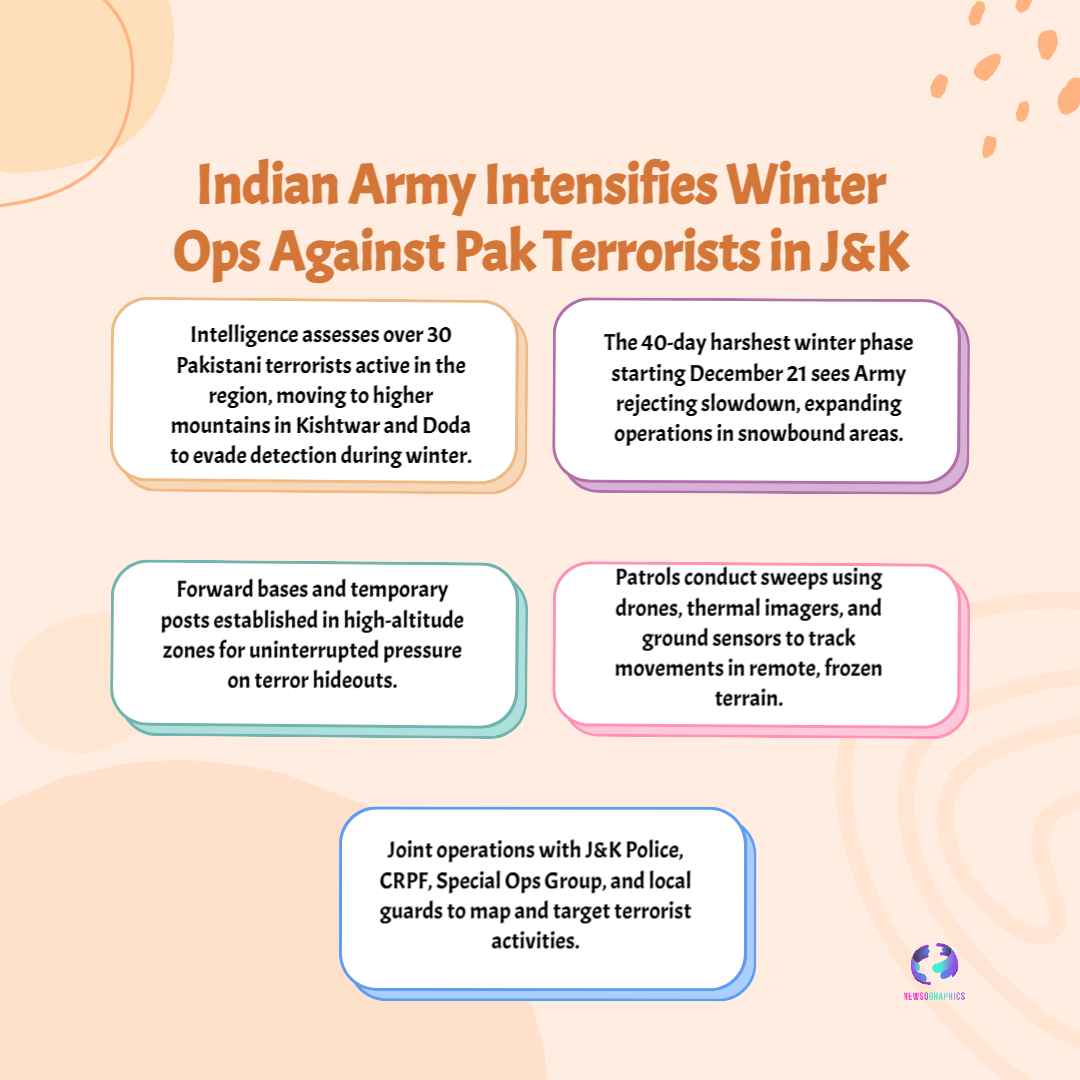
As Kashmir enters the harshest phase of winter, security dynamics in the region assume renewed urgency. Chillai Kalan, marked by freezing temperatures and heavy snowfall, traditionally slows civilian movement but sharpens military focus. This year, the season coincides with heightened alertness following intelligence assessments pointing to the active presence of over 30 Pakistani terrorists across parts of Jammu and Kashmir.
The convergence of climatic severity and security concern has prompted a recalibration of counter-terror operations, with the Indian Army positioning winter not as a constraint but as a strategic window.
Intelligence Inputs and the Current Threat Landscape
Security agencies have indicated that multiple terrorist modules remain operational despite sustained counter-insurgency pressure. These elements are believed to be strategically dispersed, aiming to exploit terrain familiarity, forest cover, and seasonal gaps in movement. The assessment underscores that infiltration attempts and local facilitation networks continue to pose challenges even as overall violence metrics fluctuate.
Rather than signaling escalation alone, the intelligence points to persistence—a reminder that terrorism in the region adapts to conditions rather than retreating from them.
Army’s Winter Operations Strategy
Sustained Presence in Extreme Conditions
Winter operations in Jammu and Kashmir are characterized by high-altitude deployments, extended patrols, and logistics-intensive planning. The Army’s approach emphasizes maintaining domination over vulnerable corridors, ensuring that snowbound routes do not become safe havens for militant regrouping.
Troops are trained and equipped to operate in sub-zero conditions, allowing operations to continue even when civilian life slows to a standstill.
Targeted Searches and Area Domination
The operational focus during Chillai Kalan includes intensified search operations in forested belts and mountainous zones. These areas, often less accessible during winter, are systematically monitored to prevent terrorists from using the season as cover for survival and planning.
The emphasis remains on precision rather than visibility, with intelligence-led actions forming the backbone of the strategy.
Chillai Kalan as a Tactical Phase
Chillai Kalan has long been viewed as a decisive phase in Kashmir’s security calendar. Historically, militant activity adapts during this period, with reduced movement but increased reliance on local support and hidden shelters. Security forces, aware of this pattern, align winter deployments accordingly.
The current operations reflect an understanding that winter can constrict options for terrorists, making sustained pressure more effective if applied consistently.
Cross-Border Dimension and Infiltration Concerns
The reference to Pakistani terrorists highlights the enduring cross-border dimension of militancy in the region. Infiltration routes, while impacted by snow and weather, are not rendered obsolete. Instead, attempts often become more calculated, relying on timing and reduced visibility.
The Army’s winter posture aims to neutralize these advantages by ensuring that surveillance and patrol intensity does not diminish with falling temperatures.
Implications for Regional Security
The continued presence of active terrorists underscores that stability in Jammu and Kashmir remains contingent on sustained vigilance. Winter operations serve not only as immediate counter-terror measures but also as deterrent signals against attempts to exploit seasonal vulnerabilities.
For local populations, the intensified security presence reflects a preventive approach—one designed to contain threats before they translate into violence during more accessible months.
A Season of Resolve
The intensification of winter operations during Chillai Kalan reinforces a broader message of operational continuity. By maintaining pressure in the most challenging conditions, the Army seeks to deny terrorist groups the tactical pauses they once relied upon.
As winter deepens across Jammu and Kashmir, the security establishment’s focus remains clear: to ensure that cold and terrain do not become allies of militancy, but variables accounted for in a sustained campaign against terror.