


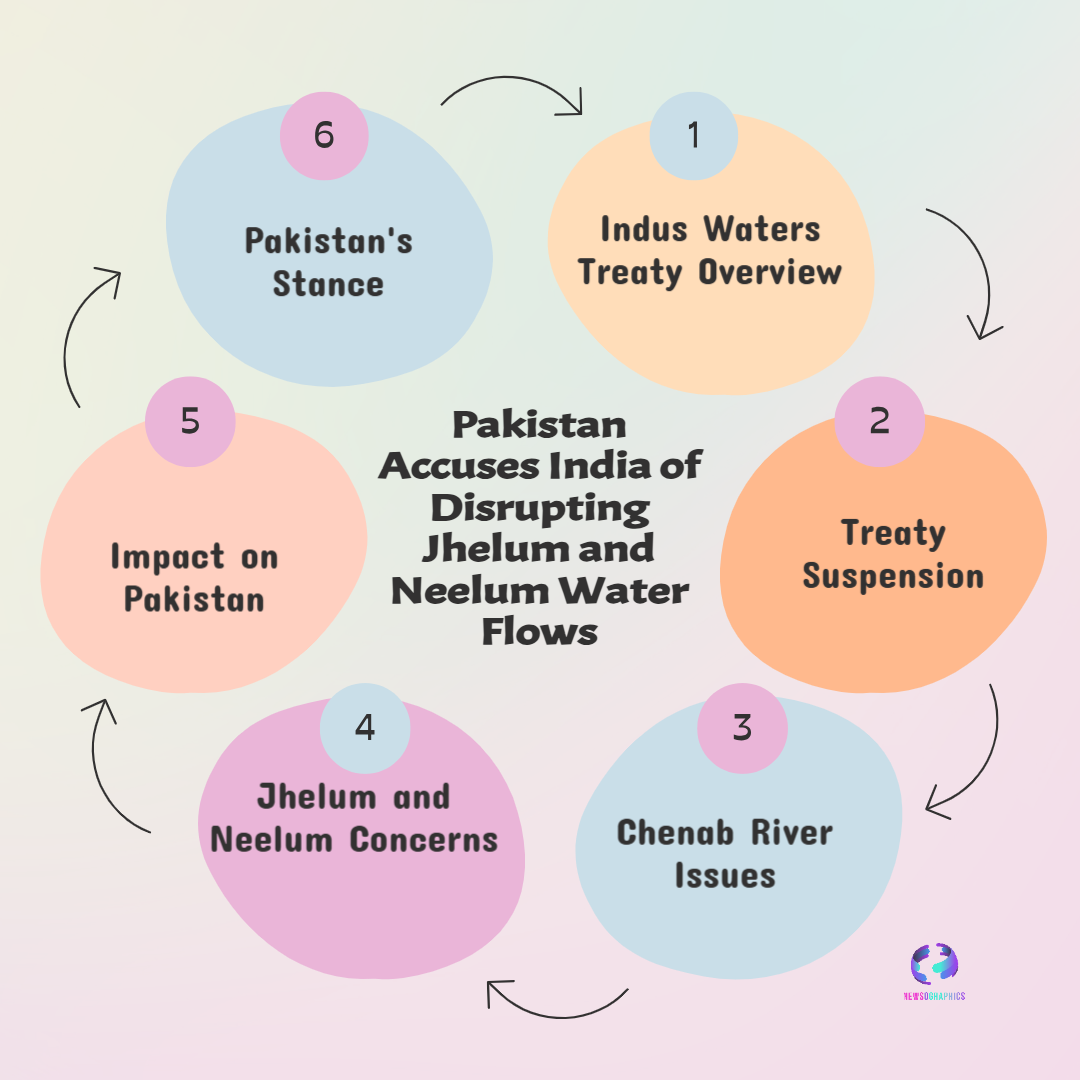
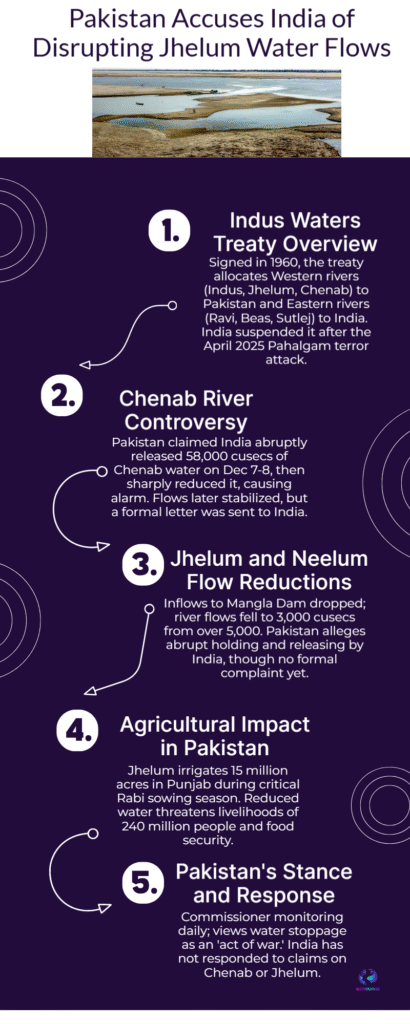
Allegations over disruptions in the Jhelum river flow revive tensions between Pakistan and India, placing the Indus Waters Treaty under renewed diplomatic and strategic scrutiny.
Water Once Again at the Centre of Bilateral Strain
Water has resurfaced as a sensitive fault line in India–Pakistan relations, with allegations of disrupted flows in the Jhelum river reigniting long-standing anxieties over shared river systems. The issue has quickly moved beyond technical hydrology into the realm of diplomacy, sovereignty, and regional stability.
India-Pakistan, rivers are not merely natural resources but strategic lifelines. Any perceived imbalance in access or control tends to trigger political responses shaped by history and mistrust.
The Jhelum River’s Strategic Significance
A Lifeline Through a Contested Landscape
The Jhelum river occupies a critical place in the Indus basin, flowing through regions where geography and geopolitics intersect. Its waters support agriculture, energy generation, and livelihoods across borders, making it acutely sensitive to upstream-downstream dynamics.
Because of this significance, even temporary or technical changes in flow patterns can be interpreted as deliberate acts, especially in an environment where bilateral trust remains fragile.
Hydrology Meets Politics
River management is inherently complex, influenced by seasonal variation, infrastructure projects, and climatic conditions. Yet in South Asia’s political context, technical explanations often struggle to outweigh political interpretations. Allegations of disruption, whether structural or incidental, are quickly absorbed into broader strategic narratives.
The Indus Waters Treaty Under Renewed Scrutiny
A Framework Built to Withstand Conflict
The Indus Waters Treaty has long been cited as one of the most resilient water-sharing agreements in the world. Designed to survive wars and diplomatic breakdowns, it established mechanisms for allocation, data exchange, and dispute resolution across the Indus basin, including the Jhelum and Chenab rivers.
However, resilience does not imply immunity. Periodic tensions test the treaty’s capacity to manage evolving political and environmental pressures.
Modern Pressures on a Historic Agreement
Infrastructure expansion, population growth, and climate variability have introduced new stresses into a framework crafted in a different era. Each new allegation or objection adds to the perception that the treaty is being stretched by contemporary realities, even as it remains the primary reference point for engagement.
Pakistan’s Concerns and Strategic Messaging
Framing Water as a Security Issue
For Pakistan, water security is inseparable from national security. Agriculture-dependent regions rely heavily on predictable river flows, and any uncertainty is framed as a threat with long-term consequences. Allegations concerning the Jhelum thus resonate domestically as matters of survival rather than diplomacy.
The emphasis on treaty obligations reflects an effort to internationalise concern while anchoring arguments within an established legal framework.
Domestic and International Dimensions
Raising such issues also serves a dual audience. Domestically, it signals vigilance over vital resources. Internationally, it positions Pakistan as a stakeholder seeking adherence to agreed norms rather than unilateral control.
India’s Position and the Question of Compliance
Infrastructure, Rights, and Treaty Interpretation
India has consistently maintained that its projects and water management practices fall within treaty provisions. From this perspective, variations in flow are framed as outcomes of natural or operational factors rather than intentional disruption.
The divergence lies less in the treaty text and more in how actions are interpreted through political lenses shaped by broader bilateral tensions.
Silence, Signals, and Diplomatic Calculus
In water disputes, restraint often functions as strategy. Responses are carefully calibrated to avoid escalation while preserving legal and diplomatic positions. This measured approach reflects an understanding that water issues, once politicised, are difficult to de-escalate.
Regional Implications Beyond Bilateral Ties
Water Stress in a Changing Climate
South Asia faces increasing water stress due to erratic monsoons, glacial melt, and rising demand. Disputes over rivers like the Jhelum highlight how environmental pressures can amplify political fault lines, turning shared resources into contested assets.
These dynamics underscore the urgency of cooperative mechanisms in a region where rivers ignore borders even when politics does not.
Precedents for Transboundary River Governance
How India and Pakistan navigate renewed tensions over river flows will be closely observed across the region. The Indus basin serves as a reference point for other transboundary water systems, making its management a broader test of conflict-resolution frameworks.
A Familiar Dispute in a Shifting Context
The resurfacing of allegations over the Jhelum river reflects a familiar pattern in India–Pakistan relations, where unresolved issues cyclically regain prominence. What has changed is the context: climate uncertainty, infrastructure expansion, and hardened political narratives have made water disputes more complex and symbolically charged.
As attention returns to the Indus Waters Treaty, the episode reinforces a persistent reality of South Asian geopolitics—shared rivers demand cooperation, but enduring mistrust ensures that water remains as political as it is elemental.