

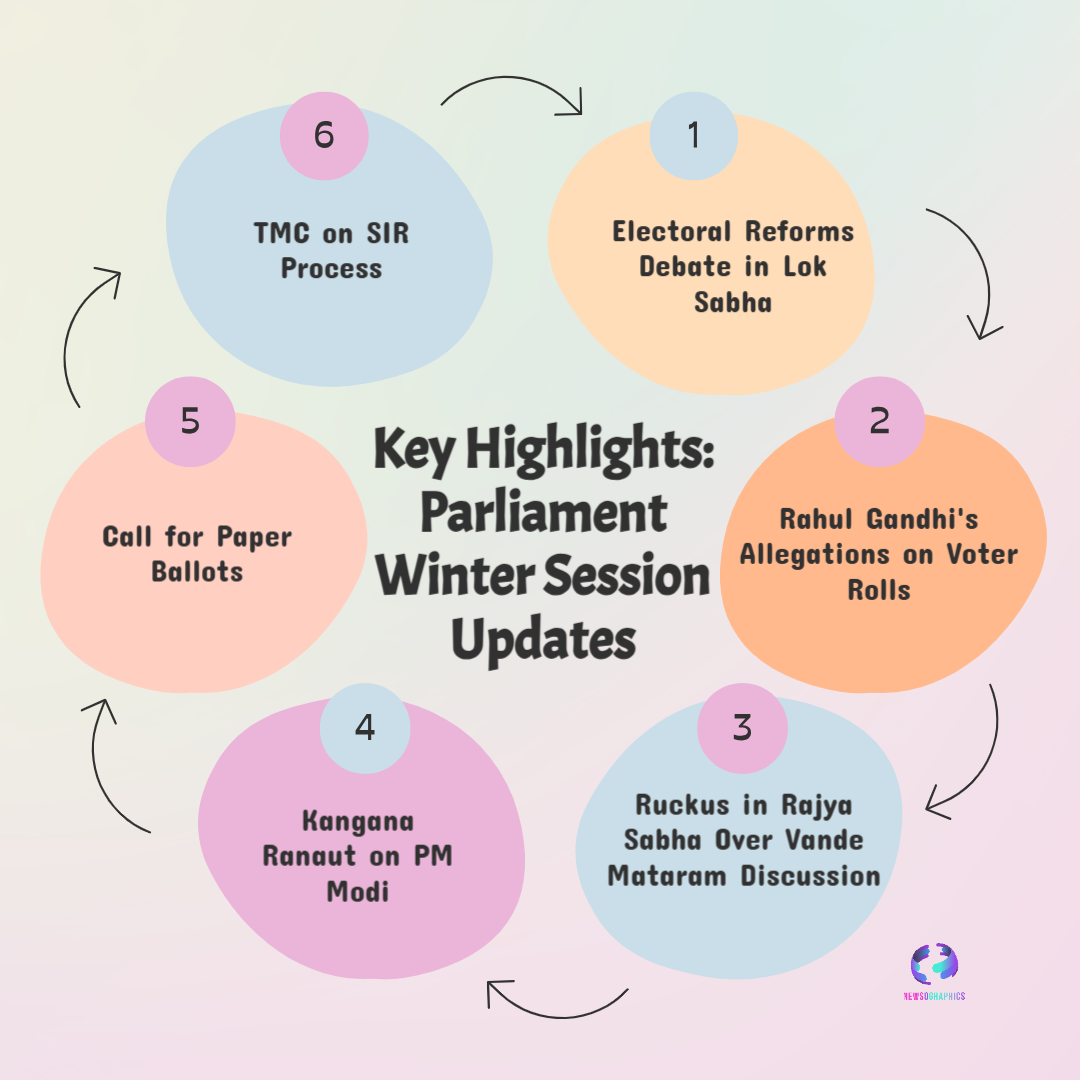
The 2025 Parliament Winter Session saw charged debates in Lok Sabha and Rajya Sabha over Vande Mataram, national security, governance, and opposition protests. Here’s a detailed editorial breakdown of the major issues shaping the session.
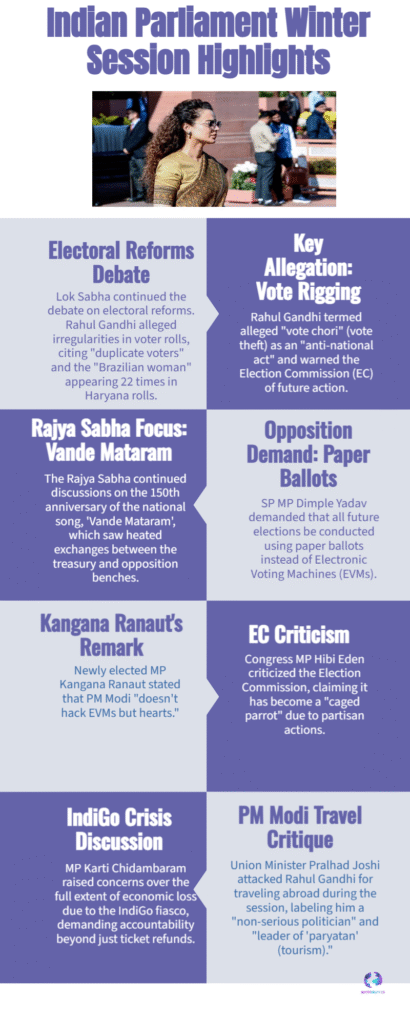
The Winter Parliament Session Opens Amid Heightened Political Tension
India’s 2025 Winter Session of Parliament began on a charged note, setting the stage for confrontational debates and sharp ideological clashes. With multiple contentious issues placed on the agenda — from constitutional expressions like Vande Mataram to governance, economic concerns, and national security — both Houses witnessed heated exchanges between the Treasury benches and the Opposition.
What was meant to be a legislative-heavy session quickly turned into a political battleground, reflecting the polarised mood of national politics.
Vande Mataram Sparks Ideological Debate in Rajya Sabha
The discussion that ignited the session
A key flashpoint emerged when members in the Rajya Sabha initiated a debate surrounding Vande Mataram, its historical context, and its place in Indian national identity. The discussion, intended to be symbolic, soon turned into a larger ideological tug-of-war.
Some MPs argued that Vande Mataram represented India’s anti-colonial spirit and remained integral to national consciousness, while others raised concerns over forcing symbolic expressions of patriotism. The divergence of viewpoints highlighted the persistent debate over cultural nationalism versus constitutional secularism.
Why the issue escalated
What made the debate more intense was the charged political climate of 2025. Members saw the discussion not merely as symbolic but as a test of ideological position — one side emphasising cultural heritage, the other guarding against what it viewed as majoritarian assertion.
Lok Sabha Witnesses Disruptions, Walkouts and Verbal Duels
Rahul Gandhi’s interventions dominate headlines
Rahul Gandhi’s participation in the Lok Sabha triggered a series of responses, leading to both applause and strong objections from the ruling coalition. His remarks on governance, institutional accountability and national security drew several interruptions.
The Treasury benches countered sharply, accusing the Opposition of politicising national issues. Exchanges frequently devolved into arguments, compelling the Speaker to intervene repeatedly.
Protests and walkouts
Opposition parties staged walkouts at multiple points during key debates, alleging misuse of parliamentary procedures and insufficient space for discussion on issues such as inflation, unemployment and federal governance.
These walkouts became a defining visual of the session — a demonstration of dissent that mirrored the political realignments outside Parliament.
Amit Shah’s Firm Stand in Both Houses
Responding to national security and governance concerns
Home Minister Amit Shah delivered forceful statements in both Houses, responding to Opposition allegations and reinforcing the government’s stance on internal security, border management, and law-and-order reforms.
He criticised the Opposition for repeatedly disrupting proceedings and framed the government’s policy direction as decisive and reform-oriented. His interventions were among the most closely watched moments of the session.
Countering criticism over institutional independence
Shah also addressed concerns raised about the functioning of investigative agencies, arguing that accusations of political misuse were unfounded. The Opposition, however, remained unconvinced, escalating the debate further.
PM Modi’s Remarks: A Call for Discipline and Productivity
Prime Minister Narendra Modi addressed Parliament with a sharp message emphasizing legislative productivity, discipline, and what he described as the “responsibility of elected representatives to uphold democratic decorum.”
He criticised repeated disruptions and stated that national issues required constructive debate rather than performative protests. The speech also highlighted government achievements and forthcoming legislative priorities, seeking to shift the narrative back to governance.
The Legislative Agenda Takes a Back Seat
While several bills were scheduled for discussion, including those related to infrastructure, digital governance and national security reforms, the disruptions significantly ate into the productive hours of both Houses.
Key legislation delayed
Debates on major bills were postponed or cut short as floor coordination broke down. With each side accusing the other of derailing Parliament, important policy discussions struggled to gain momentum.
Parliamentary productivity concerns
By the midpoint of the session, it was clear that legislative output would fall below expectations. Analysts pointed out that while debate is healthy for democracy, chronic disruptions erode parliamentary efficacy — a recurring theme in recent years.
The Broader Political Context: Why This Session Mattered
Rising political polarisation
The Winter Session did not occur in isolation; it unfolded amid intense national political shifts, state elections, and coalition recalibrations. Each party entered the session with rigid positioning, using Parliament as a stage to appeal to its respective constituencies.
Symbolism vs. substance
Much of the public discourse revolved around symbolic issues — such as Vande Mataram — rather than policy, reflecting a broader trend of politics leaning heavily on identity rather than governance.
Opposition unity tested
The session exposed fault lines within the Opposition bloc. Some parties demanded more collaborative floor strategy, while others adopted more aggressive tactics. The mixed approach diluted the effectiveness of the Opposition’s collective messaging.
What This Winter Session Reveals About India’s Parliamentary Culture
Increasingly combative debates
The 2025 Winter Session illustrated how parliamentary debates have become increasingly confrontational, sometimes at the expense of substantive legislative engagement.
Declining space for consensus
Across issues — cultural, political, economic — consensus-building appeared almost impossible. Parliamentary negotiations, once a hallmark of Indian democracy, were overshadowed by political theatrics.
Need for institutional introspection
Whether it concerns disruptions, last-minute walkouts, or the dilution of debate quality, the session underscored the urgent need to restore meaning to parliamentary deliberation.