




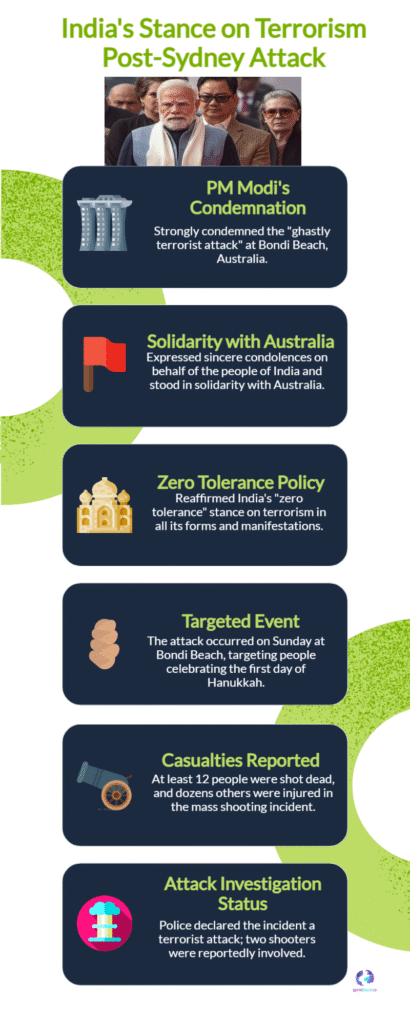
Prime Minister Narendra Modi reiterates India’s zero-tolerance stance on terrorism following reports of a deadly attack in Sydney, highlighting global security cooperation and accountability.
A Firm Message Amid Global Shock
In the aftermath of reports of a deadly attack in Sydney, Prime Minister Narendra Modi issued a strong statement reaffirming India’s long-standing position of zero tolerance towards terrorism. The remarks came as governments and citizens around the world reacted with grief and concern to yet another episode of mass violence in a public space.
The Prime Minister’s response reflected not only solidarity with the victims and their families but also a broader warning about the persistent threat posed by extremist violence, regardless of geography. His message underscored that terrorism, in any form, remains unacceptable and must be confronted with collective resolve.
India’s Zero-Tolerance Doctrine Explained
India’s zero-tolerance approach to terrorism has been a consistent pillar of its domestic and foreign policy. The doctrine emphasizes absolute rejection of violent extremism, refusal to distinguish between “good” and “bad” terrorists, and the need for accountability across borders.
By reiterating this stance after the Sydney incident, the Prime Minister reinforced India’s view that terrorism is a global menace rather than a localized problem. Acts of mass violence, whether motivated by ideology, extremism, or hatred, are seen as attacks on shared human values and democratic societies.
Global Implications of Mass Violence
Incidents like the one reported in Sydney resonate far beyond national boundaries. They raise pressing questions about public safety, radicalization, and the challenges faced by open societies in preventing lone-wolf or organized attacks.
The Prime Minister’s remarks implicitly highlighted the need for international cooperation in intelligence sharing, law enforcement coordination, and counter-radicalization efforts. In an interconnected world, security failures in one region can have psychological and political impacts worldwide.
Terrorism Beyond Borders
Modern terrorism does not operate in isolation. Financing networks, online propaganda, and ideological influence often transcend national jurisdictions. India has repeatedly called for stronger global mechanisms to disrupt these networks and for uniform standards in defining and prosecuting terrorist activities.
By linking the Sydney attack to the broader fight against terrorism, the statement positioned India as an advocate for a unified global response rather than fragmented national efforts.
Diplomatic Solidarity With Australia
Alongside the firm policy message, the Prime Minister expressed solidarity with Australia during a moment of national grief. Such gestures are a key aspect of diplomatic engagement, reinforcing mutual support between countries facing security challenges.
India and Australia have steadily strengthened their strategic partnership in recent years, particularly in areas such as counterterrorism, defense cooperation, and regional stability. Public expressions of support during crises serve to deepen trust and underscore shared democratic values.
The Broader Message to the International Community
The Prime Minister statement was not limited to condemnation alone. It served as a reminder to the international community that moral clarity is essential when confronting terrorism. Ambiguity, selective outrage, or political convenience can weaken global efforts to prevent future attacks.
By reiterating zero tolerance in response to events far from India’s borders, the message conveyed that terrorism anywhere is a concern everywhere. It reinforced the idea that global security depends on collective responsibility, consistent standards, and unwavering resolve.
A Consistent Stand in Uncertain Times
As the world continues to grapple with unpredictable security threats, India’s reiterated position signals continuity rather than reaction. The emphasis remains on prevention, cooperation, and an uncompromising stance against those who resort to violence against civilians.
In moments of tragedy, such statements serve both as expressions of empathy and as policy signals. They remind the global audience that while the contexts of attacks may differ, the principles guiding the response must remain firm and universal.