




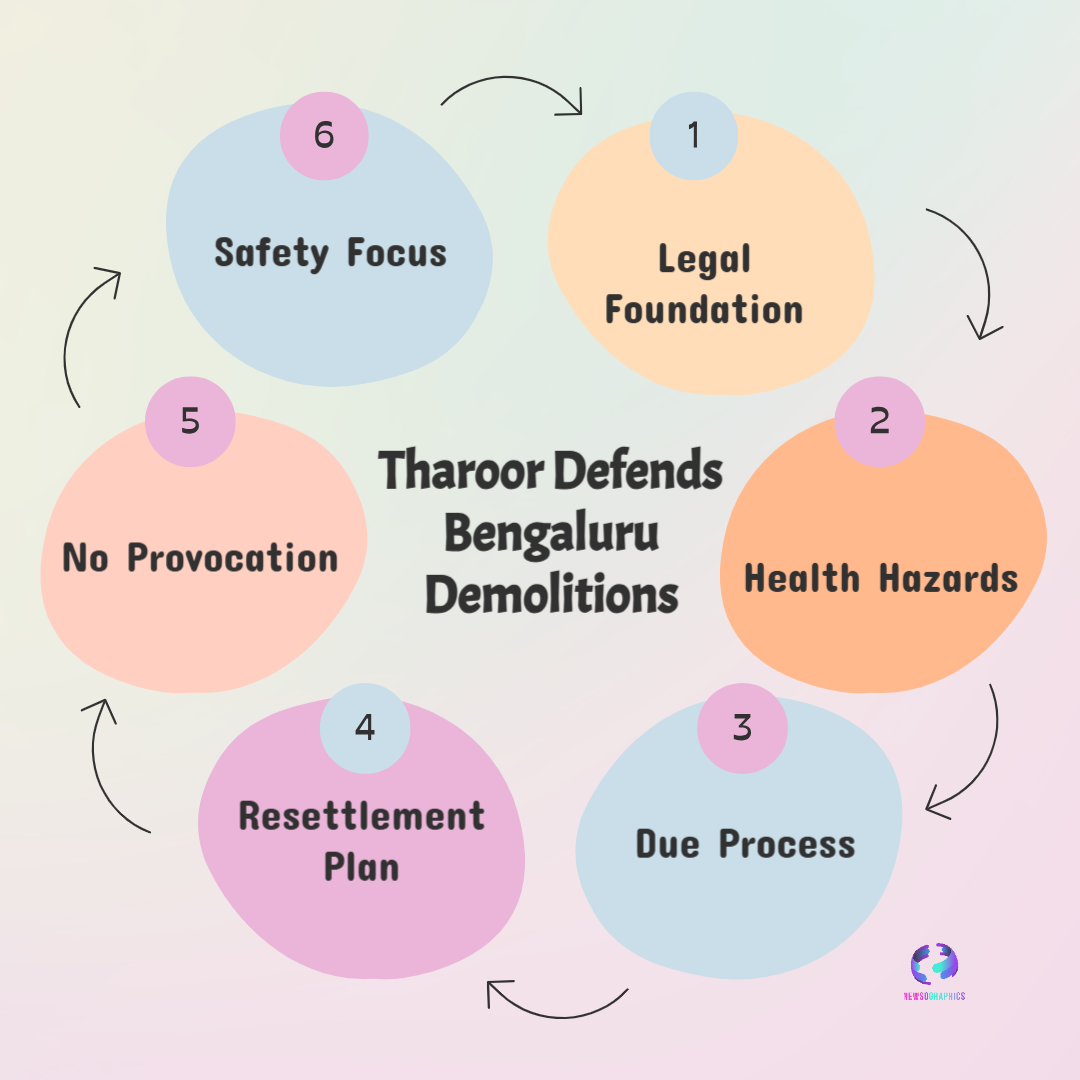
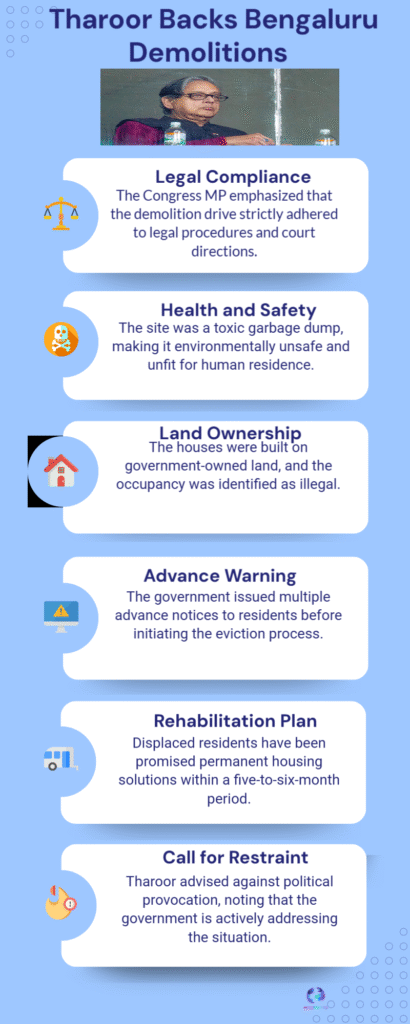
Congress leader Shashi Tharoor has backed the Karnataka government’s demolition drive in Bengaluru, stressing the need for legality, restraint, and avoidance of unnecessary provocation.
Political Endorsement Amid Urban Enforcement
The demolition drive underway in Bengaluru has drawn national political attention after Shashi Tharoor publicly endorsed the Karnataka government’s actions. His remarks framed the operation as an administrative necessity rather than a politically motivated exercise, placing emphasis on legality and proportionality.
The intervention adds a nuanced voice to an otherwise polarised debate around urban demolitions and state authority.
Karnataka Government’s Position on the Demolition Drive
The Karnataka Government has maintained that the drive targets unauthorised constructions and violations of urban planning norms. Officials have positioned the operation as part of a broader effort to restore regulatory discipline in rapidly expanding urban zones.
The emphasis, according to the administration, remains on enforcement of existing laws rather than selective or symbolic action.
Administrative Rationale Behind the Action
Bengaluru’s sustained growth has placed immense pressure on civic infrastructure. Encroachments, unauthorised extensions, and zoning violations have become recurring challenges, prompting authorities to rely on demolition as a corrective tool within the legal framework.
Tharoor’s Call for Restraint and Due Process
While backing the drive, Tharoor underscored the importance of avoiding “unnecessary provocation.” His remarks suggested that enforcement actions, even when lawful, must be calibrated to prevent social tension and political escalation.
The stance reflects an attempt to balance firm governance with sensitivity in a city marked by demographic diversity and political complexity.
Demolition Drives and the Politics of Urban Space
Urban demolition campaigns often sit at the intersection of law, politics, and public perception. In Bengaluru, the current drive has revived broader questions about consistency in enforcement and the historical tolerance of irregular construction.
Tharoor’s endorsement, tempered with caution, positions the debate within a governance lens rather than a confrontational political narrative.
Bengaluru’s Urban Growth and Regulatory Stress
As one of India’s fastest-growing metropolitan regions, Bengaluru has long struggled with uneven urban planning. Rapid commercialisation and residential expansion have frequently outpaced regulatory oversight, creating an environment where violations accumulate over time.
Demolition drives, while disruptive, emerge as periodic responses to this accumulated regulatory backlog.
Broader Signals for Governance Discourse
The episode signals an evolving discourse within national politics on urban governance. Support for enforcement, coupled with appeals for restraint, reflects an acknowledgement that state authority must be exercised with both firmness and legitimacy.
In backing the Karnataka government while cautioning against excess, Tharoor’s remarks encapsulate the delicate balance between rule enforcement and social stability in contemporary Indian cities.