


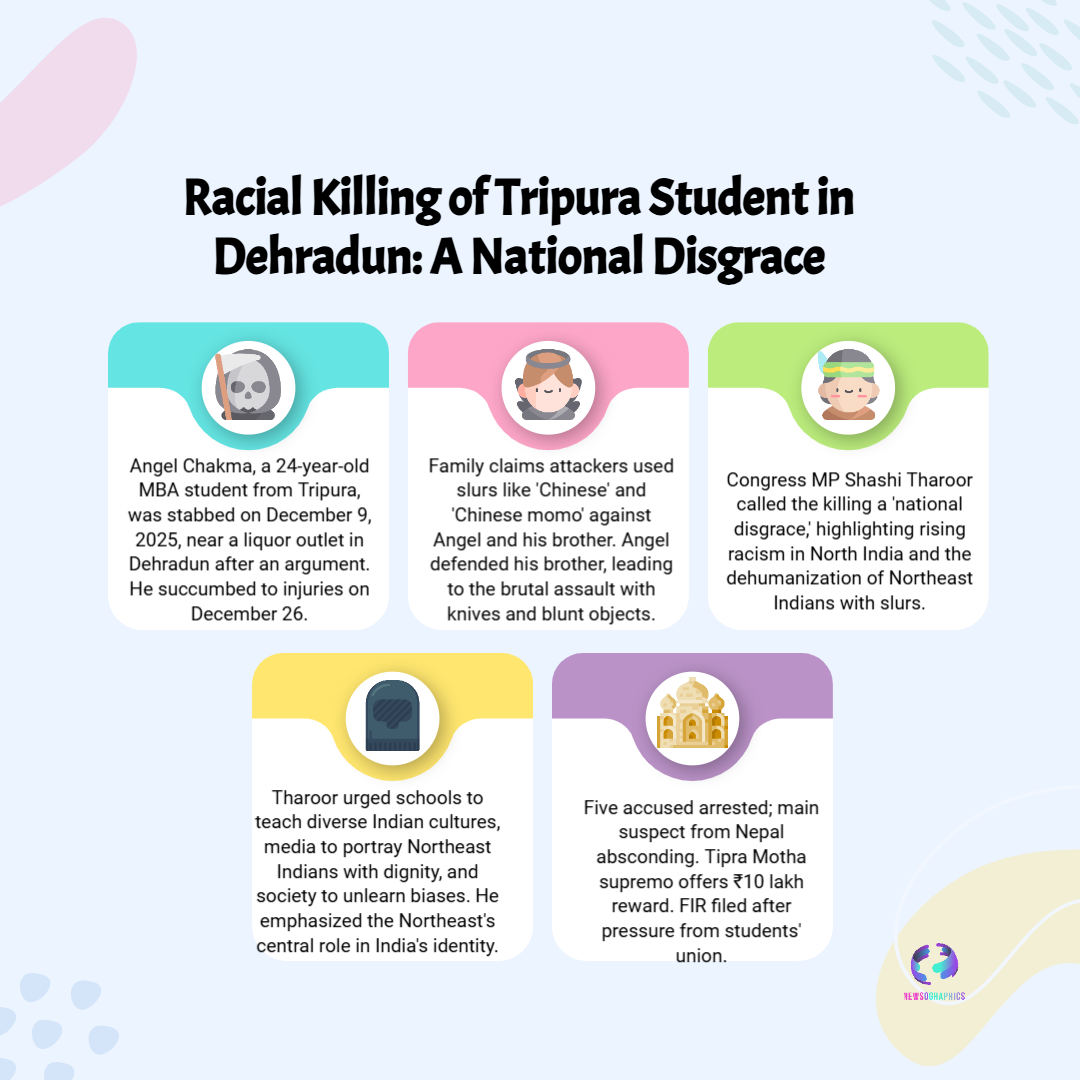
Congress MP Shashi Tharoor has described the racial killing of a student from Tripura in Dehradun as a national disgrace, renewing debate on racism, intolerance, and the safety of students from India’s Northeast.
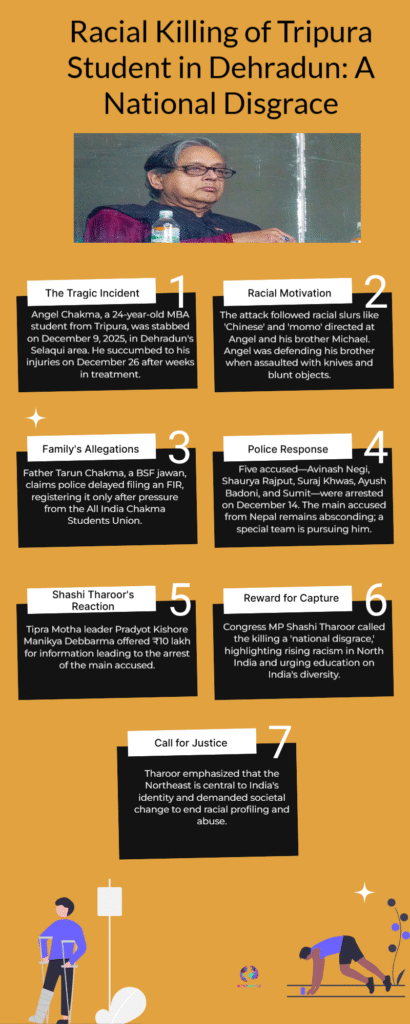
A Killing That Exposed Deep Social Fault Lines
The killing of a student from Tripura in Dehradun has sent shockwaves across the country, not merely as a criminal act but as a reflection of persistent racial prejudice. Described by Shashi Tharoor as a “national disgrace,” the incident has reignited uncomfortable conversations about how citizens from India’s Northeast are perceived and treated in other parts of the country.
The Dehradun tragedy has moved beyond the realm of law and order, touching questions of identity, belonging, and the moral responsibility of society. The language used by political leaders underscores the gravity of the moment and the urgency of introspection.
Shashi Tharoor’s Intervention and Political Significance
Framing the Incident as a National Issue
By labeling the killing a national disgrace, Tharoor elevated the incident from a regional crime to a collective failure. His statement suggests that racism within India cannot be dismissed as isolated or accidental but must be acknowledged as a systemic challenge that erodes national unity.
Such framing carries political weight, compelling institutions and the public alike to confront the broader implications rather than focusing narrowly on criminal culpability alone.
Moral Authority and Public Discourse
Tharoor’s intervention draws on moral reasoning as much as political critique. His emphasis on shame and responsibility reflects an attempt to influence public discourse, urging society to view the incident through an ethical lens rather than partisan lines.
Racism and the Experience of Northeast Indians
Historical Patterns of Othering
Citizens from the Northeast have long reported experiences of racial profiling, verbal abuse, and physical violence in Indian cities. Distinct physical features and cultural identities often become markers for discrimination, reinforcing a sense of alienation despite constitutional guarantees of equality.
The Dehradun killing fits into a troubling pattern where prejudice escalates into violence, exposing gaps between legal protections and lived realities.
Urban Spaces and Student Vulnerability
Students living away from home occupy a particularly vulnerable position. Dependence on local communities, landlords, and institutions can magnify exposure to hostility. When prejudice intersects with youth and isolation, the consequences can be devastating.
Institutional Responses and Accountability
Law Enforcement and Justice Mechanisms
Incidents of racial violence test the credibility of law enforcement agencies. Public confidence depends not only on swift arrests but also on transparent investigations and proportionate legal action. Failure to act decisively risks reinforcing perceptions of indifference toward marginalized communities.
Role of Educational Institutions
Universities and colleges hosting students from diverse backgrounds are increasingly scrutinized for their role in safeguarding inclusivity. Institutional silence or inaction in the aftermath of such incidents often compounds the sense of injustice felt by affected communities.
Broader Social Implications
National Identity and Internal Diversity
The incident challenges simplistic narratives of unity in diversity. While India celebrates pluralism rhetorically, episodes of racial violence reveal fractures that demand honest engagement. National identity, in this context, is tested by how minorities are protected rather than how diversity is proclaimed.
Media and Public Consciousness
Public reaction to the killing in Dehradun demonstrates the power of media and political voices in shaping awareness. Sustained attention can either catalyze reform or fade into symbolic outrage, depending on institutional follow-through.
A Moment of Reckoning
Beyond Condemnation
While strong words from political leaders draw attention, the deeper challenge lies in translating outrage into structural change. Addressing racism requires more than punitive measures; it demands cultural shifts within everyday interactions and institutional practices.
Enduring Impact of the Dehradun Tragedy
The killing of the Tripura student in Dehradun stands as a grim reminder of unresolved prejudices within Indian society. Tharoor’s characterization of the incident as a national disgrace captures its symbolic weight, marking it as a moment that calls for collective reflection on equality, dignity, and justice.