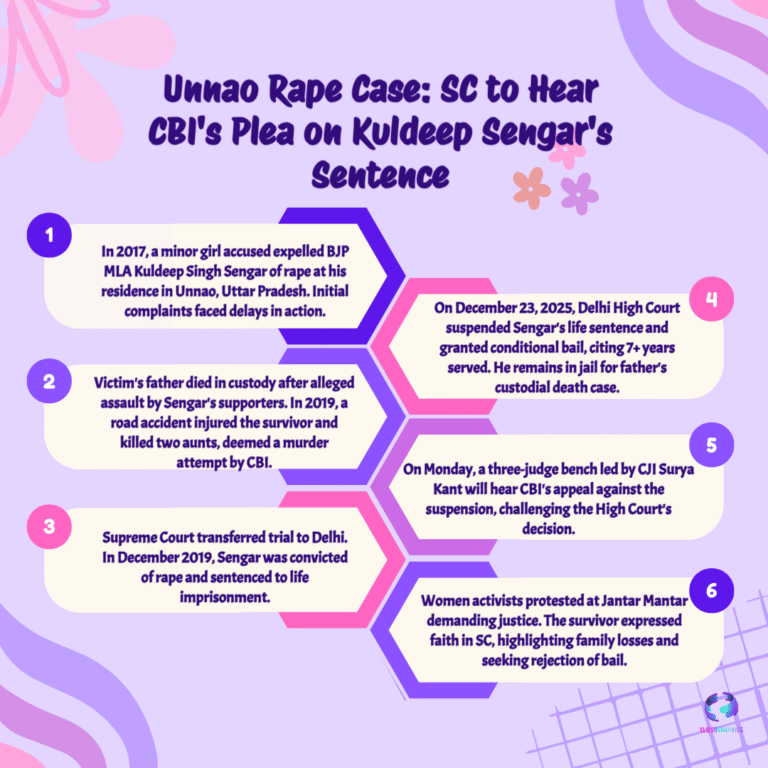




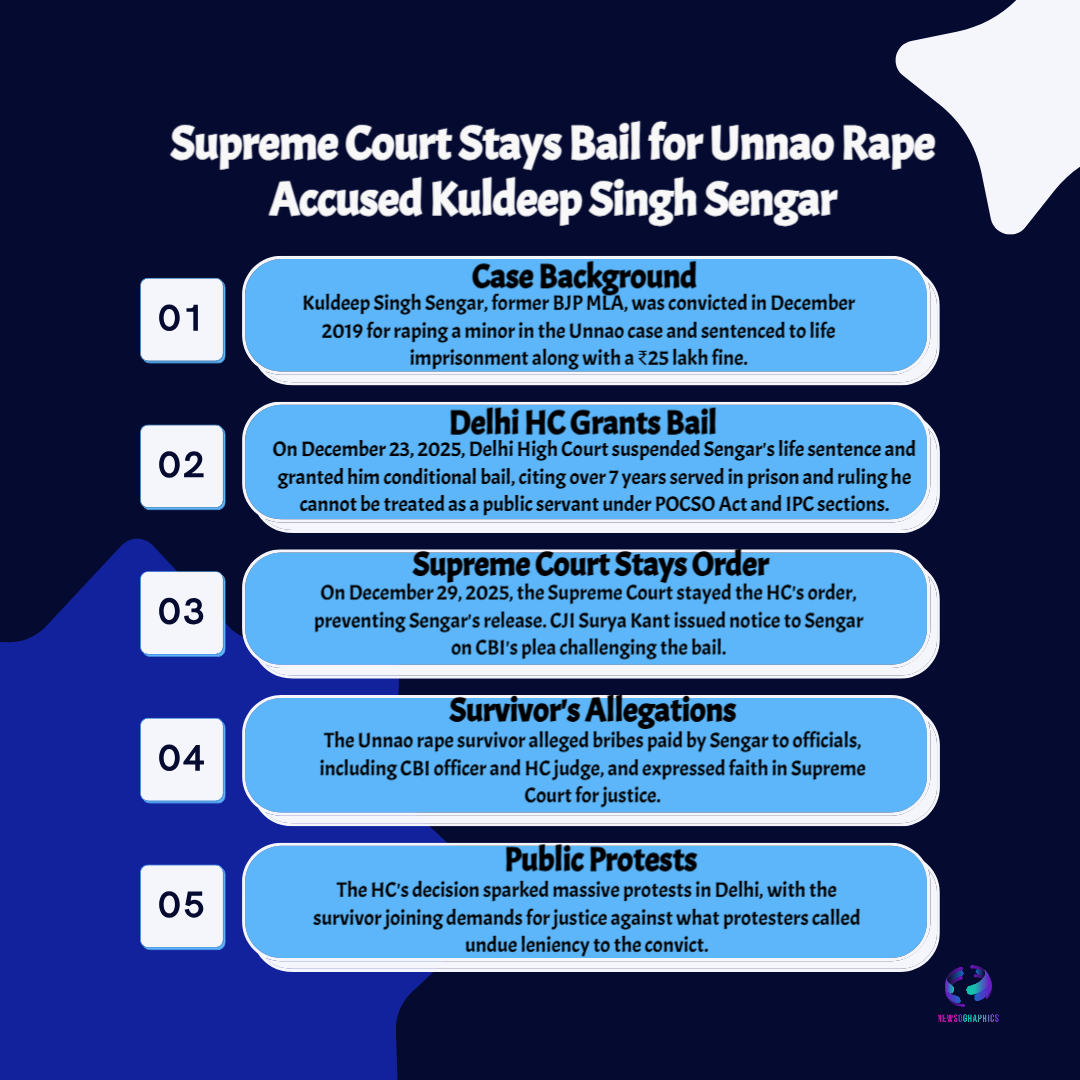
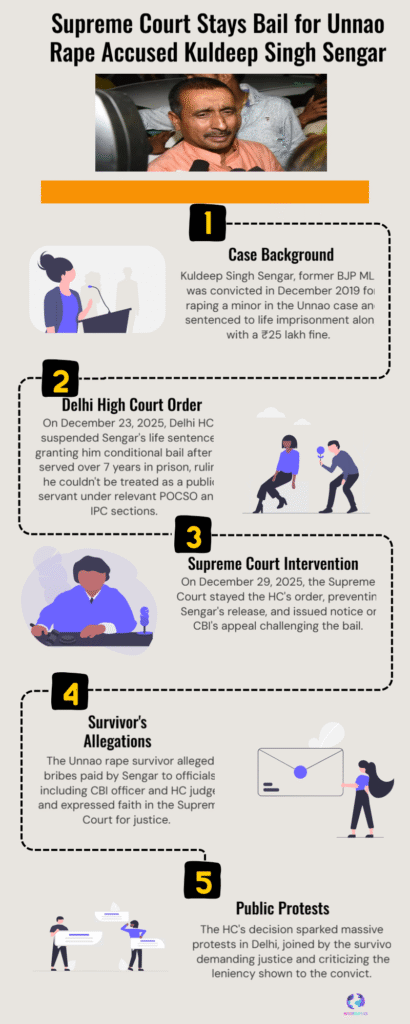
The Supreme Court has stayed the Delhi High Court’s order granting bail to former BJP MLA Kuldeep Singh Sengar in the Unnao rape case, reviving debate on judicial scrutiny, victims’ rights, and accountability in high-profile crimes.
Supreme Court Intervention in a High-Profile Criminal Case
The Supreme Court’s decision to stay the Delhi High Court order granting bail to Kuldeep Singh Sengar marks a significant moment in one of India’s most closely watched criminal cases. The Unnao rape case, which shook public conscience and exposed deep fault lines in political accountability and institutional response, has remained emblematic of the challenges faced by survivors seeking justice.
By stepping in, the apex court has asserted its supervisory role over lower judicial orders, especially in cases carrying profound social and legal consequences. The stay underscores the principle that procedural reliefs like bail cannot be viewed in isolation from the gravity of the crime and the broader impact on justice delivery.
Background of the Unnao Rape Case
Allegations and Initial Proceedings
The Unnao rape case emerged as a watershed moment in India’s legal and political discourse. The survivor accused then MLA Kuldeep Singh Sengar of rape, leading to widespread outrage after allegations surfaced of intimidation, delay, and misuse of power. The case drew national attention due to the accused’s political standing and the alleged systemic hurdles faced by the victim.
Subsequent investigations, arrests, and trials unfolded under intense public scrutiny, with the judiciary often navigating between legal process and public expectation. Convictions in related matters reinforced the seriousness with which courts treated the charges.
Conviction and Custody
Kuldeep Singh Sengar was eventually convicted and sentenced in the rape case, along with other related offences. His incarceration became symbolic of a rare instance where political influence did not ultimately shield an accused from accountability. However, legal avenues such as appeals and bail applications continued to test the robustness of judicial reasoning in such sensitive matters.
Delhi High Court’s Bail Order and Its Implications
Grounds for Granting Bail
The Delhi High Court’s decision to grant bail was rooted in procedural considerations, including the duration of custody and progress in appellate proceedings. Such reasoning is not uncommon in criminal jurisprudence, where prolonged incarceration during appeal can be weighed against the presumption of fairness in the justice system.
Yet, in cases involving sexual violence and abuse of power, bail orders often attract heightened scrutiny. Critics argue that procedural relief must be carefully balanced against the nature of the offence and its impact on survivors.
Public and Legal Reactions
The bail order reignited debates around consistency in judicial standards, especially when influential convicts seek interim relief. For many observers, the decision raised concerns about whether the justice system sufficiently factors in the psychological and societal dimensions of sexual crimes.
Supreme Court’s Stay: Legal Significance
Reasserting Judicial Oversight
By staying the High Court’s order, the Supreme Court has signaled that bail decisions in extraordinary cases warrant deeper examination. The stay does not determine the final outcome of the appeal but pauses the operation of the bail order until the apex court conducts a fuller review.
This intervention reinforces the Supreme Court’s role as the ultimate guardian of constitutional values, ensuring that lower court orders align with established legal principles and societal expectations of justice.
Impact on Victims’ Rights
The stay has been widely interpreted as a reaffirmation of the judiciary’s sensitivity toward survivors of sexual violence. In cases where the accused wields or once wielded significant power, judicial caution assumes greater importance to preserve faith in the rule of law.
Broader Questions on Bail Jurisprudence in India
Balancing Liberty and Accountability
Indian courts have long grappled with the balance between an individual’s right to liberty and the collective demand for justice in heinous crimes. Bail jurisprudence evolves through such contested cases, shaping future interpretations of fairness, proportionality, and deterrence.
The Unnao case adds another layer to this evolving discourse, highlighting how legal reasoning must adapt when crimes intersect with power structures and systemic vulnerabilities.
Institutional Trust and Public Confidence
High-profile interventions by the Supreme Court often carry implications beyond the courtroom. They influence public confidence in institutions and signal the judiciary’s awareness of its role in addressing societal inequities.
The Road Ahead in the Unnao Case
Pending Judicial Examination
With the stay in place, the Supreme Court will examine the merits of the bail order in detail. This process will involve reassessing legal grounds, the nature of the conviction, and the broader implications for justice delivery.
The outcome will not only affect the parties involved but also contribute to legal precedent on how appellate bail should be approached in serious criminal convictions.
Enduring Legacy of the Case
Regardless of the final judicial outcome, the Unnao rape case has already left an indelible mark on India’s legal landscape. It continues to shape conversations around women’s safety, political accountability, and the moral authority of the justice system.
The Supreme Court’s stay serves as a reminder that in cases of profound public importance, judicial decisions resonate far beyond legal texts, influencing societal expectations of fairness and dignity.