



On December 8, 2025, PM Modi condemned Congress’s historic decision to drop stanzas of Vande Mataram, targeting Jawaharlal Nehru over alleged appeasement politics. We explore the history, the claims, and implications of this renewed debate.
The Spark: 150th Anniversary of Vande Mataram
The debate began formally in Parliament during the winter session of 2025, commemorating 150 years since the composition of Vande Mataram, written in 1875 by Bankim Chandra Chattopadhyay.
For many, the milestone was an opportunity to reflect on the song’s legacy — as a hymn that galvanized India’s freedom struggle, as a cultural symbol, and as part of the nation’s historical and moral fabric.
Yet, what could have been a purely commemorative occasion turned into a charged debate — because the history of Vande Mataram is fraught with political, communal, and ideological tensions.
The Core of the Controversy: What Went Wrong in 1937
- The crux lies in a 1937 decision by Indian National Congress (INC) — then under the leadership of Jawaharlal Nehru — to adopt only the first two stanzas of Vande Mataram for national functions, omitting later verses invoking Hindu goddesses (like Durga, Lakshmi, Saraswati).
- The reason offered then was communal sensitivity: some sections, especially among Muslim leaders, felt that the religious imagery was exclusionary.
- That truncation — or “division” of the song, to use recent political rhetoric — has been a point of contention ever since, with critics arguing it diluted a powerful national symbol.
Over decades, this uneasy compromise has remained a flashpoint in debates about secularism, national identity, inclusion, and cultural heritage in India.
What PM Modi Said — Rekindling the Debate
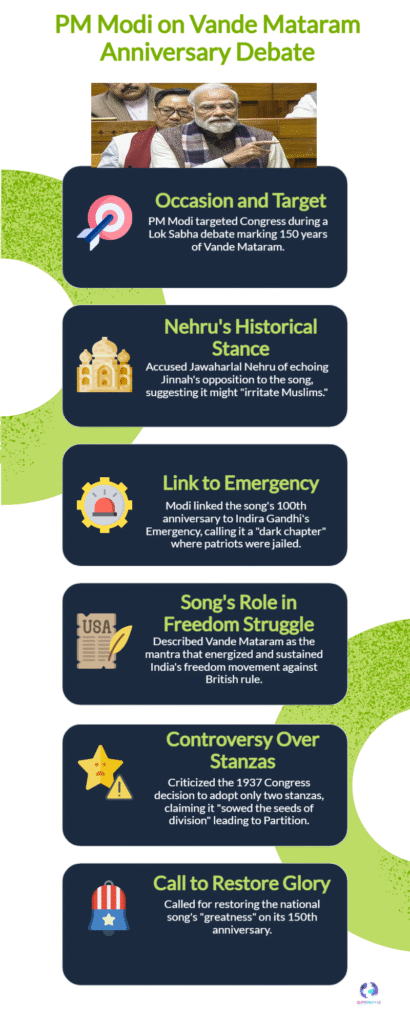
In his address at Parliament, PM Modi accused the Congress of “compromising” the song for the sake of appeasement. Key claims included:
- He alleged that Nehru, shortly after opposition from Muhammad Ali Jinnah, argued in a letter to freedom leader Subhas Chandra Bose that Vande Mataram could “provoke and irritate Muslims,” and so its usage should be reconsidered.
- According to him, the 1937 decision to trim the song sowed “the seeds of division that culminated in the Partition of India.”
- He also invoked the memory of the 1975 Emergency — arguing when the song completed 100 years, India was under one of its darkest chapters. For him, the 150th anniversary is a chance to restore the song’s full legacy.
- Modi described Vande Mataram as a “rock of resistance” across colonial oppression and urged the nation to revive its complete form as a symbol of unified national identity.
In short — the prime minister placed the song at the center of a broader narrative of historical correction, national pride, and ideological assertion.
Opposition Pushback — Is History Being Rewritten?
Unsurprisingly, the views sparked sharp reactions:
- The political opposition accused the government of using the debate to polarize and communalize history.
- Critics point out that the decision to use only part of the song was a reflection of India’s diverse social fabric and its attempt — however imperfect — at secular harmony; they caution against retroactively interpreting it as “appeasement.”
- Some suggest that the debate — especially at this political moment — risks reopening old wounds when the focus should be on building inclusive national identity rather than rekindling old divisions.
In essence: the question of what Vande Mataram represents — and to whom — remains contested.
Why This Matters — Implications Beyond Symbolism
Cultural and Emotional Significance
For many Indians, Vande Mataram is more than a song — it’s deeply tied to patriotism, struggle for freedom, and collective memory. Any debate on its wording touches core notions of identity, belonging, and respect for heritage.
Social Cohesion vs Identity Politics
The controversy underscores the tightrope India treads: how to honor symbols rooted in one cultural context, while ensuring inclusivity in a plural society. Revisiting historical decisions like the 1937 truncation inevitably revives tensions around majoritarian identity and minority sensitivities.
Historical Interpretation and Political Narrative
Which version of history prevails — one where symbols were modified for inclusivity, or one where that modification was a betrayal — has profound implications for how future generations understand nationhood, secularism, and collective memory. Political debates around such symbols influence national discourse, identity, and even legislation.
Contemporary Relevance
In a time when national identity, cultural pride, and religious pluralism are intensely debated in India, the arguments around Vande Mataram reflect deeper currents: between homogenizing nationalism and inclusive pluralism. What Parliament — or society — decides now may shape how such symbols are viewed for decades.
Conclusion: A Song, But Also a Mirror
The 150th-anniversary debate over Vande Mataram is far more than an academic or historical exercise. It reveals fault lines in how Indians — past and present — have negotiated identity, nationalism, and diversity.
Whether the full original version of Vande Mataram is revived — or its truncated form continues — the discourse around it acts as a mirror of India’s evolving relationship with its history, its values, and its plural society.
In this light, the song remains not just a relic of the past — but a living, contested symbol of what India was, is, and might become.