




After reversing her retirement, Vinesh Phogat returns with renewed determination and eyes set on the 2028 Los Angeles Olympics. Explore what her comeback means for Indian wrestling, athlete welfare, and the future of the sport.
Vinesh Phogat’s Return: A Turning Point for Indian Wrestling
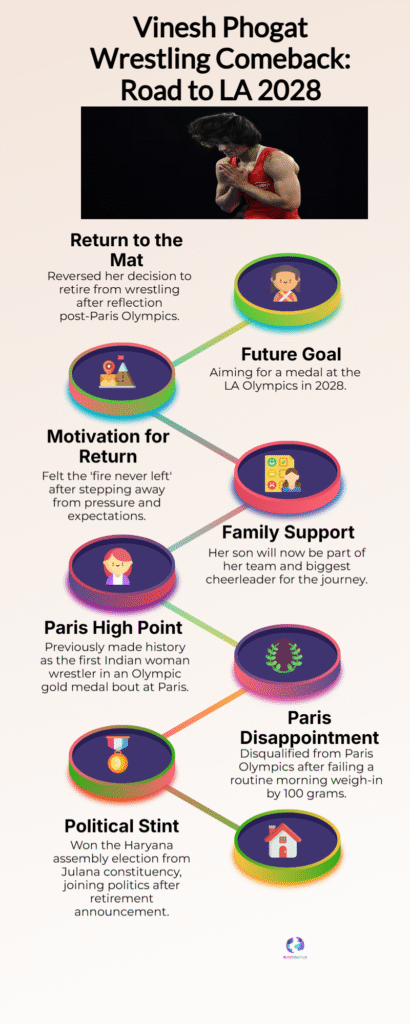
Vinesh Phogat’s decision to reverse her retirement and re-enter competitive wrestling has reignited discussion around athlete resilience, institutional accountability, and India’s long-term Olympic ambitions. Her announcement marks more than a personal comeback—it signals a moment of recalibration for India’s wrestling ecosystem, which has experienced turbulence, public protests, and administrative scrutiny in recent years.
With her sights firmly set on the 2028 Los Angeles Olympics, Phogat’s return reshapes the competitive landscape and revitalizes India’s prospects on the global stage.
What Motivated the Reversal of Retirement
The Emotional Weight of Her Initial Exit
Phogat’s initial retirement announcement came during a period of immense emotional distress following controversial circumstances surrounding trials and governance issues within Indian wrestling. It reflected not just personal disappointment but a broader frustration shared by many athletes navigating systemic challenges.
Rediscovering Purpose and Competitive Drive
The reversal of her decision underscores a renewed sense of purpose. For elite athletes, retirement is rarely a clean exit—especially when physical capability, ambition, and unfinished business converge. Phogat’s determination to pursue Olympic gold appears to be a powerful motivator, particularly as she remains one of India’s most technically sophisticated and mentally resilient wrestlers.
What Her Comeback Means for India’s Olympic Plans
A Boost to Medal Prospects
India’s wrestling contingent has historically relied on a small pool of elite performers. Phogat’s experience, combined with her ability to deliver results under pressure, elevates India’s medal outlook for 2028. Her presence also enhances international visibility and inspires younger athletes.
Mentorship for Emerging Wrestlers
As one of the most decorated wrestlers in the nation, Phogat’s return provides a critical mentorship layer. Younger wrestlers—especially women transitioning from junior to senior levels—gain access to insights that cannot be replicated through coaching alone. Her training ethic, technical adaptability, and mental discipline serve as invaluable assets to the national program.
A Push for Institutional Reforms
Her comeback once again spotlights the importance of transparent governance, athlete rights, and the need for structured support systems. Wrestling in India is at an inflection point, and strong athlete voices can accelerate change. Phogat’s continued presence ensures that athlete welfare remains central to policy conversations.
Preparing for LA 2028: What Lies Ahead
Rebuilding Physique and Competitive Rhythm
After time away from the mat, Phogat’s path includes regaining peak conditioning, restoring match confidence, and re-establishing tactical rhythm. While a multi-year runway to 2028 offers breathing space, it also demands meticulous planning to avoid burnout and injuries.
Navigating the Qualification Trail
The road to the Olympics involves international competitions, ranking tournaments, and qualification pathways that are increasingly competitive. Phogat’s familiarity with the global field gives her an advantage, but consistent participation and strategic event selection will be crucial.
Aligning With Modern Wrestling Trends
Women’s wrestling continues to evolve rapidly, with athletes adopting hybrid training systems, advanced biomechanics, and analytics-driven coaching. Phogat’s comeback signals her readiness to adapt, innovate, and elevate her game to match global standards.
The Cultural Impact of Her Return
Representation and Resilience
Phogat’s journey embodies resilience and serves as a powerful narrative for women in sports. Her decision to return challenges stereotypes around retirement, age, and expectations placed on female athletes. It reiterates that career trajectories in women’s wrestling can be dynamic and self-defined.
Renewed Public Interest in Wrestling
In a time when wrestling in India has faced administrative turmoil, her comeback provides a positive focal point. It rekindles public enthusiasm, draws attention back to the sport’s competitive potential, and restores faith in its future.
A Defining Second Chapter
Vinesh Phogat’s comeback is not simply a return to wrestling—it is a reclamation of agency, ambition, and identity. As she embarks on a new chapter targeting the 2028 Olympics, her journey promises to influence not only medal counts but the culture of Indian sport itself. and re-enter competitive wrestling has reignited discussion around athlete resilience, institutional accountability, and India’s long-term Olympic ambitions. Her announcement marks more than a personal comeback—it signals a moment of recalibration for India’s wrestling ecosystem, which has experienced turbulence, public protests, and administrative scrutiny in recent years.
With her sights firmly set on the 2028 Los Angeles Olympics, Phogat’s return reshapes the competitive landscape and revitalizes India’s prospects on the global stage.
What Motivated the Reversal of Retirement
The Emotional Weight of Her Initial Exit
Phogat’s initial retirement announcement came during a period of immense emotional distress following controversial circumstances surrounding trials and governance issues within Indian wrestling. It reflected not just personal disappointment but a broader frustration shared by many athletes navigating systemic challenges.
Rediscovering Purpose and Competitive Drive
The reversal of her decision underscores a renewed sense of purpose. For elite athletes, retirement is rarely a clean exit—especially when physical capability, ambition, and unfinished business converge. Phogat’s determination to pursue Olympic gold appears to be a powerful motivator, particularly as she remains one of India’s most technically sophisticated and mentally resilient wrestlers.
What Her Comeback Means for India’s Olympic Plans
A Boost to Medal Prospects
India’s wrestling contingent has historically relied on a small pool of elite performers. Phogat’s experience, combined with her ability to deliver results under pressure, elevates India’s medal outlook for 2028. Her presence also enhances international visibility and inspires younger athletes.
Mentorship for Emerging Wrestlers
As one of the most decorated wrestlers in the nation, Phogat’s return provides a critical mentorship layer. Younger wrestlers—especially women transitioning from junior to senior levels—gain access to insights that cannot be replicated through coaching alone. Her training ethic, technical adaptability, and mental discipline serve as invaluable assets to the national program.
A Push for Institutional Reforms
Her comeback once again spotlights the importance of transparent governance, athlete rights, and the need for structured support systems. Wrestling in India is at an inflection point, and strong athlete voices can accelerate change. Phogat’s continued presence ensures that athlete welfare remains central to policy conversations.
Preparing for LA 2028: What Lies Ahead
Rebuilding Physique and Competitive Rhythm
After time away from the mat, Phogat’s path includes regaining peak conditioning, restoring match confidence, and re-establishing tactical rhythm. While a multi-year runway to 2028 offers breathing space, it also demands meticulous planning to avoid burnout and injuries.
Navigating the Qualification Trail
The road to the Olympics involves international competitions, ranking tournaments, and qualification pathways that are increasingly competitive. Phogat’s familiarity with the global field gives her an advantage, but consistent participation and strategic event selection will be crucial.
Aligning With Modern Wrestling Trends
Women’s wrestling continues to evolve rapidly, with athletes adopting hybrid training systems, advanced biomechanics, and analytics-driven coaching. Phogat’s comeback signals her readiness to adapt, innovate, and elevate her game to match global standards.
The Cultural Impact of Her Return
Representation and Resilience
Phogat’s journey embodies resilience and serves as a powerful narrative for women in sports. Her decision to return challenges stereotypes around retirement, age, and expectations placed on female athletes. It reiterates that career trajectories in women’s wrestling can be dynamic and self-defined.
Renewed Public Interest in Wrestling
In a time when wrestling in India has faced administrative turmoil, her comeback provides a positive focal point. It rekindles public enthusiasm, draws attention back to the sport’s competitive potential, and restores faith in its future.
A Defining Second Chapter
Vinesh Phogat’s comeback is not simply a return to wrestling—it is a reclamation of agency, ambition, and identity. As she embarks on a new chapter targeting the 2028 Olympics, her journey promises to influence not only medal counts but the culture of Indian sport itself.