



Donald Trump is considering new tariffs on India after criticizing India’s 50% rice levy and rising trade imbalance. Here’s what’s driving the tension and how it could impact global trade.
Why Trump tariffs Is Turning His Attention Back to India
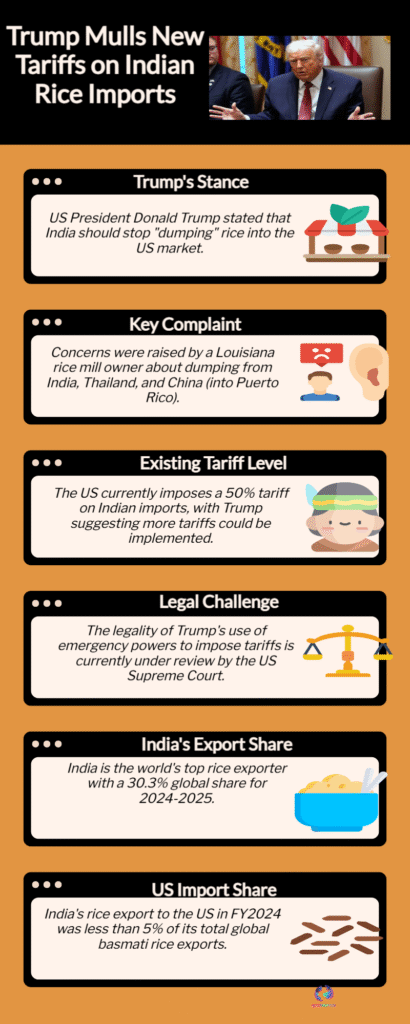
As Donald Trump ramps up his 2025 economic messaging, one target has resurfaced with force: India’s trade policy. He has publicly objected to what he calls unfair tariff structures, pointing specifically to India’s 50% levy on rice imports and other high duties across consumer and agricultural products.
Trump’s core argument remains consistent with his earlier America‑first trade doctrine — that foreign nations, including strategic partners like India, impose tariffs far higher than those allowed by the United States.
In his latest comments, he suggested the U.S. should consider reciprocal or even higher tariffs if trading partners maintain steep barriers. India, with its protective tariff framework, has once again entered the spotlight.
India’s 50% Rice Levy: Why It Triggered Trump
A Protectionist Move or Economic Necessity?
India recently imposed a 50% duty on certain rice varieties, aiming to stabilise domestic supply and keep prices in check amid fluctuating global markets.
From India’s perspective, the tariff protects:
- food security,
- domestic farmers,
- inflation management,
- export‑import equilibrium.
From Trump’s perspective, however, this is the latest evidence of what he deems uneven trade rules, where U.S. agricultural goods face high entry barriers, while India continues enjoying access to the American consumer market.
The ‘Dumping’ Debate
Trump’s warning also follows allegations that India is “dumping rice” in global markets at lower prices, affecting U.S. producers. Though economists note that India’s export pricing is influenced by subsidies and global supply shifts, the narrative plays perfectly into Trump’s economic nationalism.
A Familiar Strategy: revisiting Trump’s tariff playbook
Reciprocity as a Political Message
The renewed tariff threat aligns with Trump’s long-standing position: match or exceed any foreign tariff to level the playing field.
Under his earlier tenure, India lost its GSP (Generalized System of Preferences) benefits — a move justified by Trump on grounds of insufficient market access for U.S. businesses.
Seen in that context, the new remarks are not isolated but part of a broader message: U.S. partners must lower barriers or expect retaliation.
Domestic Politics Meets Global Trade
The timing matters. As Trump campaigns on restoring American economic dominance, India’s tariff‑heavy regime provides a convenient contrast.
It allows him to:
- appeal to U.S. farmers,
- reassert hardline trade credentials,
- revive nationalist trade rhetoric,
- pressure India in future negotiations.
What This Means for India
The Economic Stakes
India relies on the U.S. as one of its largest export markets. A tariff escalation could affect:
- agricultural exports (rice, spices, seafood),
- industrial goods (steel, chemicals),
- services growth, particularly IT.
The U.S. also remains a critical market for India’s fast-growing tech and manufacturing sectors — any tariff retaliation can ripple across supply chains.
The Diplomatic Equation
Despite Donald Trump harsh words, India and the U.S. maintain strong strategic ties in defence, manufacturing, and Indo‑Pacific cooperation.
However, tariffs introduce a transactional element that complicates long-term policy alignment.
What This Means for the United States
Political Leverage or Economic Pressure?
For U.S. farmers and manufacturers, Trump’s stance signals potential relief from price competition. But tariffs can also raise consumer costs and disrupt established import channels.
India, as a major supplier of affordable goods, plays a role in stabilising prices — meaning reciprocal tariffs would likely raise costs for American buyers.
A Strategic Balancing Act
Washington needs India as a counterweight in the Indo-Pacific. Heavy tariffs risk pushing India closer to alternative markets and reducing U.S. influence in Asia.
Why This Trade Flashpoint Matters Globally
The tension comes at a moment when global trade is already strained by:
- supply chain recalibration,
- commodity price volatility,
- protectionist shifts in major economies.
Any escalation between two of the world’s largest economies could set off ripple effects across:
- agricultural markets,
- Asian export corridors,
- U.S. consumer pricing,
- international tariff negotiations.
Final Thoughts
Trump’s fresh tariff warning against India is more than a response to a single rice levy — it’s a re‑emergence of a worldview where trade must be fought, not negotiated, unless other nations align with U.S. terms.
As India defends its domestic priorities and Trump champions protectionism, the world could see a revival of tariff tensions with far-reaching consequences. For now, India’s rice levy has become the spark — but the trade debate ahead promises to be much larger.