




The recent mass cancellations faced by IndiGo stem from new crew-duty regulations, lean staffing, and its dominant size — factors that combined to derail its schedule while smaller airlines managed to adapt. A close look at why rivals fared far better.
What triggered the crisis for IndiGo
New norms increased pilot rest and capped duty times
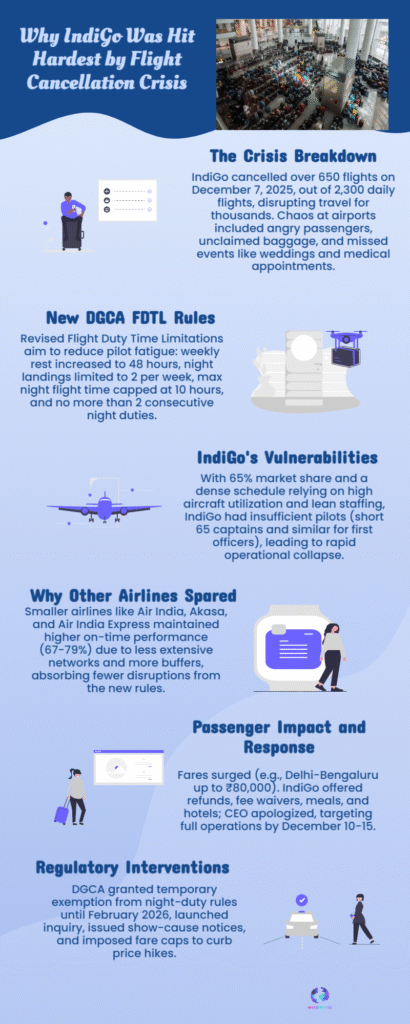
From November 2025, the national regulator DGCA (Directorate General of Civil Aviation) implemented stricter “Flight Duty Time Limitations” (FDTL) aimed at reducing fatigue and improving safety. Under the new norms: weekly rest periods were increased, the definition of night duty was broadened, the number of permissible night-landings per pilot was sharply reduced, and maximum duty hours tightly constrained.
For an airline used to frequent night flights, tight turnaround times and minimal downtime — like IndiGo — such changes demand major adjustments in crew rostering, staffing strength, and scheduling buffers.
IndiGo’s lean roster + high utilization left little buffer
IndiGo operated on a “lean staffing” model: relatively fewer pilots per aircraft and high aircraft utilization.
As a result, when FDTL norms took effect, the airline reportedly lacked the buffer — extra crews or slack — needed to cope with increased rest requirements or duty-time limits. Files indicate that crew shortfalls (especially among captains and first officers) triggered cancellations rapidly as schedule pressure mounted.
Why Other Airlines Handled It Better
Smaller networks → lesser disruption
Many rival airlines operate fewer flights and have lower overall scale compared to IndiGo. Because their schedules are less dense and don’t rely as heavily on quick fleet rotation or overnight flights, they had more flexibility to adjust with the new norms.
Also, because their operations involved fewer flights per day, even if crew-rostering challenges emerged, they impacted fewer services — making disruptions far less visible and overall manageable.
Pre-emptive adjustments & conservative scheduling
Some airlines reportedly anticipated the stricter norms and adjusted their rosters or flight schedules accordingly — possibly scaling back the number of night flights, adding buffer, or spacing out crew rotations. This allowed them to stay compliant while avoiding widespread cancellations.
Conversely, IndiGo — despite being given months’ notice — apparently underestimated how many more pilots or crew reserves it would need to maintain its high-frequency and night-heavy operations.
The Role of Market Dominance — Why IndiGo’s Size Backfired
Because IndiGo controls about two-thirds of India’s domestic air travel market (roughly 60–65 %), its internal disruption had outsized ripple effects across airports and booking systems nationwide.
In essence, when an airline with such a dominant share collapse under regulatory pressure, there are few alternatives at scale to absorb the displaced passengers — causing visible chaos: long queues, cancellations, baggage-pileups, and widespread delays.
Smaller airlines, even if they faced minor issues, simply didn’t have enough volume to trigger a systemic crisis.
Underlying Issues — What This Reveals about the Aviation Industry
- High-utilization business models are fragile: Airlines that rely heavily on night flights, tight turnarounds, and minimal buffer reduce costs — but leave almost no room for regulatory changes or operational shocks.
- Regulatory compliance needs strategic planning: When regulations change (like fatigue-management norms), scaling back operations or expanding crew numbers must be pre-emptive and well-timed. Failure to do so can lead to collapse.
- Market concentration amplifies risk: When a few airlines dominate the market, trouble at one can destabilize the entire system. Diversification of carriers or more balanced market shares might mitigate this.
- Safety vs. convenience — tradeoffs matter: The new norms aim to improve safety by reducing pilot fatigue — laudable from a regulatory standpoint. But their impact shows that implementing safety rules on large-scale operations demands careful management, or risk massive disruption.
What This Means for Passengers & the Road Forward
- Passengers flying on dominant carriers must anticipate potential disruptions following major regulatory changes — especially during transition periods.
- Airlines now face pressure to balance cost-efficiency with resilience: lean staffing may save money, but may also lead to failure under stress.
- Regulators and industry must plan longer lead times when pushing big rule changes, with realistic assessments of fleet size, staffing, and buffer needs.
- Market diversity (more airlines, fair competition) appears more important than ever — to ensure that when one airline falters, the system doesn’t collapse.