
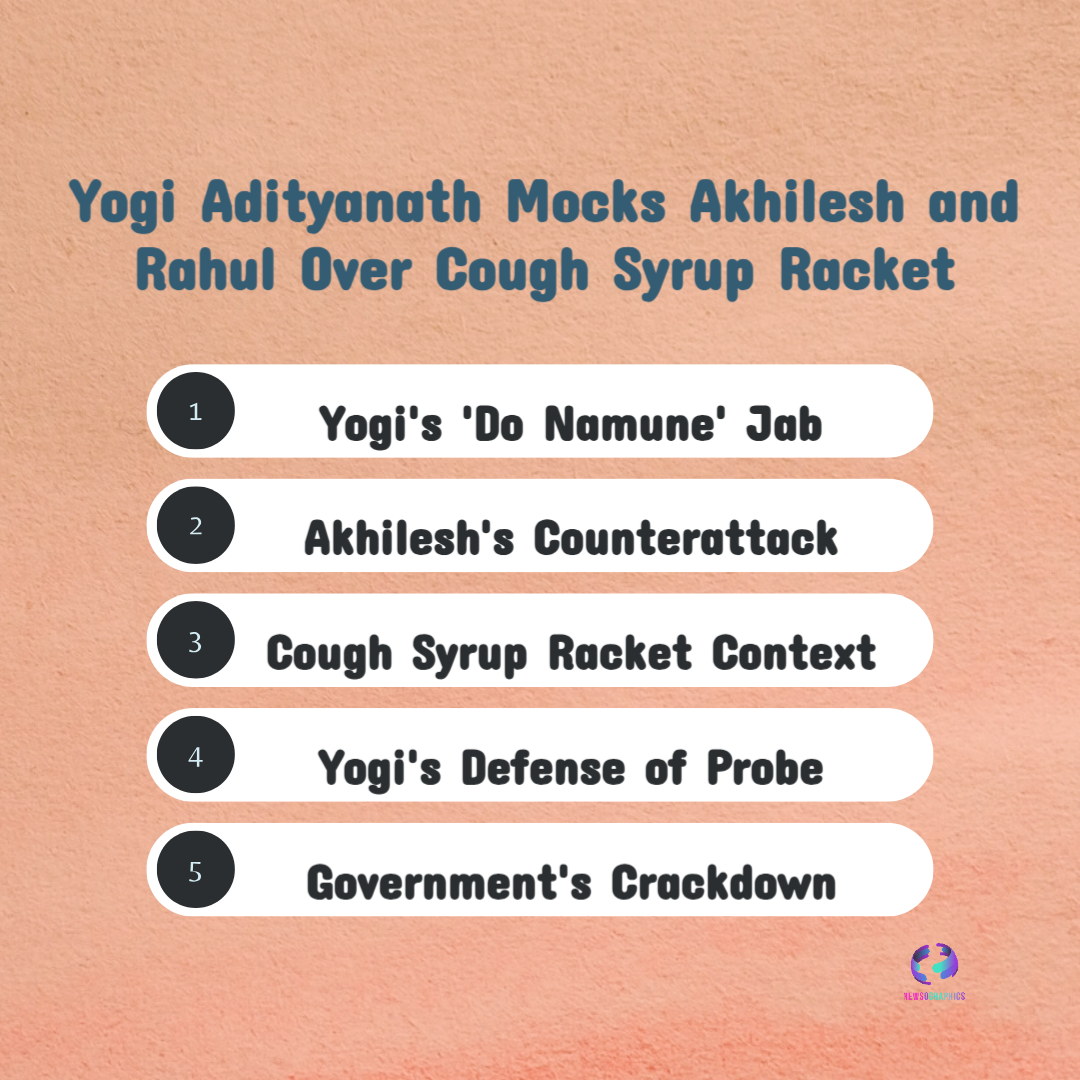
Uttar Pradesh Chief Minister Yogi Adityanath sharpens his political attack on Akhilesh Yadav and Rahul Gandhi, using the ‘cough syrup racket’ jibe to escalate the state’s election-bound narrative.
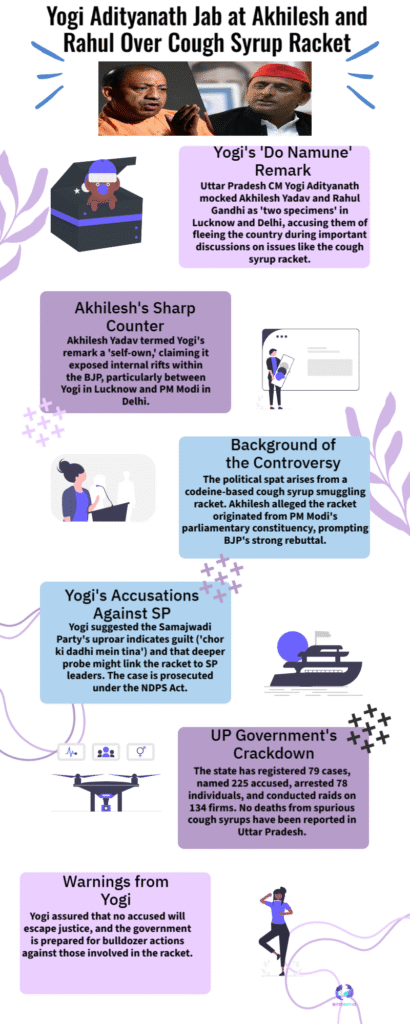
Political Rhetoric Intensifies in Uttar Pradesh
The political temperature in Uttar Pradesh rose sharply as Chief Minister Yogi Adityanath launched a pointed verbal attack on opposition leaders, sharpening an already combative discourse. Yogi Adityanath remarks, framed around the phrase “cough syrup racket,” were aimed at questioning the credibility and governance record of rival formations while reinforcing his administration’s law-and-order narrative.
Delivered with characteristic bluntness, the statement was less about a single allegation and more about shaping perception—positioning the ruling establishment as decisive and the opposition as compromised.
The Targets: Akhilesh Yadav and Rahul Gandhi
At the center of the attack stood Akhilesh Yadav, the former chief minister and Samajwadi Party president, alongside Congress leader Rahul Gandhi. By clubbing the two figures together, the BJP’s top leadership in the state attempted to blur ideological distinctions and present the opposition as a single, ineffective bloc.
The rhetorical strategy leaned heavily on symbolism—using a phrase associated with illicit trade to imply administrative negligence and moral ambiguity during previous regimes.
The Symbolism Behind the ‘Cough Syrup Racket’ Remark
Rather than detailing legal specifics, the phrase functioned as a political metaphor. It evoked images of regulatory failure, cross-border crime, and weak enforcement—issues that resonate strongly with voters concerned about safety and governance.
By invoking such imagery, the ruling party aimed to contrast its own record of crackdowns and policing reforms with what it portrays as a permissive past under opposition-led governments.
Governance Narrative Versus Opposition Record
Law and Order as the Core Campaign Axis
Under Yogi Adityanath’s leadership, law and order has been projected as a central achievement. Encounters, police reforms, and high-profile crackdowns are repeatedly cited as evidence of administrative resolve. The latest jibe fits neatly into this framework, reinforcing a binary narrative: strict governance versus alleged disorder.
Opposition’s Challenge of Countering Perception
For the Samajwadi Party and Congress, the challenge lies in dismantling a narrative that is repeatedly reinforced through sharp, memorable soundbites. The opposition’s emphasis on social justice, economic stress, and democratic safeguards often struggles to gain equal traction amid rhetoric that prioritizes security and control.
Electoral Context and Timing
The remarks come at a time when political messaging in Uttar Pradesh is becoming increasingly aggressive. As alliances shift and electoral arithmetic tightens, verbal attacks are serving as tools to consolidate core voter bases while keeping rivals on the defensive.
The timing suggests a deliberate attempt to dominate headlines and frame the election debate on terms favorable to the ruling party.
Impact on the Broader Political Discourse
Such exchanges underscore a broader transformation in Indian electoral politics, where symbolic language and pointed jibes increasingly outweigh policy-heavy debate. While supporters view this approach as clarity and strength, critics argue it deepens polarization and reduces complex governance issues to slogans.
In Uttar Pradesh, however, the effectiveness of this style has been repeatedly tested—and often rewarded—making it a central feature of the current political contest.
Conclusion: A Calculated Escalation
Yogi Adityanath “cough syrup racket” remark represents more than a passing insult; it is a calculated escalation in Uttar Pradesh’s political battle. By invoking potent imagery and directly naming his rivals, the chief minister Yogi Adityanath has reinforced a narrative designed to resonate with voter anxieties around crime, control, and leadership.
As the campaign atmosphere thickens, such rhetoric is likely to remain a defining element of the state’s political storyline, shaping both perception and momentum in the months ahead.