
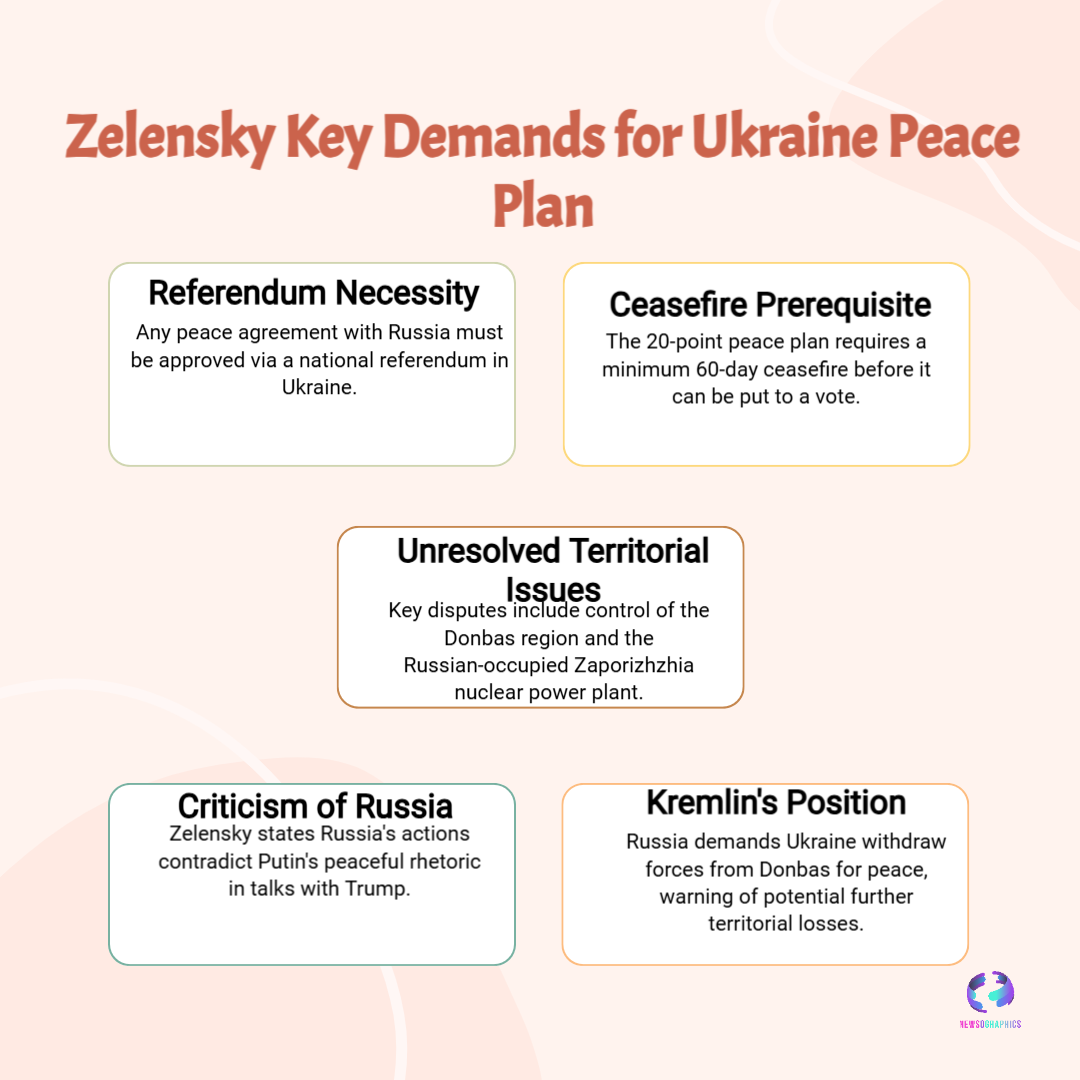
Ukrainian President Volodymyr Zelensky has outlined key conditions for a peace framework, stressing the need for a referendum and a 60-day ceasefire as foundational steps toward ending the conflict.
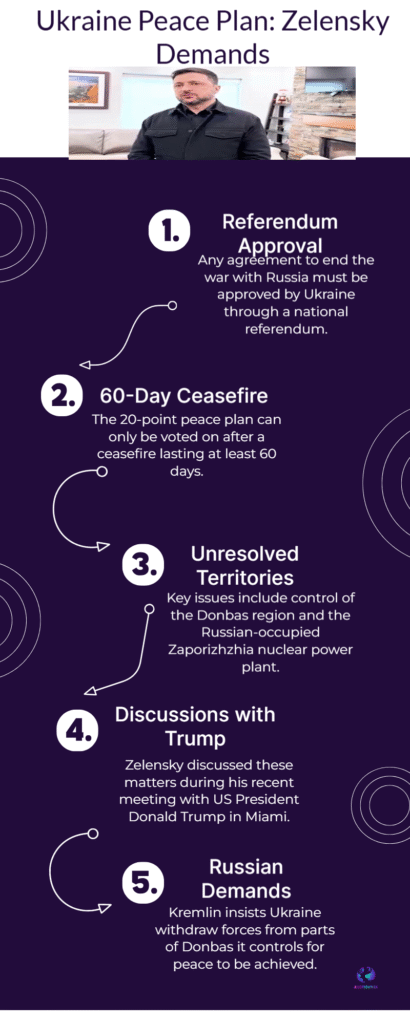
Zelensky Evolving Peace Framework Amid Prolonged Conflict
As the war in Ukraine continues to reshape regional and global geopolitics, President Volodymyr Zelensky has articulated a clearer outline of what Kyiv considers essential for any meaningful peace process. The emphasis on democratic legitimacy and a structured pause in hostilities reflects Ukraine’s attempt to balance military realities with political sovereignty.
Rather than abstract calls for negotiations, the outlined framework signals defined benchmarks that Kyiv believes must precede substantive dialogue. These conditions are designed to create both internal consensus and external credibility.
Central Role of a National Referendum
Democratic Mandate in Territorial Decisions
A national referendum occupies a pivotal place in Ukraine’s peace vision. For Kyiv, decisions affecting territorial integrity and future status cannot be confined to closed-door negotiations. A public mandate is presented as the only legitimate mechanism to validate outcomes that may redefine national borders or governance.
This insistence highlights Ukraine’s broader narrative that sovereignty resides with its citizens, not merely with political leadership or international intermediaries.
Political Stability and Internal Consensus
Beyond legitimacy, a referendum is positioned as a stabilizing instrument. By anchoring decisions in public approval, the Ukrainian leadership aims to prevent long-term political fragmentation and accusations of imposed settlements. In a post-war environment, such consensus is viewed as essential for reconstruction and governance.
The Proposal for a 60-Day Ceasefire
Creating Space for Diplomacy
The call for a 60-day ceasefire reflects a strategic pause rather than an end in itself. Ukraine frames this period as a necessary window to enable negotiations, humanitarian relief, and confidence-building measures without the constant pressure of active combat.
A defined timeframe also seeks to prevent open-ended ceasefires that risk collapse or exploitation, a concern rooted in past experiences.
Humanitarian and Logistical Considerations
A temporary cessation of hostilities would allow for civilian evacuations, repair of critical infrastructure, and delivery of aid. From Ukraine’s perspective, humanitarian imperatives are inseparable from political negotiations, as prolonged civilian suffering undermines any durable peace.
Preconditions Versus Concessions
Ukraine’s Position on Sovereignty
Zelensky’s articulation of conditions underscores a refusal to frame peace as unilateral concession. The emphasis remains on internationally recognized sovereignty, security guarantees, and accountability. Kyiv’s stance suggests that peace, in its view, must not legitimize force-driven territorial changes.
This positioning also serves as a message to allies, reinforcing Ukraine’s alignment with democratic norms and international law.
Signaling to International Partners
By publicly outlining conditions, Ukraine signals predictability and seriousness to its partners. The peace framework is designed to reassure supporters that Kyiv’s objectives remain principled rather than opportunistic, maintaining diplomatic and military backing.
Global Reactions and Diplomatic Implications
Impact on Negotiation Dynamics
Clear conditions inevitably shape the contours of any future talks. While they may complicate immediate negotiations, they also establish a structured baseline that reduces ambiguity. For mediators, such clarity can either facilitate focused dialogue or expose irreconcilable differences.
Broader Geopolitical Context
The peace outline arrives amid shifting global priorities, with international actors balancing fatigue from prolonged conflict against concerns over precedent. Ukraine’s insistence on referendums and ceasefire timelines situates the conflict within a rules-based framework, appealing to states wary of normalized aggression.
The Road Ahead for Ukraine’s Peace Vision
Challenges to Implementation
Translating outlined conditions into reality remains fraught with uncertainty. Trust deficits, battlefield dynamics, and external pressures all complicate prospects for adherence to ceasefires or agreement on referendum processes. The framework, while defined, faces formidable obstacles.
Symbolism and Strategic Messaging
Even if immediate peace remains elusive, the articulation of clear conditions serves a strategic purpose. It reinforces Ukraine’s narrative as a democratic state defending agency and law, shaping how history may interpret both the conflict and its eventual resolution.
Zelensky’s peace outline thus stands as both a diplomatic signal and a political statement, defining Ukraine’s red lines while keeping the door to structured dialogue open.